Friðheimar serves Tomato-Focused Greenhouse Farm cooking for lunch or brunch, with tomato soup, fresh bread, garden views, and an extensive wine list.
Pearl is the En Primeur Club membership app — saves, bookings, and concierge access live there. Same editors, same standards.
- Address
- 5HH4+225 Friðheimar, 806 Reykholt, Iceland
- Phone
- +354 486 8894
- Website
- fridheimar.is
- Directions
- Get directions
 Saves & bookings on Pearl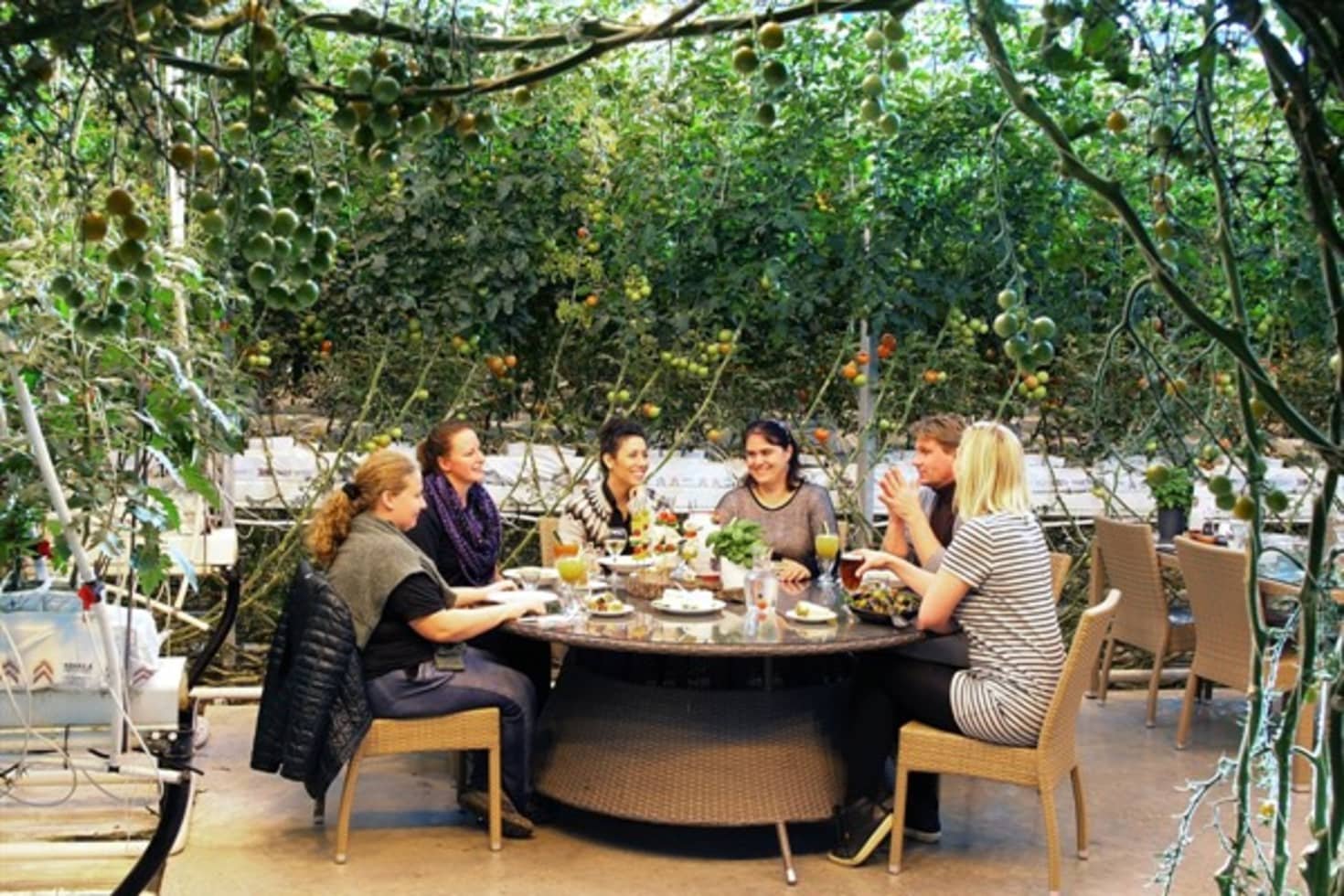
Grown Under Glass: Iceland's Geothermal Greenhouse Restaurant
Drive south from Reykjavík along Route 35 toward the Golden Circle and the landscape gradually strips back to lava field and sky. There are few dining signals here — no restaurant rows, no clusters of signage. Friðheimar arrives as a low-lying greenhouse complex in the farming settlement of Reykholt, in the South region, and the effect of stepping inside is immediate: warm air, the dense green smell of tomato vine, and rows of plants suspended above wooden tables. Iceland's geothermal network heats these greenhouses year-round, and that infrastructure is not incidental to the food — it is the food's entire premise.
The Ingredient Case: What Geothermal Cultivation Means at This Latitude
Iceland imports the vast majority of its produce. Growing vegetables at 64 degrees north, through winters where daylight can drop to four hours, requires energy inputs that would be economically and ecologically prohibitive without a geothermal grid. Friðheimar sits within that grid. The farm uses volcanic heat and, during darker months, grow-lights powered by renewable electricity to sustain tomato cultivation across the full calendar year. The result is a farming operation that produces tomatoes at a latitude where outdoor cultivation is essentially impossible, and which serves those tomatoes directly to visitors within the same structure they are grown in.
This closed-loop model, from soil to plate inside a single building, places Friðheimar in a different conversation from most farm-to-table operations, where the farm and the table are typically separated by supply chains of varying length. Here the supply chain is the length of the dining room. That specificity matters when considering Iceland's broader food scene, where the sourcing credentials of Reykjavík's leading restaurants, places like DILL in Reykjavík and Moss in Grindavík, rest partly on access to quality Icelandic-grown ingredients. Friðheimar is, for tomatoes at least, a primary source rather than a downstream beneficiary.
Internationally, the approach echoes the sourcing philosophy seen at concept-driven restaurants like Atelier Moessmer Norbert Niederkofler in Brunico, where the regional landscape defines what reaches the plate. The difference is scale and accessibility: Friðheimar operates as a working farm open to the public rather than a fine-dining destination operating on advance tasting-menu bookings.
The Format: Lunch in a Working Greenhouse
Friðheimar operates as a lunch venue, and the format is built entirely around the tomato harvest. The menu is anchored in the farm's own produce, with tomato soup as the central offering. Bread arrives fresh, and the experience is deliberately unfussy. There is no tasting menu format, no theatrical service progression. What the format offers instead is context: you are eating food that was growing above your head moments before service.
The greenhouse atmosphere shifts through the year. Midwinter visits arrive in near-darkness outside and full warm light inside, the contrast between the Icelandic cold and the humid tomato warmth giving the experience a quality that summer visits, with their long Arctic daylight, do not replicate. Both are worth considering when planning; they are materially different meals in terms of atmosphere even if the food remains constant. For the Golden Circle itinerary, which typically also includes Þingvellir, Geysir, and Gullfoss, Friðheimar sits logistically close enough to incorporate without deviation from the standard circuit.
Visitors planning the broader South region dining picture can extend their itineraries to include Fjöruborðið in Stokkseyri for langoustine, or consider the geothermal-adjacent experience at Nesjavallavirkjun in Selfoss. Our full Reykholt restaurants guide maps additional options in the area. For a contrast between Iceland's farm-sourced model and its urban fine-dining scene, DILL Restaurant in Reykjavik operates on New Nordic principles that trace back partly to Icelandic ingredient culture. The Chef's Table at Moss Restaurant in Iceland offers another high-commitment format rooted in the country's volcanic geography.
For those comparing Iceland's place-driven dining with analogous experiences elsewhere, the farm-integrated model has parallels in producer-led restaurants globally. Dal Pescatore in Runate in Italy and Quattro Passi in Marina del Cantone both operate from a deep-rootedness in local production, though through entirely different culinary traditions. At the technical and conceptual end, HAJIME in Osaka and Atomix in New York City represent sourcing-driven cuisine at a different tier of formality. Friðheimar operates at neither extreme: it is not haute cuisine, nor is it casual in the sense of being unconsidered. The food serves the farm's logic rather than a chef's ambition, and that inversion is the point.
Who This Is For and What to Expect
Friðheimar functions well as a standalone visit on the Golden Circle route, particularly for travellers who want to eat lunch at a fixed point in the day without backtracking to Reykjavík. The greenhouse setting reads as inherently accessible: no formal dress expectations, no multi-hour commitment, no advance sommelier consultation required. Families with children eat here without tension, and the environment holds genuine educational weight for younger visitors given Iceland's geothermal energy story. That said, the menu is narrow by design, and visitors expecting a wide à la carte selection will need to adjust expectations. The tomato focus is absolute. Visitors who have moved through more format-intensive experiences, perhaps Lazy Bear in San Francisco or Le Bernardin in New York City, will find Friðheimar operates on an entirely different register. It asks less of the diner and delivers something more literal: the farm itself as the experience.
For visitors arriving from the Keflavík direction, Malai-Thai in Keflavik and Von Mathús-Bar in Hafnarfjor Ur cover different parts of the pre-Golden Circle stop. For those heading north after the South circuit, Strikið in Akureyri anchors the capital of the north. Emeril's in New Orleans offers a useful genre contrast for American travellers thinking about what farm-forward actually means in different culinary cultures.
Planning Your Visit
Friðheimar operates as a lunch venue and sits on the Golden Circle route approximately equidistant between the Geysir geothermal area and Þingvellir National Park. Given its position on one of Iceland's most-travelled day-trip circuits, and the fact that it offers a fixed format with limited seating in a greenhouse that fills quickly during peak season, advance booking is advisable for visits between May and September. Winter visits attract fewer tour groups and carry the atmospheric contrast of warm green growth against the dark exterior. The farm is self-contained, and there are no significant nearby dining alternatives at the same location, making it a plan-ahead rather than walk-in proposition during high season.
Side-by-Side Snapshot
| Venue | Cuisine | Price | Awards |
|---|---|---|---|
| FriðheimarThis venue — the venue you are viewing | This venue | Not listed | Not listed |
| DILL | New Nordic, Creative | €€€€ | Michelin 1 Star |
| Matur og Drykkur | Icelandic, Traditional Cuisine | €€€€ | Icelandic, Traditional Cuisine, €€€€ |
| Moss | Modern Cuisine | €€€€ | Michelin 1 Star |
| ÓX | Nordic, Modern Cuisine | €€€€ | Michelin 1 Star |
| Lava | Nordic | Nordic | Not listed |
At a Glance
- Scenic
- Cozy
- Rustic
- Family
- Casual Hangout
- Garden
- Open Kitchen
- Extensive Wine List
- Farm To Table
- Local Sourcing
- Garden
Current opening hours
- Monday
- 11:30 AM–4 PM
- Tuesday
- 11:30 AM–4 PM
- Wednesday
- 11:30 AM–4 PM
- Thursday
- 11:30 AM–4 PM
- Friday
- 11:30 AM–4 PM
- Saturday
- 11:30 AM–4 PM
- Sunday
- 11:30 AM–4 PM
Hours can change for holidays and private events. Last verified .
Serene and magical greenhouse atmosphere surrounded by fragrant tomato vines, flowers, and natural light.
Know Before You Go
- Getting there
- 5HH4+225 Friðheimar, 806 Reykholt, Iceland