Hapcheon Gukbapjip

Hapcheon Gukbapjip has held consecutive Michelin Bib Gourmand recognition in 2024 and 2025, placing it among the more consistent dwaeji-gukbap specialists in Busan's Nam-gu. The kitchen operates at the ₩ price tier, keeping the bowl accessible while the broth discipline sits well above the category average. For anyone tracing Busan's pork bone soup tradition to a credentialed address, this is the reference point.
Pearl is the En Primeur Club membership app — saves, bookings, and concierge access live there. Same editors, same standards.
- Address
- 235 Yongho-ro, Nam-gu, Busan, South Korea
- Phone
- +82 51-628-4898
- Directions
- Get directions
 Saves & bookings on Pearl
Busan's Dwaeji-gukbap Tradition, Anchored in Nam-gu
Approach a gukbap shop in Busan early enough and the scene is always the same: steam lifting off large pots, the particular density of a broth that has been going since before dawn, and the low-level clink of ceramic bowls being stacked and restacked. Hapcheon Gukbapjip, on Yongho-ro in Nam-gu, fits cleanly inside that register. There is nothing in its physical presence that signals the two consecutive Michelin Bib Gourmand awards it holds for 2024 and 2025.
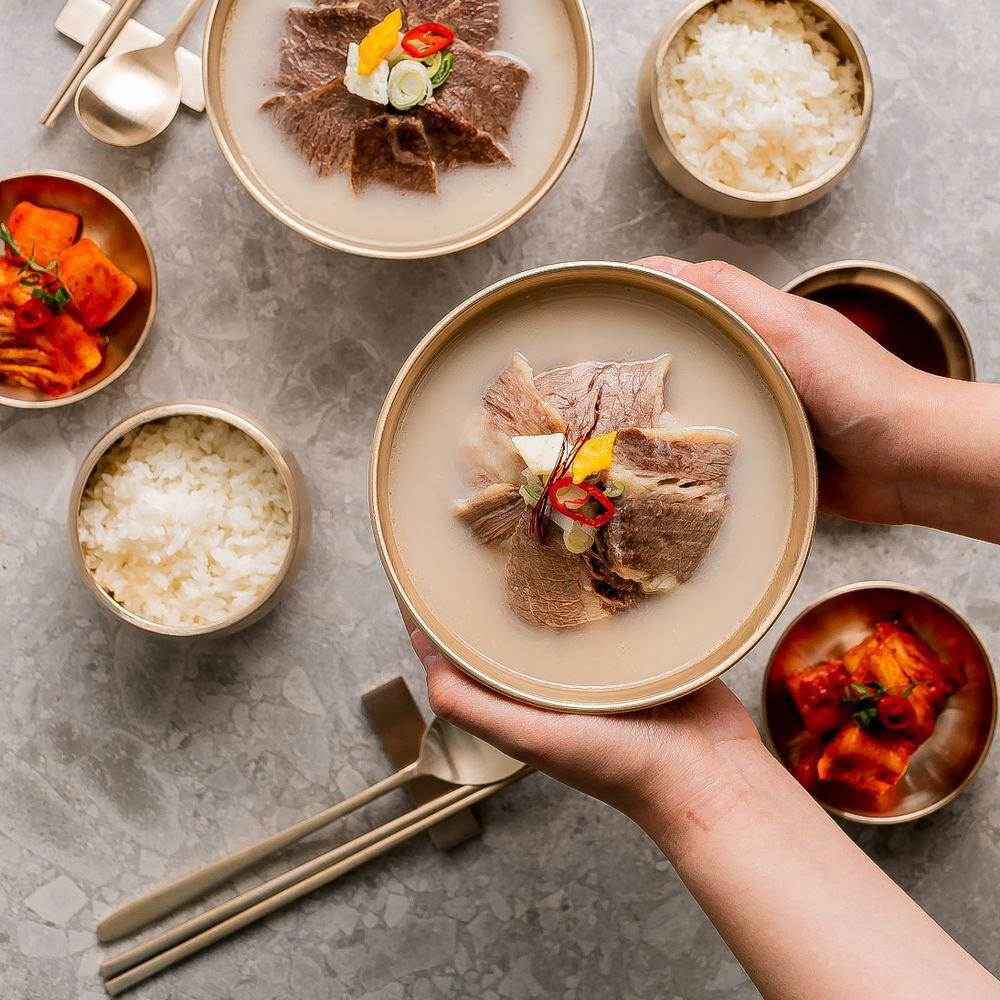
Dwaeji-gukbap is one of the few Korean dishes whose identity is so thoroughly tied to a single city that eating it elsewhere requires an asterisk. The bowl is Busan's, born from the post-war displacement of the 1950s, when pork offcuts and bones available near the port were transformed into a working-class staple that the city has since refined into a point of civic pride. The broth is milky from extended bone simmering, the pork sliced and served directly into the soup, with rice arriving either submerged or on the side depending on preference. Accompanying the bowl: kimchi, salted shrimp paste, and sliced green onion to adjust as you go. The dish resists refinement. Its authority comes from consistency and volume, not from technical elaboration.
Where Sourcing Defines the Bowl
In a category defined by repetition, what separates a Bib Gourmand from a respectable neighborhood shop often comes down to the sourcing decisions that happen before service begins. Dwaeji-gukbap broth requires pork bones that have enough collagen and fat structure to produce opacity and body over a long simmer. Cuts that come from animals raised with more space and time, or sourced through suppliers who maintain consistent quality at the carcass level, produce a different result in the pot than commodity pork. The milky white broth that characterizes the leading bowls in Busan is not a function of technique alone; it reflects what was put in at the start.
Hapcheon Gukbapjip operates under chef Ki-jung Cheon, and the kitchen's approach to ingredient selection, is reflected in the bowl itself. The Bib Gourmand designation points to strong quality for the price, which, at a ₩-tier category already priced for accessibility, makes any quality difference easier to notice. Two consecutive years of that recognition indicates something disciplined rather than accidental.
The ₩-Tier Signal and What It Actually Means
Busan's recognized restaurant scene runs a wide price spread. At the higher end, Palate holds a Michelin star at the ₩₩ tier, and Mori operates at ₩₩₩ with similar recognition. Hapcheon Gukbapjip's ₩ pricing puts it at the opposite end of that spectrum, in direct company with local naengmyeon and gukbap shops where the meal is meant to cost roughly the price of a transit fare. The Michelin apparatus treating that price point with the same seriousness it brings to tasting-menu formats is a structural argument about what Korean food culture actually values.
For comparison within the dwaeji-gukbap category, Anmok represents the broader Busan comparable set at the same price tier. In Seoul, the same dish is tracked through addresses like ANAM, Gwanghwamun Gukbap, and Okdongsik, each operating within a Seoul interpretation of the form that tends to be slightly more refined and less port-city in character. The Busan versions, including Hapcheon, carry a rougher authority rooted in the dish's original context.
Beyond the gukbap category, Busan's Michelin-tracked scene includes Jeongjitgan and Namakzip, both of which operate in different registers and price tiers. Across Korea more broadly, high-end Korean cuisine draws global attention through addresses like Mingles and Gaon in Seoul, and tradition-rooted experiences like Baegyangsa Temple in Jangseong-gun. The restaurant operates in a different register entirely, but the critical framework that evaluates all of them shares a baseline respect for ingredients and execution that makes comparisons structurally valid. See also Kwon Sook Soo and The Flying Hog for how Korean pork culture lands across price tiers and regions.
Nam-gu as a Context, Not Just a Coordinate
Nam-gu is not where most Busan visitors orient their food itinerary. The Gwangalli and Haeundae corridors pull more foot traffic, and the Seomyeon food streets draw a younger crowd. Nam-gu's position on Yongho-ro places the restaurant inside a residential-commercial zone where the customer base skews local. That geographic reality is itself an ingredient: gukbap shops that serve a daily local clientele are under a different kind of accountability than those positioned for tourist throughput. Consistency matters more when the same customers return weekly.
Planning a Visit
The restaurant sits at 235 Yongho-ro, Nam-gu, Busan. At the ₩ price point, the meal is accessible without advance financial planning, though the Bib Gourmand recognition will have sharpened interest among food-focused visitors. Gukbap shops in Busan typically open early, with peak service running through the morning and midday hours, the dish has its natural gravity as a breakfast or lunch format, though practice varies by address. Arrival timing and a willingness to wait if needed is the standard approach.
The Essentials
Comparable venues nearby, for context on price, style, and recognition.
| Venue | Cuisine | Price | Notes |
|---|---|---|---|
| Hapcheon GukbapjipThis venue — the venue you are viewing | Dwaeji-gukbap | $ | Not listed |
| PILI PILI | Not listed | $ | Gwangan 1(il)-dong, Authentic Thai Cuisine |
| Eonyang Bulgogi Busanjip | Not listed | $$ | Namcheon 2(i)-dong, Eonyang Bulgogi |
| Cha Ae Jeon Halmae Kalguksu | Not listed | $$ | Yeonsan 9(gu)-dong, Traditional Korean Kalguksu Noodles |
| Jin Dweji Gomtang | Millak-dong, Modern Dwaeji Gomtang | $ | Not listed |
| 1969 Buwondong Kalguksu | Nampo-dong, Traditional Busan Kalguksu | $ | Not listed |
Recognition history
Dated appearances from independent guides and award organizations, with the underlying list record or original source where available.
Michelin Bib Gourmand
Michelin
Michelin Bib Gourmand
Michelin
Continue exploring
More in Busan
Restaurants in Busan
Browse all →
At a Glance
- Classic
- Cozy
- Casual Hangout
Current opening hours
- Monday
- 9:30 AM–2 PM, 2:30–8 PM
- Tuesday
- 9:30 AM–2 PM, 2:30–8 PM
- Wednesday
- 9:30 AM–2 PM, 2:30–8 PM
- Thursday
- 9:30 AM–2 PM, 2:30–8 PM
- Friday
- 9:30 AM–2 PM, 2:30–8 PM
- Saturday
- 9:30 AM–2 PM, 2:30–8 PM
- Sunday
- 9:30 AM–2 PM, 2:30–8 PM
Hours can change for holidays and private events. Last verified .
Classic, no-frills Korean eatery with comforting, time-tested atmosphere focused on traditional flavors.