
A compact Sannomiya dumpling room with counter seating, table seats, and a narrow menu built around gyoza and beer. Gyoza Senmon Ten Akaman Sannomiya ten sits in Kobe’s casual specialist tier: low spend, no private rooms, no smoking, and Tabelog 100 Dumplings selections in 2019, 2021, and 2024.
Pearl is the En Primeur Club membership app — saves, bookings, and concierge access live there. Same editors, same standards.
- Address
- 兵庫県神戸市中央区北長狭通2-2-1
- Phone
- +81783310831
- Website
- akaman-gyoza.jimdofree.com
 Saves & bookings on Pearl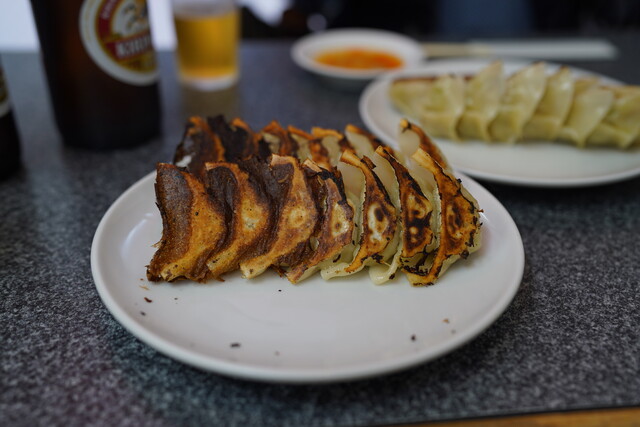
Sannomiya’s small restaurants often announce themselves through scale rather than spectacle: short frontage, close seating, a room designed for turnover, and a menu that does not ask the guest to study. Gyoza Senmon Ten Akaman Sannomiya ten belongs to that Kobe grammar. The physical container matters here because the format is narrow by design: counter seats, a pair of tables, gyoza, beer, and little room for ceremony.
That restraint places it in a different category from Kobe’s beef-led rooms and multi-course dining addresses. The city can sell polish with ease, from teppanyaki counters such as Aburi Niku Kobo Wakkoku Shinkobe ten and Aburi Niku Kobo Wakkoqu Kitano Sakamoto Ten to higher-spend sake dining like Banshu Jizake Hino. Akaman’s appeal is more urban and compressed: the quick specialist shop as a serious dining form, not a consolation prize.
A small gyoza room built around repetition, not range
Japanese dumpling culture rewards focus. A gyoza specialist is not trying to compete with an izakaya’s breadth; it wins or loses on consistency, pacing, and the social rhythm of ordering another round. Here, the menu’s narrowness is the editorial point. Gyoza and beer define the experience, and the house rule of two or more dumpling servings per person reinforces the room’s purpose.
The seating plan sharpens that purpose. Fourteen seats, split between a six-seat counter and two four-seat tables, create a room where the counter is not decoration but operating logic. The layout suits pairs and small groups better than long, lingering parties. Private rooms and private use are not part of the format, which keeps the experience closer to Kobe’s everyday specialist dining than to destination tasting-menu theatre.
Recognition gives the simplicity a harder edge. The restaurant was selected for Tabelog’s Dumplings “Tabelog 100” in 2019, 2021, and 2024, a useful signal in a category where Michelin-style international markers rarely capture the full spread of local craft. Its Tabelog score is 3.54, but the more telling detail is repeated selection in a national dumpling list: this is a narrow-format shop judged within its own discipline.
Why Sannomiya is the right frame
Sannomiya works because it compresses Kobe’s dining habits into walkable blocks: commuters, shoppers, late-afternoon drinkers, and visitors moving between station exits and side streets. A compact gyoza shop makes sense in that environment. It can function before a bar, after coffee, or as the main event when the evening calls for speed and precision rather than a long reservation.
The price tier also matters. Dinner sits in the low JPY 1,000 range, with lunch listed below JPY 999, putting the shop alongside Kobe’s casual city-centre addresses rather than its celebration rooms. In the comparison set, Gyoza no Mise Hyotan Sannomiya ten occupies a similar low-spend dumpling lane, while Akaneya Coffee Ten shows how Sannomiya also supports old-school specialist rooms outside the dinner format. European Ryori Mon, at a higher casual bracket, points to another Kobe habit: legacy Western-influenced dining that sits between everyday and occasion.
For travellers building a Kobe food day, Akaman works as a precision stop rather than a full itinerary anchor. Pair the city-centre dumpling format with coffee at Akaneya Coffee Ten, a neighbourhood meal at Akari, or a different casual register at Ali's Halal Kitchen. For a broader map, use Our full Kobe restaurants guide, then cross-check drinking, lodging, and regional context through Our full Kobe bars guide, Our full Kobe hotels guide, Our full Kobe wineries guide, and Our full Kobe experiences guide.
The design lesson: small room, clear rules, low friction
The room’s value is not decorative architecture. It is operational design. Counter seating shortens the distance between order and plate, tables allow small-group flexibility, and the absence of card, electronic-money, and QR payments keeps the transaction old-fashioned. Non-smoking status also changes the feel of a compact dumpling room, especially in a category long associated with beer, close quarters, and quick turnover.
Reservations are unavailable, so the experience belongs to the walk-in side of Japanese dining culture. That can frustrate travellers who plan every meal, but it also keeps the shop in the same democratic lane as ramen counters, standing bars, curry specialists, and old coffee houses. The better reading is not scarcity for its own sake; it is format discipline. A fourteen-seat dumpling room with a narrow menu does not need the machinery of a fine-dining booking calendar.
For readers comparing across Japan, the useful parallel is not cuisine but specialization. A curry address such as [Curry Senmon Ten] Maruyama Kyoju. in Sapporo, a compact modern room like.know in Kumamoto, or a focused casual stop such as (Shoku) Vietnam in Kawasaki all show how Japanese city dining often rewards narrow briefs. The same logic can be traced beyond Japan in places such as Jōdo Saké Bar in Los Angeles and Onigiri Time in Pasadena, where compact formats carry cultural weight when the execution is disciplined.
Akaman is not the Kobe meal for travellers chasing long-form service or chef-led narrative. It is the room for understanding how Sannomiya eats when space is tight, the menu is short, and reputation is built inside a single category. That is a serious form of dining, and Kobe has room for it alongside beef counters, coffee rooms, and late-night drinking addresses. For wider itinerary contrast, look to -Grilled beef Sukiyaki- KAMAKURA TANUKIAN 鎌倉 たぬき庵 in Kamakura. 鮪と炭火焼き うお炭 秋葉原店 in Tokyo, and.cafe in Osaka; each sits in a different Japanese dining rhythm, but the shared lesson is the same: format shapes the meal before the first order is placed.
Comparable Options
Comparable venues at a glance for context.
| Venue | Cuisine | Price | Notes |
|---|---|---|---|
| Gyoza Senmon Ten Akaman Sannomiya tenThis venue — the venue you are viewing | Gyoza specialty shop | $ | Not listed |
| Jin Gyoza | Japanese Gyoza & Dumplings | $ | Chūō |
| Koga Ryuseimen | Ramen & Tsukemen | $ | Higashinada |
| Gyoza Daigaku | Japanese Dumplings (Gyoza) | $ | Chūō |
| Ichie An | Traditional Japanese soba | $ | .null |
| Kyuan | Traditional Soba Noodle Shop | $ | Hyōgo |
Recognition history
Dated appearances from independent guides and award organizations, with the underlying list record or original source where available.
Tabelog 100 #52 · No. 52
Tabelog · Tabelog 100 - Dumplings - 2024
Continue exploring
More in Kobe
Restaurants in Kobe
Browse all →
Bars in Kobe
Browse all →



Hotels in Kobe
Browse all →


At a Glance
- Classic
- Lively
- Intimate
- Solo
- After Work
- Casual Hangout
- Late Night
- Standalone
- Beer Program
A no‑frills, old‑school dumpling counter with just 14 seats, bright functional lighting, fast turnover, and a bustling, slightly noisy atmosphere focused entirely on eating gyoza and drinking beer.