
Kobe’s yoshoku tradition is less about nostalgia than precision: Western forms translated into Japanese lunch-and-supper habits. Grill Suematsu fits that civic grammar with omurice, yoshoku and European-leaning cooking in a compact Sannomiya house setting, backed by Tabelog 100 Yoshoku selections in 2020, 2022, 2023 and 2025.
Pearl is the En Primeur Club membership app — saves, bookings, and concierge access live there. Same editors, same standards.
- Address
- 2 Chome-1-9 Kanocho, Chuo Ward, Kobe, Hyogo 650-0001, Japan
- Phone
- +81 78-241-1028
- Website
- grill-suematsu.com
 Saves & bookings on Pearl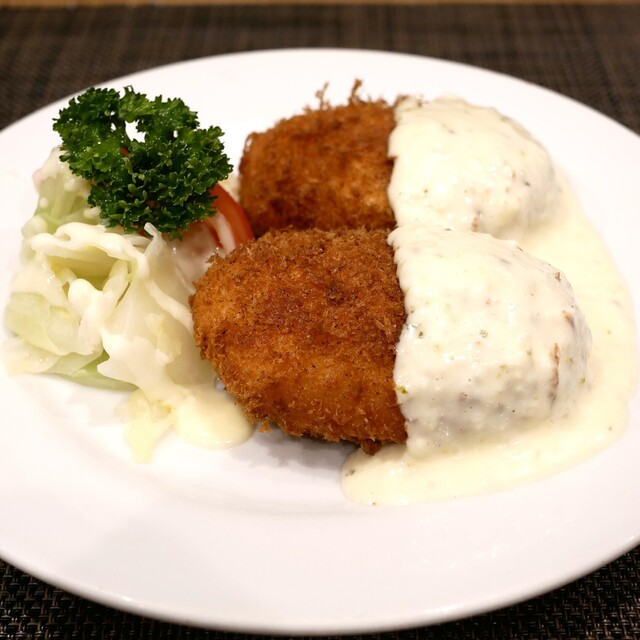
The approach to a small yoshoku house in Sannomiya has a different tempo from Kobe’s steak counters and hotel dining rooms. The city’s port history made Western cooking familiar earlier than in many Japanese cities, but the enduring local pleasure is not ceremony; it is the everyday discipline of omelette rice, sauce work, cutlets, grills and compact rooms where lunch can be as meaningful as dinner. Grill Suematsu belongs to that Kobe register: close enough to the central station orbit to feel urban, small enough to keep the meal in the scale of a neighbourhood address.
Yoshoku is often misread as retro Western food. In Japan, it is a separate cuisine with its own expectations: rice alongside demi-glace, omelettes treated as main events, European forms adapted to Japanese pacing and portioning. Kobe gives that category extra weight because the city has long balanced international influences with local appetite. In this context, Grill Suematsu is not competing with the city’s premium beef rooms so much as preserving a lower-priced, craft-led lane within central Kobe dining.
Sannomiya yoshoku, not steakhouse theatre
Kobe’s dining reputation travels abroad through beef, but the city’s daily restaurant culture is broader and more useful than that single export suggests. Around Sannomiya and Kitano, the choice often splits between beef-focused counters, cafés, Chinese-influenced dining, curry, ramen and yoshoku rooms that carry the port-city inheritance without turning it into spectacle. Readers mapping the area can compare the beef axis through Aburi Niku Kobo Wakkoku Shinkobe ten and Aburi Niku Kobo Wakkoqu Kitano Sakamoto Ten, then read Grill Suematsu as the more domestic counterpoint.
The recognition matters because yoshoku has fewer global shorthand signals than sushi, kaiseki or steak. Tabelog selected the restaurant for its Yoshoku 100 lists in 2020, 2022, 2023 and the WEST 2025 edition, with a listed score of 3.70. That does not turn the meal into a trophy exercise. It places the restaurant inside a serious regional conversation about Japanese-style Western cooking, a category where consistency and local repeat custom matter more than international glamour.
The format reinforces that reading. The room is listed at 18 seats, divided between a small counter and tatami seating upstairs. That scale changes the meal: yoshoku here is not treated as a hotel-brasserie category but as a close-quarters Kobe habit, one suited to friends and families as much as visitors chasing the city’s better-known beef itinerary. Private rooms and private use are not part of the proposition, which keeps the experience closer to neighbourhood dining than destination staging.
Omurice and the Japanese grammar of Western food
Omurice is the clue to the restaurant’s role. The dish is not simply an omelette with rice; it is a shorthand for the way Japan absorbed Western technique and made it local, practical and emotionally legible. The same applies to yoshoku more broadly: sauces carry memory, rice anchors the plate, and European references are filtered through Japanese expectations of balance and speed. The restaurant’s listed categories, yoshoku, omurice and European cooking, put it squarely in that lineage.
Within Kobe, that makes it a useful stop for travellers who want the city beyond marbled beef. The better comparison is not a luxury tasting counter but another modestly priced, category-specific restaurant with a defined audience. In the local comparison set, Ali's Halal Kitchen sits in a similar budget band while serving a different community and culinary function; Yuzaburo occupies a far higher dinner bracket, and Marutaka Chuka Soba Kobe Ninomiya Ninomiya ten belongs to a ramen economy. The point is not hierarchy. It is that Kobe’s centre works through specialised pockets rather than one dominant dining style.
That pocket also connects naturally to the way a day in Sannomiya is structured. A coffee stop at Akaneya Coffee Ten, a casual meal at Akari, or South Asian cooking at Ali's Halal Kitchen all show how central Kobe dining is assembled from small, focused rooms. For a wider scan, use Our full Kobe restaurants guide, with parallel planning via Our full Kobe hotels guide, Our full Kobe bars guide, Our full Kobe wineries guide and Our full Kobe experiences guide.
A compact Kobe address with practical edges
The practical character is part of the editorial assessment. Lunch reservations are not accepted, while reservations are available outside that window. Payment is cash-only, parking is not provided, and nearby coin parking is the fallback. The second-floor stairs are narrow and steep, a detail that matters for older guests, children and anyone choosing between counter seating and upstairs tatami tables. Non-smoking status and take-out service broaden its usefulness, but the room size keeps expectations grounded.
For travellers building a Japan dining route, the restaurant sits in a different category from destination restaurants that announce themselves through luxury cues. A broader itinerary might move from beef sukiyaki at -Grilled beef Sukiyaki- KAMAKURA TANUKIAN 鎌倉 たぬき庵 in Kamakura to charcoal tuna at. 鮪と炭火焼き うお炭 秋葉原店 in Tokyo, café culture at.cafe in Osaka, regional cooking at.know in Kumamoto, Vietnamese cooking at (Shoku) Vietnam in Kawasaki, curry in Hokkaido at [Curry Senmon Ten] Maruyama Kyoju. in Sapporo, then Japanese-inflected drinking and casual formats overseas at Jōdo Saké Bar in Los Angeles and Onigiri Time in Pasadena. Against that spread, this Kobe address is valuable because it clarifies a genre that rarely receives the same international attention as sushi or wagyu: yoshoku as lived city food, executed in a room small enough for its limits to define its charm.
The Minimal Set
Side-by-side context: comparable cuisine and price.
| Venue | Cuisine | Price | Notes |
|---|---|---|---|
| Grill SuematsuThis venue — the venue you are viewing | Not listed | $$ | Not listed |
| Grill Ippei Shinkaiti honten | Not listed | $$ | Hyōgo, Yoshoku (Japanese-Style Western Cuisine) |
| CAFE KESHiPEARL | Chūō, Cheesecake & coffee café | $$ | Not listed |
| Kobe Onsen Sosaku Dining So | Not listed | $$ | Kita, Creative Japanese set meals in an onsen complex |
| Yakiniku Horumon Bar Bovin | Chūō, Yakiniku & Horumon Bar | $$ | Not listed |
| Kisetsu Ippin Ryori Fujiwara | Not listed | $$ | Chūō, Seasonal Japanese Izakaya & Seafood |
Recognition history
Dated appearances from independent guides and award organizations, with the underlying list record or original source where available.
Tabelog 100 #16 · No. 16
Tabelog · Tabelog 100 - Yoshoku - WEST - 2025
Continue exploring
More in Kobe
Restaurants in Kobe
Browse all →
Bars in Kobe
Browse all →
Hotels in Kobe
Browse all →


At a Glance
- Cozy
- Classic
- Intimate
- Date Night
- Solo
- Family
- Casual Hangout
- Open Kitchen
- Standalone
Current opening hours
- Monday
- 11:30 AM–2 PM, 6–9:30 PM
- Tuesday
- Closed
- Wednesday
- 11:30 AM–2 PM, 6–9:30 PM
- Thursday
- 11:30 AM–2 PM, 6–9:30 PM
- Friday
- 11:30 AM–2 PM, 6–9:30 PM
- Saturday
- 11:30 AM–2 PM, 6–9:30 PM
- Sunday
- 11:30 AM–2 PM, 6–9:30 PM
Hours can change for holidays and private events. Last verified .
Warm and nostalgic yoshoku house with a snug counter facing the open kitchen downstairs and simple tatami seating upstairs; lively but not loud, with the feel of a long‑standing neighborhood favorite.