

Michelin Plate
Our verdict
Bangkok's omakase tier has a clear upper bracket, and Ginza Sushi Ichi operates firmly within it. The Gaysorn Centre counter imports its daily catch from Tokyo's Toyosu market and its sushi rice from Yamagata, replicating the flagship's sourcing chain at ten marble-side seats. Consistent Opinionated About Dining Asia rankings since 2023 and a Michelin Plate in both 2024 and 2025 confirm its position among the city's most seriously credentialed Japanese restaurants.

Pearl is the En Primeur Club membership app, where members save venues, book tables and use the concierge.
The menu
What to order
- Uni and ikura don
- Kohada nigiri
- Chu-toro
Luxury Retail Real Estate as a Sushi Address
Bangkok's premium omakase scene has quietly consolidated inside the city's high-end shopping complexes. The logic is not accidental: Gaysorn Centre, Lumphini, and the surrounding Pathum Wan district form the densest concentration of high-net-worth retail and hospitality in the Thai capital, and the clientele for ฿฿฿฿-tier Japanese counters overlaps almost entirely with the customer base those buildings attract. Ginza Sushi Ichi occupies a third-floor room at 999 Gaysorn Centre, a location that places it squarely within this pattern rather than at any remove from it.
The Ginza name is not decorative. The original restaurant operates in Tokyo's Ginza district, one of the most expensive postal codes in the world for omakase dining, and the Bangkok branch is built as a functional extension of that operation rather than a licensed spin-off with loosened standards. That distinction shapes everything about how the counter is run.
The Counter: Ten Seats, Marble, and Pine
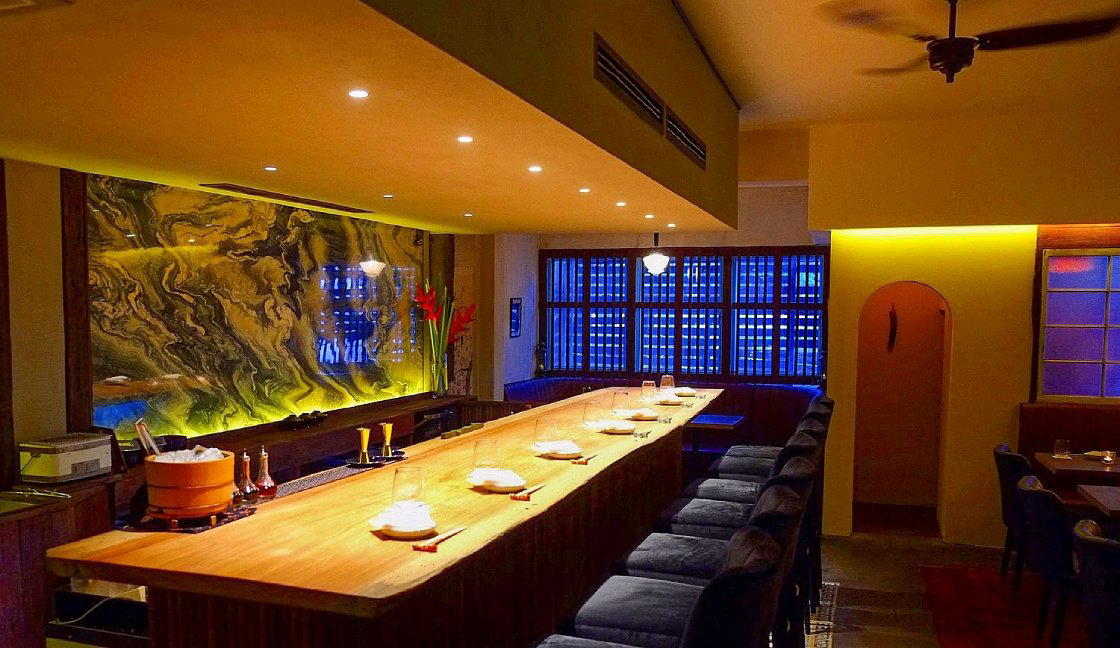
Omakase counters in Bangkok range from six seats to twenty, and the size of the room determines more than just the atmosphere. At ten seats around a marble counter, Ginza Sushi Ichi sits in the range where the itamae can control the pace of each course without delegating, and where conversation can move between the chef and a diner without broadcasting to the room. The pine walls keep the interior neutral in the way that serious Japanese dining rooms tend to: the food is the material on display, not the architecture.
Private rooms are available alongside the main counter, which positions the venue for corporate dining and occasion meals at the top end of Bangkok's Japanese restaurant market. That dual-format offering is common among the city's most credentialed Japanese rooms, where a significant share of revenue comes from private bookings rather than walk-in or standard reservation traffic.
Sourcing as the Differentiating Argument
The clearest statement Ginza Sushi Ichi makes about its positioning is logistical: the daily catch arrives from Tokyo's Toyosu market, and the sushi rice is sourced from Yamagata Prefecture, using the same rice-vinegar formula as the flagship. In a city where several strong sushi counters source domestically or through regional Japanese wholesale networks, a direct Toyosu supply chain carries real operational cost and real credibility.
Yamagata rice is not an incidental detail. The prefecture produces short-grain varieties with specific starch and moisture characteristics that affect how the rice behaves at body temperature against the fish. Using the same formula as the Tokyo original means the nigiri served in Bangkok is calibrated to the same texture benchmark, not adjusted for local ingredient availability. That consistency is the core argument for a multi-city operation of this kind.
Sake is part of the offering, which is standard at this tier but worth noting for guests planning an extended evening rather than a lunch sitting. The format across both lunch (12:00 to 2:30 pm) and dinner (6:00 to 11:00 pm, with Sunday service ending at 10:00 pm) is omakase, with nigiri as the focus. Monday is the weekly closure.
Where It Sits in the Bangkok Sushi Market
Bangkok's sushi scene has developed a clear tiering. At the ฿฿฿฿ level, the serious counters are distinguished less by price than by sourcing provenance, chef lineage, and consistency of recognition. Ginza Sushi Ichi holds a Michelin Plate in both 2024 and 2025, and its Opinionated About Dining Asia rankings have been consistent: Highly Recommended in 2023, then ranked positions across multiple consecutive years, reaching as high as #138 in 2023 and #186 in the 2024 cycle. In the 2025 OAD Asia rankings it appears at #188.
That trajectory places it in a competitive set that includes other Bangkok counters with serious Japanese credentials. Sushi Masato and Sushi Ichizu occupy broadly similar territory in terms of format and price register. Nikaku approaches the counter format from a different angle, while Fillets and In the Mood for Love represent Bangkok's broader range of approaches to premium Japanese fish-focused dining.
Regionally, the Bangkok counter can be placed alongside operations like Sushi Shikon in Hong Kong, another multi-city Japanese counter export that uses provenance and direct Tokyo supply as its primary differentiators. The comparison is not about equivalence of recognition but about the structural logic shared by serious Japanese omakase rooms operating outside Japan, where the supply chain is the argument. Harutaka in Tokyo provides a reference point for what the upstream end of that supply chain looks like at its most uncompromising.
The broader Bangkok ฿฿฿฿ tier is anchored by restaurants with Michelin star recognition in Thai cuisine: Sorn holds three stars, Baan Tepa two. In that context, Ginza Sushi Ichi's Michelin Plate acknowledges technical seriousness without placing it in direct competition with Bangkok's starred Thai rooms. It is operating in a distinct category, and the OAD Asia rankings, which weight connoisseur dining heavily, are arguably the more relevant measure for a counter of this type.
The Neighbourhood Context
Pathum Wan is not a dining neighbourhood in the way that older Bangkok areas like Silom or Charoen Krung have developed food scenes with independent character. It is instead a commercial and luxury-retail district where the density of high-income office and hotel population sustains a concentration of premium restaurants within larger buildings. That context means Ginza Sushi Ichi is not a destination that rewards neighbourhood wandering before or after the meal. The Gaysorn Centre address functions as a self-contained destination, with the counter experience as the full itinerary for the evening.
Guests arriving from elsewhere in Bangkok for a dinner sitting should factor in that Pathum Wan traffic, particularly on weekday evenings, can add meaningfully to journey times. The BTS Chit Lom station provides the most direct public transport option and removes that variable entirely.
Planning Your Visit
Ginza Sushi Ichi is located on the third floor of Gaysorn Centre, 999 Lumphini, Pathum Wan, Bangkok. The counter runs Tuesday through Sunday, with lunch from noon to 2:30 pm and dinner from 6:00 pm. Sunday dinner closes at 10:00 pm; all other evenings run to 11:00 pm. Monday is closed. The ten-seat counter and available private rooms mean that reservations, particularly for dinner, should be made well in advance. The format is omakase with a nigiri focus, and sake is available to accompany the meal.
For a fuller picture of dining in the city, our full Bangkok restaurants guide covers the range from street-level Thai to the ฿฿฿฿ tier. If you are building a broader trip around the visit, our Bangkok hotels guide, bars guide, and experiences guide map the city's other premium options. Beyond Bangkok, the EP Club Thailand coverage includes PRU in Phuket, Aeeen in Chiang Mai, AKKEE in Pak Kret, and further afield, Angeum in Phra Nakhon Si Ayutthaya and Agave in Ubon Ratchathani.
What Dish Is Ginza Sushi Ichi Famous For?
Ginza Sushi Ichi is built around nigiri omakase, with fish sourced daily from Toyosu market in Tokyo. The format prioritises the quality and temperature of the fish above elaboration, and the sushi rice, sourced from Yamagata Prefecture using the same vinegar formula as the flagship Tokyo restaurant, is central to the counter's identity. There is no single signature dish in the conventional sense: the omakase structure means the menu moves with the market and the season, and the fish available on any given day in Tokyo determines what arrives in Bangkok. The sake selection accompanies the meal rather than competing with it. Consistent OAD Asia rankings from 2023 through 2025 and a Michelin Plate across both 2024 and 2025 reflect the counter's credentialed position in the Bangkok Japanese dining market.
How It Stacks Up
A compact comparison to help you place this venue among nearby peers.
| Venue | Cuisine | Price | Awards | Notes |
|---|---|---|---|---|
| Ginza Sushi IchiThis venue (the venue you are viewing) | Traditional Japanese Omakase | $150–200 | Michelin Plate | Not listed |
| Sorn | Fine Southern Thai | $200–300 | 3 Michelin Stars · World's 50 Best #12 | Southern Thai, ฿฿฿฿ |
| Côte by Mauro Colagreco | Riviera Mediterranean Fine Dining | $200–300 | 2 Michelin Stars · World's 50 Best #91 | Mediterranean, Modern Cuisine, ฿฿฿฿ |
| Baan Tepa | Creative Thai Fine Dining | $150–200 | 2 Michelin Stars · World's 50 Best #53 | Thai contemporary, ฿฿฿฿ |
| Gaa | Modern Indian Fine Dining with Thai Influences | $150–200 | 2 Michelin Stars · World's 50 Best #95 | Modern Indian, Indian, ฿฿฿฿ |
| Sühring | Modern German Fine Dining | $200–300 | 3 Michelin Stars · World's 50 Best #18 | German, ฿฿฿฿ |
Recognition history
Dated appearances from independent guides and award organizations, with the underlying list record or original source where available.
Michelin Plate
Michelin
Opinionated About Dining Top Restaurants in Asia Recommended
Opinionated About Dining
Full recognition history (10 entries)
Michelin Plate
Michelin
Opinionated About Dining Top Restaurants in Asia Ranked #256
Opinionated About Dining
Opinionated About Dining Top Restaurants in Asia Ranked #188
Opinionated About Dining
Michelin Plate
Michelin
Opinionated About Dining Top Restaurants in Asia Ranked #240
Opinionated About Dining
Opinionated About Dining Top Restaurants in Asia Ranked #186
Opinionated About Dining
Opinionated About Dining Top Restaurants in Asia Highly Recommended
Opinionated About Dining
Opinionated About Dining Top Restaurants in Asia Ranked #138
Opinionated About Dining
Continue exploring
More in Bangkok
Restaurants in Bangkok
All restaurants in Bangkok →
Bars in Bangkok
All bars in Bangkok →
Details
- Elegant
- Sophisticated
- Intimate
- Special Occasion
- Business Dinner
- Chefs Counter
- Private Dining
- Sake Program
- Omakase
- Counter Dining
- Sake
Current opening hours
- Monday
- Closed
- Tuesday
- 11:30 AM–2:30 PM, 5:30–10 PM
- Wednesday
- 11:30 AM–2:30 PM, 5:30–10 PM
- Thursday
- 11:30 AM–2:30 PM, 5:30–10 PM
- Friday
- 11:30 AM–2:30 PM, 5:30–10 PM
- Saturday
- 11:30 AM–2:30 PM, 5:30–10 PM
- Sunday
- 11:30 AM–2:30 PM, 5:30–10 PM
Hours can change for holidays and private events. Hours as of .
Simple, plain decor with a serious, professional atmosphere focused on the chef's craft at the marble sushi counter.