Our verdict
釣船茶屋 ざうお 新宿店/Fishing Restaurant Zauo Shinjuku runs as an interactive fishing seafood izakaya inside Shinjuku Washington Hotel, with casual, lively service and a sake program.

Pearl is the En Primeur Club membership app, where members save venues, book tables and use the concierge.
The menu
What to order
- Tai (sea bream)
- Hirame (flounder)
- Ise ebi (lobster)
Where the Fish Is Still Swimming When You Order It
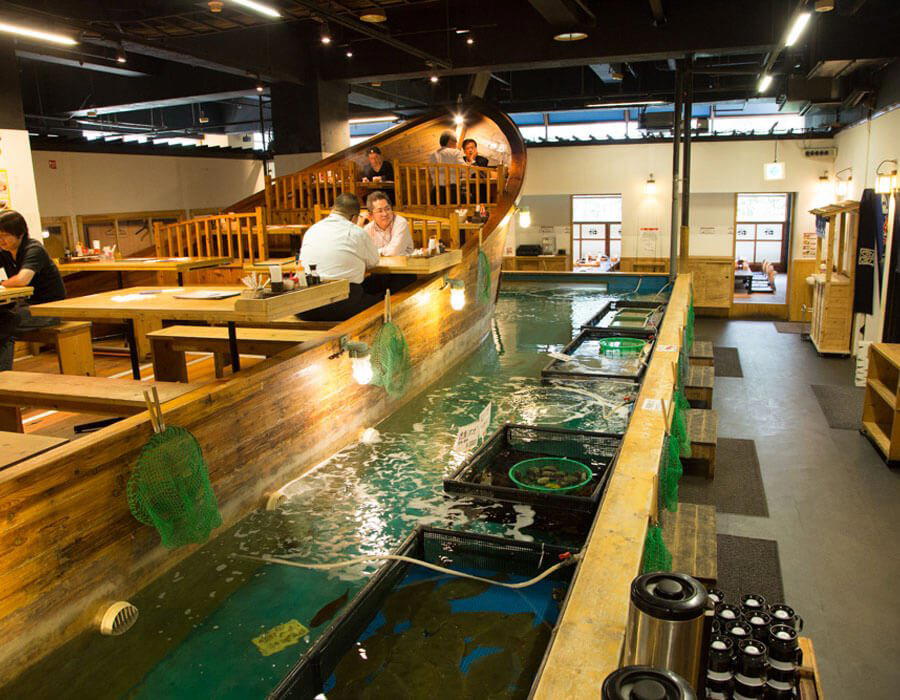
Walk into Zauo Shinjuku on the ground floor of the Shinjuku Washington Hotel and the first thing you register is water. Large tanks dominate the floor space, stocked with live fish, and the seating is arranged around and above them on platforms designed to resemble fishing boats. Guests are handed rods. The fish you catch is, in most cases, the fish you eat. This is not a metaphor or a theatrical garnish bolted onto a conventional menu: the catch-and-cook format is the entire premise, and the kitchen exists to process whatever comes up on your line.
Tokyo's dining scene in Nishishinjuku runs on contrast. A short walk from this address, Michelin-starred omakase counters like Harutaka command ¥¥¥¥ price points and months-long waiting lists. Kaiseki formats at places like RyuGin treat Japanese ingredient culture with the kind of reverence that requires complete silence at the pass. Zauo occupies the opposite pole in both price and atmosphere, but it is drawing from the same deep cultural well: the Japanese relationship with fresh seafood, with the act of fishing, and with the ritual of transforming a living catch into a meal. That relationship, stripped of ceremony, is what this restaurant literalises.
Fishing Culture as the Cultural Substrate
Japan's fishing tradition extends well beyond an appetite for fresh fish. The act of fishing itself carries a specific cultural weight, from rural ama divers working coastal waters to weekend anglers treating Tokyo's rivers and reservoirs as respite from the city. Izakaya culture across Japan has long incorporated live tanks, particularly for lobster, crab, and certain shellfish, as a guarantee of freshness and a minor spectacle. Zauo takes that convention and builds an entire format around it, scaling the izakaya tank into something large enough to require a rod and line.
The result is a format that resonates differently with different audiences. For Japanese guests, particularly those bringing children or out-of-town relatives, there is familiarity in the fishing premise alongside the novelty of doing it inside a restaurant. For international visitors arriving during autumn or winter, when the tanks are typically stocked with a broader variety of seasonal species, it offers a legible entry point into Japan's seafood culture that needs no culinary vocabulary to enjoy. This is the kind of restaurant that L'Effervescence or Sézanne could never be: accessible by design, loud by intention, and entirely uninterested in refinement as a goal.
The Format in Practice
Guests who catch their own fish typically receive it prepared in a style of their choosing: sashimi, salt-grilled, fried, or simmered. The kitchen handles the dispatch and preparation, so the experience sits somewhere between participatory theatre and actual fishing. The rods are real enough, the wait is real enough, and the fish, once caught, is real enough. What changes is the consequence: the catch goes directly from tank to kitchen rather than to a cooler and a drive home.
Not every guest catches something, and not every guest tries. Zauo operates a menu alongside the fishing format, so the experience does not depend on skill or luck. This dual structure, fishing as option rather than obligation, keeps the format workable for groups with mixed appetites for participation. It also keeps the pace of the evening unpredictable in a way that formal dining is not, which is either a feature or a flaw depending on your expectations walking in.
The social architecture of the place supports group dynamics. The boat-platform seating, the shared spectacle of the tanks, and the noise level all push the experience toward communal eating rather than intimate dining. This is a restaurant that functions as an event. Comparing it directly against the tasting-menu formats at Crony would miss the point entirely: these venues serve different social purposes and different occasions, and the city benefits from having both.
Shinjuku as the Right Context
The Shinjuku Washington Hotel location situates Zauo in a part of the city that moves fast and accommodates almost every category of visitor. Nishishinjuku's density of hotels, its proximity to the station, and its mix of salary-worker restaurants and tourist-facing venues make it a practical base for guests who are not eating their way through a list but who want to eat something genuinely Japanese in character without committing to the full omakase apparatus. The ground-floor position in a hotel building also means it absorbs walk-in traffic in a way that a standalone restaurant down a back alley could not.
Japan's broader restaurant geography reflects a similar pattern of accessible seafood formats sitting alongside high-end specialists. Goh in Fukuoka and Gion Sasaki in Kyoto represent the formal end of Japanese seafood and ingredient culture; Zauo represents the participatory, informal end. Both are legitimate expressions of a country that takes the provenance of its seafood seriously. The same cultural logic that drives a chef to source fish directly from a named fishing port drives a restaurant chain to install live tanks and put rods in customers' hands: freshness as theatre, freshness as value, freshness as proof.
Visitors spending time in other Japanese cities will find comparable logics at work. HAJIME in Osaka and akordu in Nara approach Japanese ingredients through rigorous fine-dining lenses. aki nagao in Sapporo, Aji Arai in Oita, and Akakichi in Imabari each operate within regional seafood traditions that share a common foundation: the assumption that fish should be as close to the water as possible when it reaches the plate. Zauo literalises that assumption to an almost absurd degree, and the absurdity is part of the appeal.
Planning a Visit
The Shinjuku Washington Hotel sits in Nishishinjuku and is a short walk from the west exit of Shinjuku Station, one of the highest-traffic transit hubs in the world. The ground-floor restaurant is accessible without a hotel room. Walk-ins are feasible at off-peak hours, though groups and weekend evenings benefit from advance reservation. No dress code applies in any meaningful sense; the environment is relaxed and the seating prioritises comfort over formality. Expect to share the space with families, tourist groups, and office parties in roughly equal proportion. The experience runs leading with at least two people: solo fishing at a tank designed for groups is functional but misses the social energy the format is built around.
For comparison across the EP Club portfolio, see Le Bernardin in New York City and Lazy Bear in San Francisco for interactive and participatory dining formats at a very different tier of formality, or consult our full Tokyo restaurants guide to place Zauo within the wider context of what the city currently offers. Additional reference points for Japanese dining across price tiers appear at Abon in Ashiya, affetto akita in Akita, and Ajidocoro in Yubari District.
Frequently asked questions
What should I order at Fishing Restaurant Zauo Shinjuku?
The format is built around catching your own fish from the live tanks and choosing a preparation method: sashimi, salt-grilling, frying, and simmered dishes are standard options across the Zauo chain. If fishing does not appeal, the kitchen menu runs alongside the catch-your-own option. The fresh seafood in the tanks reflects seasonal availability, so autumn and winter visits tend to offer a wider species range. Think of the order decision less as a menu choice and more as a preparation preference applied to whatever is in the tank.
Do I need a reservation for Fishing Restaurant Zauo Shinjuku?
Walk-ins are possible during quieter periods, but the Shinjuku location draws a consistent mix of tourist groups, families, and office parties, particularly on weekends and public holidays. Groups of four or more should treat a reservation as practical rather than optional. The restaurant sits in the Shinjuku Washington Hotel, which gives it a steady stream of hotel guests as well as foot traffic from Nishishinjuku, so capacity is not always predictable from the outside. Book ahead if your visit is time-sensitive or part of a fixed itinerary.
What is Fishing Restaurant Zauo Shinjuku leading at?
The format delivers something that Michelin-level omakase counters and kaiseki restaurants do not: active participation in the sourcing of your meal. The live tanks and rod-fishing premise make the provenance of the fish visible in the most direct way possible, which aligns with a strand of Japanese food culture that treats freshness as both a culinary and a moral standard. The restaurant functions leading as a group experience, where the shared spectacle of fishing creates an event that a conventional menu cannot replicate.
Is Fishing Restaurant Zauo Shinjuku appropriate for children?
The catch-and-cook format makes this one of the more genuinely child-appropriate dining experiences in central Tokyo. The fishing rods, the live tanks, and the visible connection between catch and meal hold attention in ways that a tasting menu or a quiet counter cannot. The noise level and seating configuration, with boat-style platforms surrounding the tanks, support the kind of informal, active dining that works well for mixed-age groups. Families with young children make up a consistent portion of the customer base across the Zauo chain, and the Shinjuku location is no exception.
Comparable Spots
Comparable venues nearby, for context on price, style, and recognition.
| Venue | Cuisine | Price | Awards | Notes |
|---|---|---|---|---|
| 釣船茶屋 ざうお 新宿店/Fishing Restaurant Zauo ShinjukuThis venue (the venue you are viewing) | Interactive Fishing Seafood Izakaya | $20–30 | Not listed | Not listed |
| Sato no Yado | Japanese Seafood Cafeteria | $10–20 | Tabelog 100 #51 | Kichijoji |
| Nanxiang Steamed Bun Restaurant (南翔饅頭店) | Shanghai Xiaolongbao | $20–30 | Not listed | Roppongi |
| いこま寿司 | Traditional Edomae Sushi | $10–20 | Not listed | Setagaya (Umegaoka) |
| 陳麻婆豆腐 麺飯館 | Authentic Sichuan Mapo Tofu and Noodles | $10–20 | Not listed | Shinjuku |
| 餃子歩兵 | Kyoto-style Gyoza | $10–20 | Not listed | Ginza |
Continue exploring
More in Tokyo
Restaurants in Tokyo
All restaurants in Tokyo →


Bars in Tokyo
All bars in Tokyo →



Details
- Lively
- Energetic
- Whimsical
- Family
- Group Dining
- Casual Hangout
- Celebration
- Open Kitchen
- Sake Program
- Sustainable Seafood
- A La Carte
- Small Plates
- Sake Program
- Pescatarian Friendly
Current opening hours
- Monday
- 11:30 AM–2:30 PM, 5–10 PM
- Tuesday
- 11:30 AM–2:30 PM, 5–10 PM
- Wednesday
- 11:30 AM–2:30 PM, 5–10 PM
- Thursday
- 11:30 AM–2:30 PM, 5–10 PM
- Friday
- 11:30 AM–2:30 PM, 5–10 PM
- Saturday
- 11:30 AM–2 PM, 4–10 PM
- Sunday
- 11:30 AM–2 PM, 4–10 PM
Hours can change for holidays and private events. Hours as of .
Fun, nautical-themed space with lively atmosphere around a large central boat and fish tanks, illuminated for evening dining.