Our verdict
Figuig occupies a quiet address on Rue Brey in Paris's 17th arrondissement, bringing North African culinary tradition into a neighbourhood better known for its Haussmann calm than its dining scene. The cooking draws on Maghrebi ingredient culture — spice routes, preserved flavours, and slow-cooked technique — in a format that reads as both specific and considered. For Paris diners tracking the city's shift toward cuisine from the southern Mediterranean, it is a reference point worth knowing.

Pearl is the En Primeur Club membership app — saves, bookings, and concierge access live there. Same editors, same standards.
- Address
- 13 Rue Brey, 75017 Paris, France
- Phone
- +33143806934
- Hours
- Mon–Sat 12 PM–12 AMSun 11 AM–12 AM
- Website
- aufiguig.fr
- Directions
- Get directions
- Booking
- Book on TheFork
The menu
What to order
- Couscous Figuig
- Tagine d'agneau aux pruneaux et amandes
- Pastilla de poulet
Where the 17th Arrondissement Meets the Maghreb
Paris's 17th arrondissement runs from the gilded edge of the 8th toward the quieter residential blocks around Batignolles and Pereire. It is not a neighbourhood that appears on most dining itineraries — the city's heavily decorated addresses cluster around the 8th, the 1st, and the Left Bank, from Alléno Paris au Pavillon Ledoyen on the Champs-Élysées to Arpège on Rue de Varenne. That distance from the grand circuit is part of what defines smaller neighbourhood restaurants in this part of the city: they serve a local constituency first, and the broader dining public when word travels.
Figuig, at 13 Rue Brey, operates in that context. The address is a residential street, modest in scale, and the restaurant's presence there reflects a pattern common to Paris's North African dining scene — one in which the most considered Maghrebi cooking often appears not in the tourist-facing districts but in the arrondissements where the community itself has built density over generations. The 17th has long been one of those areas, with a significant population of North African and West African origin shaping the commercial and culinary character of its quieter blocks.
The Ingredient Logic of Maghrebi Cooking
The editorial angle most relevant to Figuig is not technique or decor but sourcing: where the food comes from, and what that provenance communicates about the cooking's ambition. North African cuisine at its most considered is a sourcing-intensive tradition. Preserved lemons, whose fermentation process takes weeks and whose quality varies sharply between producers; ras el hanout blends, which in Morocco alone can contain anywhere from twelve to thirty spices depending on the merchant; and slow-dried or cured ingredients like khlii (a kind of preserved lamb or beef confit from the Moroccan tradition) are not interchangeable commodities. The gap between a dish built on these ingredients sourced carefully and one assembled from generic spice-rack substitutes is the gap between the tradition and a shorthand version of it.
This matters when reading Figuig against the broader Paris market for North African food. The city has a large population of Moroccan, Algerian, and Tunisian origin, and the restaurant offering across that spectrum runs from perfunctory canteen-style couscous through to kitchens that treat Maghrebi sourcing with the same seriousness that French haute cuisine has long applied to its own regional larder. Figuig, by name and by location, signals an intent to operate closer to the latter position. The figuig, a date-palm oasis town on the Moroccan-Algerian border, famous across the Maghreb for its palm groves and the quality of its produce, is a name that carries weight within that culinary tradition. Using it as a restaurant name is a statement of geographic specificity, the kind of signal that a knowledgeable diner would read as intentional.
Reading the Room: Atmosphere and Format
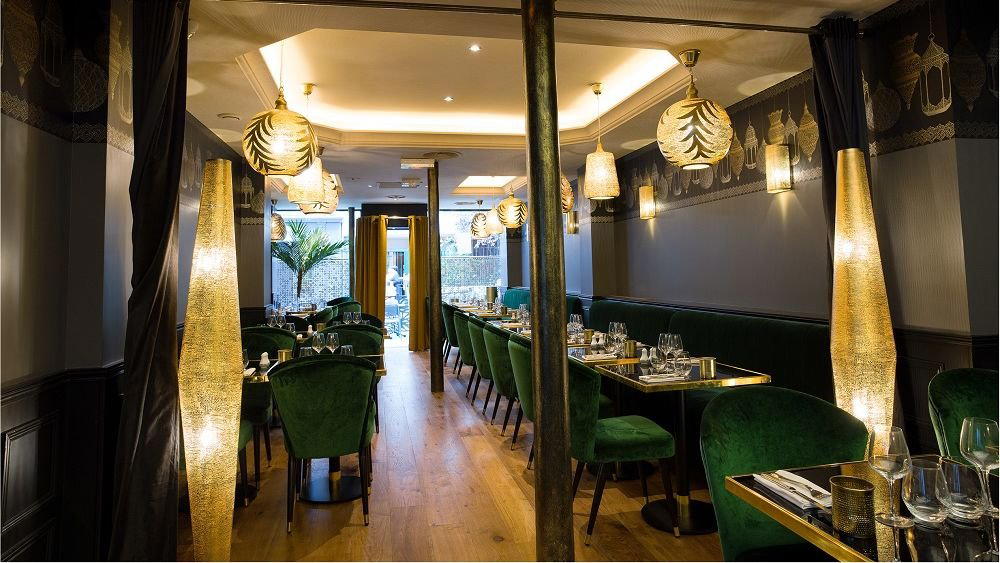
Small restaurants on residential Paris streets tend to follow a consistent format logic: modest frontage, compact interior, a menu that changes with season and supply rather than holding a fixed card year-round. The physical environment on Rue Brey reflects the wider character of this part of the 17th: Haussmann-scale apartment buildings, pavement widths that make outdoor terracing marginal rather than central, a neighbourhood pace that is unhurried by the standards of the more trafficked arrondissements.
In terms of atmosphere, the expectation set by this kind of address is intimacy rather than spectacle. Paris's most decorated rooms, Le Cinq at the Four Seasons George V, L'Ambroisie on Place des Vosges, operate with a formality of service and a grandeur of setting that is inseparable from their identity. A neighbourhood restaurant in the 17th trades on different terms: proximity to the kitchen, a room where conversation carries, a relationship between host and regular that builds over visits rather than performing itself in a single evening.
For North African restaurants specifically, that intimacy is often reinforced by the format of the food itself. Sharing dishes, tagines that arrive at the centre of the table, bread used as the primary utensil for a portion of the meal, these are formats that require a certain kind of room and a certain kind of service pace. They do not suit the assembly-line efficiency of a high-cover brasserie, and they reward a diner who is not in a hurry.
Paris's North African Dining Scene in Context
The broader French dining establishment has had a complicated relationship with North African cuisine. Couscous and tagine are among the most consumed dishes in France by volume, surveys have regularly placed couscous among the country's most popular home-cooked meals, yet the Michelin Guide and the prestige press have historically given Maghrebi restaurants little of the recognition directed at, say, the Japanese-French crossover cooking that earned Kei its stars, or the regional French tradition upheld by institutions like Auberge de l'Ill in Alsace and Bras in Laguiole.
That gap is beginning to close, slowly, as a younger generation of Maghrebi-French chefs applies fine-dining technique to the flavour memory of their family kitchens. The movement is most visible in Paris, where the population density and the dining press create conditions for recognition. Figuig sits within this moment, at a point where the sourcing and preparation of North African food are increasingly evaluated on the same terms as any other serious cuisine rather than categorised separately as ethnic or informal. The trajectory parallels what has happened in other European cities with significant postcolonial culinary inheritance, London with South Asian cooking, Amsterdam with Indonesian, where a second generation has built upward from the neighbourhood base.
For readers tracking the wider French restaurant world, the contrast is instructive. The prestige circuit, from Mirazur in Menton to AM par Alexandre Mazzia in Marseille to Troisgros in Ouches, operates on a different set of signals than Figuig. But the ingredients conversation, about provenance, specificity, and why sourcing decisions communicate culinary seriousness, runs across both tiers. It is the same question you would ask at Flocons de Sel in Megève or at Auberge du Vieux Puits in Fontjoncouse, and it is the right question to ask at Figuig.
See our full Paris restaurants guide for broader context on how the city's dining map is organised by arrondissement, price tier, and cuisine tradition. For readers also tracking European fine dining beyond Paris, reference points include Assiette Champenoise in Reims, Au Crocodile in Strasbourg, and internationally, Le Bernardin and Atomix in New York, and Paul Bocuse in Collonges-au-Mont-d'Or for the classical French anchor.
Is Figuig representative of the new wave of Maghrebi restaurants in Paris?
The restaurant's name references Figuig, the oasis town on the Moroccan-Algerian border with a well-established identity in North African food culture, which positions it within a generation of Paris restaurants that treat Maghrebi cuisine as a sourcing-serious tradition rather than a casual category. This places it in a similar conversation to other Paris addresses where immigrant-origin cooking is being reread through a fine-dining ingredient lens, even if without the formal award recognition that has so far accrued primarily to French and French-adjacent kitchens in the city.
Budget Reality Check
Comparable venues nearby, for context on price, style, and recognition.
| Venue | Cuisine | Price | Notes |
|---|---|---|---|
| FiguigThis venue — the venue you are viewing | Authentic Moroccan | $50–100 | Not listed |
| Essaouira | Authentic Moroccan | $30–50 | 16th Arr. - Passy, Authentic Moroccan |
| Market | French-Asian Fusion | $50–100 | 8th Arr. - Élysée, French-Asian Fusion |
| Mollard | Traditional French Brasserie with Seafood | $50–100 | 8th arrondissement, Traditional French Brasserie with Seafood |
| Lily Wang | Asian Fusion | $100–150 | 7th Arr. - Palais-Bourbon, Asian Fusion |
| Café Pierre Hermé | Not listed | $30–50 | 7th arrondissement, French Patisserie Café |
Continue exploring
More in Paris
Restaurants in Paris
Browse all →

Bars in Paris
Browse all →
Hotels in Paris
Browse all →

Details
- Cozy
- Elegant
- Romantic
- Date Night
- Special Occasion
- Family
- Brunch
- Live Music
- A La Carte
- Vegetarian Friendly
Current opening hours
- Monday
- 12 PM–12 AM
- Tuesday
- 12 PM–12 AM
- Wednesday
- 12 PM–12 AM
- Thursday
- 12 PM–12 AM
- Friday
- 12 PM–12 AM
- Saturday
- 12 PM–12 AM
- Sunday
- 11 AM–12 AM
Hours can change for holidays and private events. Last verified .
Cozy and elegant with a warm, inviting atmosphere blending tradition and modernity, enhanced by fragrant dishes and attentive service.