Our verdict
In Matsue, a city shaped by castle town ritual and Shimane's exceptional produce, オマッジオ ダ コニシ occupies the quieter, more considered end of the local dining spectrum. The address in Higashiasahimachi places it within easy reach of the historic district, and the restaurant draws on the regional sourcing traditions that make this part of the San'in coast compelling for serious eaters. Visitors researching premium dining in the region will find context in our full Matsue restaurants guide.

Pearl is the En Primeur Club membership app, where members save venues, book tables and use the concierge.
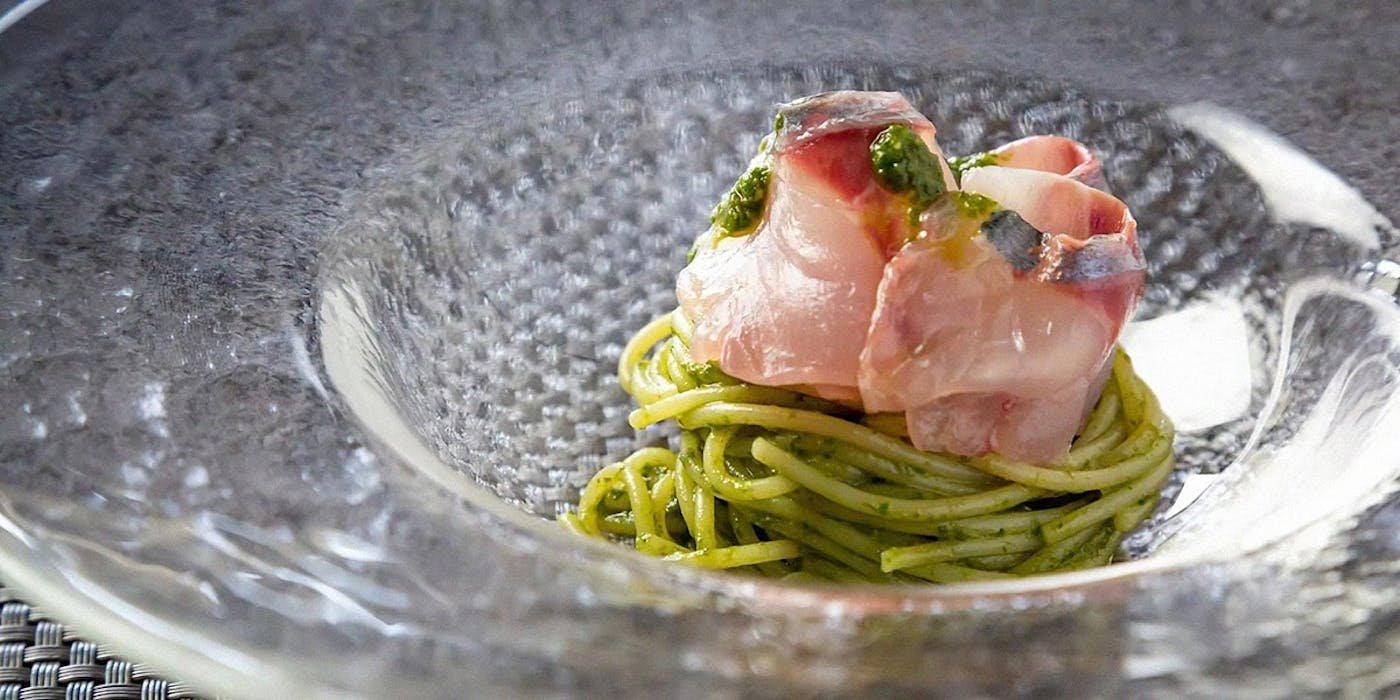
Matsue's Ingredient Logic and Where オマッジオ ダ コニシ Sits
San'in, the coastal strip running along the Sea of Japan through Shimane and Tottori prefectures, operates on different culinary terms than the more trafficked Tokaido corridor. The produce calendar here is shaped by cold-water fisheries, highland mountain vegetables, and a rice culture so specific to its geography that local varieties remain largely unknown outside the region. Matsue, the castle town at the heart of Shimane, has traditionally expressed this through kaiseki ritual and tea ceremony culture, Matsue being one of Japan's three great tea towns. The question for any restaurant operating here is how it positions itself relative to that tradition: working inside it, translating it, or proposing something parallel.
オマッジオ ダ コニシ, addressed at 216-8 Higashiasahimachi in the historic eastern quarter, sits in an area where old merchant-town architecture and the rhythms of the castle neighbourhood establish an ambient register before you walk through any door. The address places it near the Ohashi River corridor, which connects Shinji Lake to the north with the city's inner waterways, a geography that has historically defined Matsue's freshwater ingredient palette as much as its proximity to the sea. Shijimi clams from Lake Shinji are among Japan's most regionally specific ingredients, a bivalve so tied to this particular lake ecosystem that they carry protected designation significance in the local food identity. Any serious kitchen in Matsue works through its relationship with that ingredient, along with the broader San'in seafood calendar.
For context on what premium Japanese dining looks like at a national level, reference points such as Gion Sasaki in Kyoto and Harutaka in Tokyo illustrate how regional produce specificity and technique depth translate into recognized credentials in major cities. HAJIME in Osaka takes the French-innovative route, while akordu in Nara demonstrates how European technique can be applied to deeply local Japanese ingredient sourcing in a secondary city context. オマッジオ ダ コニシ's Italian-inflected name signals a different orientation, suggesting a kitchen that translates Shimane's ingredients through a European lens rather than a strictly washoku framework, a positioning that places it in an interesting relationship with the local tradition rather than inside it.
The San'in Sourcing Argument
Western Honshu's Sea of Japan coast is systematically underrepresented in the national restaurant conversation, which tends to cluster around Tokyo, Kyoto, Osaka, and Fukuoka. That concentration of critical attention doesn't reflect the quality of the raw materials available in the San'in region. Shimane's fishing ports bring in winter crab, flatfish, and seasonal shellfish on a quality tier that rivals the more publicized fishing regions of Hokkaido or Kyushu. The highland areas around the Chugoku mountain range, which forms the interior of the peninsula, produce mushrooms, mountain herbs, and cold-climate vegetables with a flavour density that's partly a function of the specific soil and temperature conditions.
Restaurants in Matsue that take ingredient sourcing seriously are effectively working with materials that have not been subject to the same market pressure and price inflation as equivalent ingredients in Tokyo. The shijimi clams are the most emblematic example: abundant locally, culturally embedded in the city's food rituals, and still priced in relation to local demand rather than export premium. For a kitchen applying European technique to these materials, the argument writes itself through the plate rather than through marketing language.
This kind of regional European-Japanese translation is not exclusive to Matsue. Goh in Fukuoka demonstrates how a Kyushu-rooted kitchen can operate at the highest technical level while staying anchored to regional sourcing. Across the Sea of Japan coast, restaurants in less-trafficked cities including those covered in our features on Nanao and Takashima are working through similar questions of how to frame local ingredients for a dining public that may not have pre-existing reference points for them.
Dining in the Historic Quarter
Higashiasahimachi places the restaurant in Matsue's eastern residential and commercial band, within walking distance of Matsue Castle and the Lafcadio Hearn Memorial Museum. This is not a nightlife strip or a dense restaurant row. The neighbourhood operates at a pace set by the castle town's civic character: measured, historically conscious, and shaped by residents rather than tourist throughput. That context tends to attract restaurants that prioritise regulars and local relationships over transient volume, which in turn shapes how ingredient sourcing relationships get built, directly with nearby producers rather than through metropolitan wholesale channels.
For visitors arriving from outside Shimane, Matsue is accessible by the JR Sanin Line from Okayama, or by limited express from Yonago. The city is not on a Shinkansen line, which keeps its visitor base smaller and more deliberately self-selecting than comparable castle towns on the main trunk routes. That visitor profile tends to suit a dining room built around considered pacing and ingredient-led cooking rather than high-turnover casual formats.
Given that Matsue's premium dining options are limited in number relative to the city's scale, restaurants in this tier tend to book at a pace that reflects local demand rather than national reservation platform traffic. Planning at least several weeks ahead is a reasonable baseline, particularly during the autumn and spring shoulder seasons when San'in tourism is most concentrated.
For comparison with other regional Japanese restaurants where booking intelligence matters, this Sapporo venue and this Nishikawa-machi restaurant both operate in secondary-city contexts where lead times differ from urban norms. Internationally, the booking discipline required for a restaurant like Le Bernardin in New York or Atomix reflects a different kind of demand pressure, but the underlying principle of planning ahead in proportion to seat scarcity applies across all of them.
For a wider map of where オマッジオ ダ コニシ sits within the city's dining options, our full Matsue restaurants guide covers the range from tea-ceremony sweets to the San'in seafood houses that anchor the city's food identity. Further regional context is available through our coverage of Bistro Ange in Toyohashi and Denko Sekka in Hiroshima, both of which illustrate how western Honshu's restaurant scene is developing outside the major metropolitan centres.
Frequently asked questions
Is オマッジオ ダ コニシ a family-friendly restaurant?
The restaurant sits in Higashiasahimachi, Matsue's eastern quarter near the castle district, in a setting that reads more intimate than casual.
What kind of setting is オマッジオ ダ コニシ?
The address at 216-8 Higashiasahimachi places the restaurant within Matsue's historic eastern band, a neighbourhood of residential streets and local businesses close to Matsue Castle and the Lafcadio Hearn Memorial Museum. That context suggests a quieter, neighbourhood-scale room rather than a destination hotel or large urban dining floor. The Italian name, Omaggio, meaning 'homage', implies a considered, personal approach to the cooking.
Why is there an Italian restaurant in Matsue, a city more associated with traditional Japanese cuisine?
Matsue has a documented reputation for wagashi confectionery and tea culture tied to its samurai history, but it also sits on one of Japan's most productive coastal stretches for seafood and agricultural produce. Italian cooking, with its structural emphasis on single-origin ingredients and simple preparation, translates well to San'in's raw material quality, a logic that has led a number of regional Japanese cities to support serious Italian rooms outside the major metropolitan centres. オマッジオ ダ コニシ, based in Higashiasahimachi, appears to operate within that tradition.
What should I order at オマッジオ ダ コニシ?
An Italian kitchen in this location logically builds around those local materials. Asking the kitchen about their current sourcing when you visit will give a more accurate picture than any fixed menu description.
How do I find オマッジオ ダ コニシ?
オマッジオ ダ コニシ is located at 216-8 Higashiasahimachi, Matsue, Shimane 690-0001, Japan, Matsue.
How far ahead should I plan for オマッジオ ダ コニシ?
Reservation lead times are not publicly listed, but Matsue operates on a smaller dining circuit than Tokyo or Osaka, which can mean shorter waits at lesser-known restaurants, or, for a well-regarded local room, a tighter availability window because the pool of open tables is smaller to begin with. Planning at least two to three weeks ahead for a weekday, and longer for weekends or peak seasons around the castle district, is a reasonable baseline.
A Quick Peer Check
Comparable venues nearby, for context on price, style, and recognition.
| Venue | Cuisine | Price | Awards | Notes |
|---|---|---|---|---|
| オマッジオ ダ コニシThis venue (the venue you are viewing) | Modern Italian with Local Shimane Ingredients | $50–100 | Not listed | Not listed |
| China Sanchi Soba Kobo Funatsu | Japanese Soba | $1–10 | Tabelog 100 #65 | Gotsu/Nakahara area |
| KARLY tonomachi | Japanese Spice Curry | $10–20 | Not listed | Tonomachi |
| Teuchi Kamiyo Soba | Traditional handmade soba (Izumo-style) | $10–20 | Tabelog 100 #80 | Matsue Shinjiko Onsen area |
| エンボカ軽井沢 旧軽井沢店 | 薪窯ピッツェリア | $30–50 | Not listed | 旧軽井沢 |
| Olivio | Italian Classics and Homemade Pasta | Not listed | Not listed | Kutchan, Abuta District |
Continue exploring
More in Matsue
Details
- Elegant
- Intimate
- Sophisticated
- Date Night
- Special Occasion
- Open Kitchen
- Extensive Wine List
- Local Sourcing
- Prix Fixe
- Tasting Menu
- Sake Program
Current opening hours
- Monday
- 12–2 PM, 6–10 PM
- Tuesday
- 12–2 PM, 6–10 PM
- Wednesday
- 12–2 PM, 6–10 PM
- Thursday
- 12–2 PM, 6–10 PM
- Friday
- 12–2 PM, 6–10 PM
- Saturday
- 12–2 PM, 6–10 PM
- Sunday
- 12–2 PM, 6–10 PM
Hours can change for holidays and private events. Hours as of .
Refined and elegant with beautifully presented dishes in an intimate setting.