1 Michelin Star · Guía Repsol 1 Sol · Conde Nast Hot List Restaurants
Our verdict
A 12-seat haute cuisine bar on Calle de Gaztambide in Chamberí, EMi runs a single surprise menu shaped by training at Noma, Geranium, Azurmendi, and Atomix. The format is intimate and technically demanding, with Nordic and Korean influences threading through each course. For Madrid's small-counter haute cuisine scene, it occupies a distinct position.

Pearl is the En Primeur Club membership app, where members save venues, book tables and use the concierge.
The menu
What to order
- Smoked eel tartlet with kelp and tofu
- Gim bugak with nori and shrimp
- Otoro with caviar and mussel escabeche
- Seabream with white kimchi and squid
- Cep mushroom ice cream with seaweed caramel
Twelve Seats, One Menu, No Negotiation
Chamberí is not Madrid's most obvious address for haute cuisine. The neighbourhood sits northwest of the city centre, residential in character, with the kind of local bars and mid-range restaurants that serve the professionals and families who actually live there. That context is part of what makes EMi's format so deliberate: a 12-seat counter restaurant on Calle de Gaztambide, running a single surprise menu with a fully open kitchen, positioned in a district that has not historically competed with Salamanca or the old city for fine dining attention. The choice of location says something about the project's priorities: this is not a restaurant built around visibility or foot traffic.
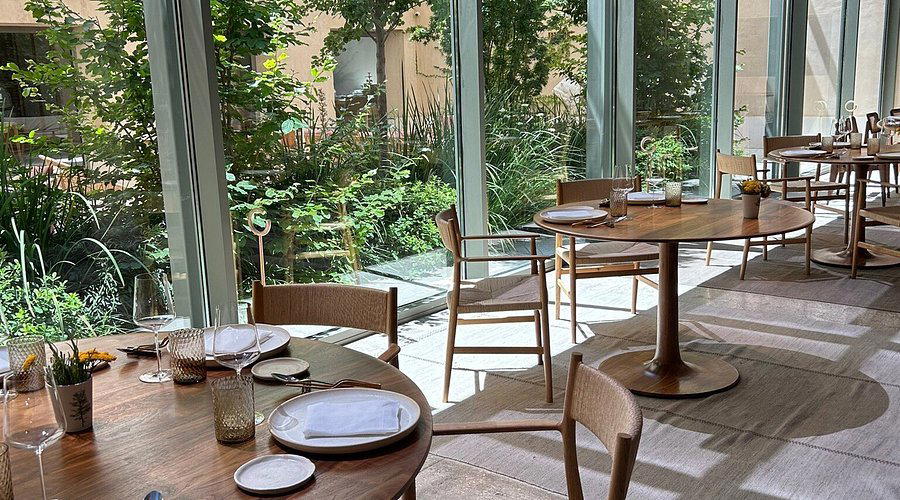
The physical arrangement matters here. The counter seats a maximum of 12 diners, with a small private room that overlooks the kitchen. In a city where haute cuisine has traditionally operated through larger dining rooms and multi-room service formats, the 12-seat constraint places EMi in a different peer group entirely. Madrid's most decorated kitchens, including DiverXO (three Michelin stars, progressive Asian-creative), Coque and Deessa (two stars each), operate at scales where the kitchen-to-diner relationship is necessarily mediated. At EMi, the open kitchen is the dining room. What the brigade is doing is not a backdrop, it is the primary visual and sensory experience from every seat.
A Training Biography Written in Technique
Spain's highest-profile restaurants increasingly draw from international training networks, and the CV behind EMi is one of the more demanding in that regard. Chef Rubén Hernández Mosquero, originally from Extremadura, accumulated his formation across some of the most technically serious kitchens of the past two decades: Azurmendi in the Basque Country, Noma and Geranium in Copenhagen, Minibar by José Andrés in Washington, and Atomix in New York. The last two are particularly instructive as context for EMi's menu. Minibar operates as a hyper-technical tasting format; Atomix sits at the apex of Korean fine dining in the United States, holding two Michelin stars and representing a very specific integration of Korean culinary tradition with haute cuisine technique. That the Nordic and Korean influences in EMi's menu are not decorative borrowings but reflect genuine immersion in those kitchens gives the fusion positioning considerably more credibility than the word typically carries.
This kind of formation, spanning three continents and multiple Michelin-starred environments, has become a recognisable path for a particular tier of Spanish chef. The difference at EMi is that the result has not been filtered through a conventional fine dining format. There is no à la carte option, no choice of menu length, and no adjustment for preferences beyond dietary requirements. The surprise menu is the only offering. That rigidity is a deliberate editorial statement about what the kitchen wants to put on the plate each service.
Nordic-Korean Fusion in Madrid's Creative Tier
Madrid's creative dining scene has consolidated around a core of high-profile, award-heavy addresses. DSTAgE, Paco Roncero, and the DiverXO group have defined what ambitious cooking looks like in the city for most of the past decade. The fusion category within that tier has generally trended toward Asian-Spanish combinations, with DiverXO's progressive Asian-creative format being the most decorated example. EMi's Nordic-Korean orientation is a different proposition: more restrained in presentation cues, more fermentation-aware in technique, and operating from a counter format that has more in common with the Scandinavian and Japanese omakase traditions than with the theatrical plated service most associated with Madrid's leading end.
The menu is described as complex but balanced, with dishes that are technically demanding without being self-consciously showy. That description aligns with the specific kitchens in the chef's background. Geranium, which holds three Michelin stars in Copenhagen, operates from a philosophy of precision and product clarity. Noma, regardless of how its influence is now assessed, established a global template for fermentation, foraged ingredients, and Nordic terroir. Bringing those reference points into a Madrid kitchen serving Spanish diners requires calibration, and the 12-seat format gives the kitchen the capacity to execute at a level of detail that would collapse under volume.
An Extensive Wine Cellar at This Scale
For a 12-seat operation, the wine program at EMi is reported to carry exclusive labels across an extensive cellar. Small-format haute cuisine restaurants in this tier typically approach wine one of two ways: a short, list aligned tightly with the menu, or a deep cellar that positions the pairing experience as a secondary attraction. The latter is the more ambitious and expensive proposition for an operator of this size, and it signals that the wine element is taken as seriously as the food. For comparison, Madrid addresses with deep cellars at the leading price tier, such as Coque, have used wine service as a structural component of the overall experience rather than an accompaniment. How EMi's cellar plays against its menu at the 12-seat scale will be one of the more interesting elements for visitors focused on pairing.
EMi in the Context of Spanish Haute Cuisine
Spain's broader haute cuisine circuit is anchored by long-established institutions: Arzak and Martin Berasategui in the Basque Country, El Celler de Can Roca in Girona, Cocina Hermanos Torres in Barcelona, Aponiente on the Atlantic coast. Madrid competes within that national circuit with a younger but increasingly credentialed creative scene. EMi arrives into that context as an unusually small-format operation with an unusually international training pedigree. It does not yet carry the institutional weight of those established names, but the counter format and training lineage give it a distinct identity within its own tier. For visitors already familiar with comparable small-counter formats in New York, such as Le Bernardin's approach to precision service or Atomix's omakase structure, EMi will read as a recognisable format in an unfamiliar city context.
The restaurant is also a personal project in the most direct sense: the name honours the chef's late brother, Emilio. That biographical weight does not need to translate into a dining narrative, but it does signal that this is not a commercial vehicle or a brand extension. In Madrid's current creative tier, where several notable addresses are chef-patron projects of genuine conviction, that distinction matters as a frame for what the kitchen is trying to do. For the full picture of what Madrid's restaurant scene currently offers, see our full Madrid restaurants guide, as well as guides to hotels, bars, wineries, and experiences in the city.
Know Before You Go
- Address: C. de Gaztambide, 64, Chamberí, 28015 Madrid, Spain
- Neighbourhood: Chamberí, northwest of the city centre
- Format: Single surprise tasting menu only; no à la carte
- Capacity: Maximum 12 diners at the counter, plus a small private room overlooking the kitchen
- Kitchen: Fully open, visible from all counter seats
- Wine: Extensive cellar with exclusive labels
- Booking: Contact the restaurant directly; given the 12-seat capacity, advance reservations are strongly advisable
Frequently asked questions
Is EMi formal or casual?
EMi occupies a deliberate middle register: a fully open kitchen and a counter for just 12 diners create proximity rather than ceremony, yet the cooking, rooted in training at Noma, Geranium, and Atomix, demands serious attention. Call it chef's-counter focused rather than formally stiff or casually relaxed.
What part of town is EMi in?
EMi is located at C. de Gaztambide, 64, Chamberí, 28015 Madrid, Spain, Madrid.
What's EMi known for in terms of accolades?
EMi has received recognition including: In the heart of Chamberí, this elegant restaurant has been built on four solid pillars: personality, professionalism, hard work and an unbreakable will! The driving force behind the project is Rubén Hernández Mosquero, a globetrotting chef ….
What dish is EMi famous for?
EMi runs a single surprise menu, so no fixed dish defines the kitchen publicly. The cooking draws on Nordic and Korean influences filtered through the chef's time at Noma, Azurmendi, and Atomix, producing complex, technically layered fusion plates that change with the menu.
Should I book EMi in advance?
With only 12 seats and a private room overlooking the kitchen, capacity is tight by design. A counter of this size at this level of technical ambition in a residential Chamberí address fills well ahead, booking as early as possible is advisable.
What's the signature at EMi?
The format itself is the signature: one surprise menu, no alternatives, served to a maximum of 12 diners around a fully open kitchen. The kitchen's fluency across Nordic and Korean registers, built across stints at Geranium, Atomix, and Il Ristorante at the Bvlgari Hotel Tokyo, gives the menu its defining technical range.
At-a-Glance Comparison
A compact comparison to help you place this venue among nearby peers.
| Venue | Cuisine | Price | Awards | Notes |
|---|---|---|---|---|
| EMiThis venue (the venue you are viewing) | Modern Nordic-Korean Fusion Fine Dining | $150–200 | 1 Michelin Star · Guía Repsol 1 Sol | Not listed |
| DiverXO | Avant-Garde Spanish Tasting Menu | $300–500 | 3 Michelin Stars · World's 50 Best #4 | Progressive - Asian, Creative |
| Deessa | Modern Valencian Fine Dining | $150–200 | 2 Michelin Stars · La Liste Top Restaurants | Modern Spanish, Creative |
| Smoked Room | Modern Japanese Fire Omakase | $200–300 | 2 Michelin Stars · La Liste Top Restaurants | Progressive Asador, Contemporary |
| Coque | Modern Spanish Fine Dining | $300–500 | 2 Michelin Stars · La Liste Top Restaurants | Spanish, Creative |
| Paco Roncero | Avant-Garde Spanish Fine Dining | $150–200 | 2 Michelin Stars · La Liste Top Restaurants | Creative |
Recognition history
Dated appearances from independent guides and award organizations, with the underlying list record or original source where available.
Michelin 1 Star
Michelin
Conde Nast Hot List Restaurants
Conde Nast
Guía Repsol 1 Sol
Guía Repsol
Opinionated About Dining Newly Added European Restaurants
Opinionated About Dining
Full recognition history (6 entries)
Opinionated About Dining Top Restaurants in Europe Recommended
Opinionated About Dining
Opinionated About Dining Top New Restaurants in Europe Ranked #7
Opinionated About Dining