
Kyoto’s curry culture is easier to understand at counter scale than through temple-district polish. Curry Senmon Ten Biyanto works in that compact register: an eight-seat, counter-only room in Sakyo Ward, selected for Tabelog Curry WEST 100 in 2023 and 2024, with pricing that keeps it in the everyday lunch-and-dinner bracket rather than the destination tasting-menu economy.
Pearl is the En Primeur Club membership app — saves, bookings, and concierge access live there. Same editors, same standards.
- Address
- Japan, 〒606-8391 Kyoto, Sakyo Ward, Shogoin Nishimachi, 12
- Phone
- +81 75-751-7415
- Website
- tabelog.com
 Saves & bookings on Pearl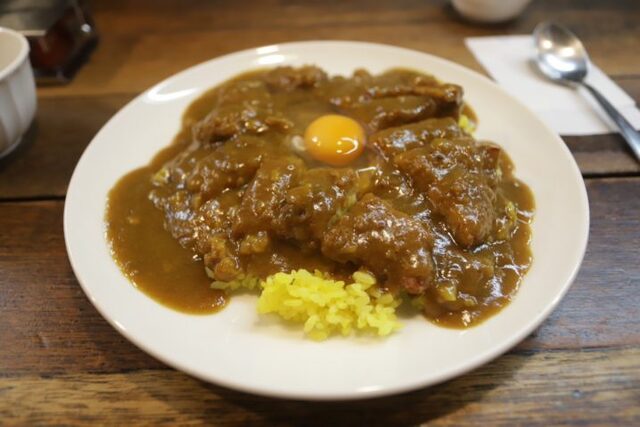
Approach this part of Sakyo Ward and Kyoto changes register. Ceremonial dining rooms and garden-facing ryotei recede; frontage, counter width, solo-diner rhythm, and how quickly a small kitchen turns a room matter more. Curry Senmon Ten Biyanto belongs to that Kyoto: compact, practical, and built around the Japanese curry specialist rather than the multi-course restaurant. The point is not spectacle, but how much identity a room can carry with only eight counter seats and one category to defend.
Japanese curry is often flattened into comfort-food shorthand, but Kyoto gives it several lanes: department-store plates for commuters, student-area shops tuned to price and speed, and specialist counters where curry is the whole argument. Biyanto sits in the last category. Its Tabelog Curry WEST 100 selections in 2023 and 2024 place it in a regional group where consistency, local following, and category focus matter more than dining-room theatre. The listing’s 3.65 score is not a luxury signal; it usefully marks a modestly priced curry counter operating above the anonymous lunch-shop tier.
Eight counter seats make the room part of the cooking logic
Design here is operating discipline, not decoration. Counter-only restaurants in Japan compress ordering, cooking, serving, eating, and clearing. With eight seats, each diner becomes part of the service geometry. There is little room for performative lingering, and that limit is the strength. Kyoto has enough restaurants that ask guests to contemplate space; this format asks them to read pace.
That matters for curry. Unlike kaiseki, where architecture and sequence can become half the meal, a curry specialist works through concentration. The plate arrives as a complete proposition, and the counter keeps attention on temperature, portion, and repetition. The absence of private rooms is no deficit; it clarifies the format. Solo diners and pairs make sense because the room rewards directness over occasion dressing.
Sakyo Ward gives the format a credible setting. Around Jingu Marutamachi and the university-heavy east side, value-conscious eating does not mean careless eating. Small specialists survive because regulars understand category depth: ramen, soba, curry, tonkatsu, coffee. For visitors planning beyond temples and hotel dining rooms, this is where Kyoto’s daily appetite becomes legible. For a wider map of the city’s dining range, Our full Kyoto restaurants guide is the useful starting point; for adjacent planning, see Our full Kyoto hotels guide, Our full Kyoto bars guide, Our full Kyoto wineries guide, and Our full Kyoto experiences guide.
Kyoto curry sits between daily food and specialist obsession
Kyoto’s international dining reputation still leans toward tea, tofu, wagashi, kaiseki, and the seasonal grammar of Japanese cuisine. Curry complicates that picture. It is imported, adapted, and thoroughly domestic in Japan, with its own hierarchy of roux, spice handling, rice, portioning, and shop personality. A small Kyoto curry counter does not need the cultural weight of a centuries-old tradition to be serious. It needs repetition, restraint, and a reason for locals to return after novelty fades.
Biyanto’s Tabelog Curry WEST 100 recognition matters because the category is regional, not city-only. It places the restaurant against curry specialists across western Japan, not just nearby lunch counters. The listed price band, under JPY 999, also shapes the read: this is not a premium reinterpretation using curry as a luxury vehicle. It belongs to the affordable specialist bracket, where the question is whether a narrow format can earn loyalty without expanding into broader restaurant theatrics.
That differs from Kyoto’s higher-spend rooms, such as Abbesses or Italian dining in the orbit of cenci. It also differs from the quick regional comfort of 551蓬莱, the contemporary small-format language around [ki:], and the casual precision of 3TOKU6MI Shijo karasuma ten. The comparison is not cuisine similarity, but how Kyoto supports sharply defined rooms at different price points, from sweets specialists such as Aburi Mochi Honke Nemoto Kazariya to counters that ask for little more than appetite and timing.
For travellers building a Japan-wide view of compact food formats, the same logic appears elsewhere through different ingredients and communities: [Curry Senmon Ten] Maruyama Kyoju. in Sapporo.cafe in Osaka.know in Kumamoto, (Shoku) Vietnam in Kawasaki. 鮪と炭火焼き うお炭 秋葉原店 in Tokyo, and -Grilled beef Sukiyaki- KAMAKURA TANUKIAN 鎌倉 たぬき庵 in Kamakura. Outside Japan, tight specialist formats travel differently, from Jōdo Saké Bar in Los Angeles to Onigiri Time in Pasadena.
Read it as a counter, not a destination dining room
The right expectation is a focused curry specialist with structural limits. Reservations are unavailable, seating is minimal, and the counter will not suit groups trying to turn lunch into a long social meal. The stronger use case is solo dining, a pair moving through Sakyo Ward, or a traveller who wants Kyoto’s everyday food intelligence without defaulting to ramen or convenience-store efficiency.
The practical sharpness is part of the appeal. Cash is the safest assumption because card, electronic money, and QR payments are not accepted. Take-out is listed, children are welcome, and the room is non-smoking. Parking is not attached, though coin parking is nearby. Those details define the experience as much as the award badge does: this is a small, category-led address whose success depends on matching the format rather than demanding flexibility from it.
Kyoto rewards diners who separate occasion from quality. Some rooms are built for ceremony; others for repetition. Curry Senmon Ten Biyanto belongs to the second group, which is why it deserves attention inside a serious Kyoto itinerary. It shows a side of the city where craft is measured not by tableware or choreography, but by a compact counter’s ability to make a narrow idea hold its ground.
Comparable Options
Comparable options at the same price tier.
| Venue | Cuisine | Price | Notes |
|---|---|---|---|
| Curry Senmon Ten BiyantoThis venue — the venue you are viewing | Japanese Curry | $ | Not listed |
| Honke Funahashiya | Japanese traditional sweets | $ | Nakagyō |
| Menya Takakura Nijou | Kyoto ramen and tsukemen shop | $ | Nakagyō |
| Kasagiya | Traditional Japanese sweets café & tea house | $ | Higashiyama |
| GOKKEI Ichijouji honten | Ultra-rich chicken paitan ramen | $ | Sakyō |
| Seikou Udoku | Japanese Mazesoba | $ | Uji |
Recognition history
Dated appearances from independent guides and award organizations, with the underlying list record or original source where available.
Tabelog 100 #32 · No. 32
Tabelog · Tabelog 100 - Curry - WEST - 2024
Continue exploring
More in Kyoto
Restaurants in Kyoto
Browse all →
Bars in Kyoto
Browse all →
Hotels in Kyoto
Browse all →
Wineries in Kyoto
Browse all →
At a Glance
- Classic
- Cozy
- Solo
- Family
- Casual Hangout
- Standalone
Current opening hours
- Monday
- 11 AM–3 PM, 5:30–9 PM
- Tuesday
- 11 AM–3 PM, 5:30–9 PM
- Wednesday
- 11 AM–3 PM, 5:30–9 PM
- Thursday
- 11 AM–3 PM, 5:30–9 PM
- Friday
- 11 AM–3 PM
- Saturday
- Closed
- Sunday
- 11 AM–4 PM
Hours can change for holidays and private events. Last verified .
Compact, counter-only, no-frills curry shop atmosphere with a busy, popular neighborhood feel.