Our verdict
On the Alameda, Santiago's main artery, Confitería Torres carries more than a century of Chilean social history within its walls. One of the city's oldest surviving confiterías, it operates in a category that has nearly disappeared from Latin American capitals — the grand civic café where business, politics, and lunch have always shared a table. For visitors mapping the city's dining heritage, it belongs near the top of any historical itinerary.

Pearl is the En Primeur Club membership app — saves, bookings, and concierge access live there. Same editors, same standards.
- Address
- Av. Alameda Libertador Bernardo O'Higgins 1570, 8330199 Santiago, Región Metropolitana, Chile
- Phone
- +56 2 2688 0751
- Hours
- Mon–Wed 10 AM–8 PMThu–Fri 10 AM–9 PMSat–Sun Closed
- Website
- confiteriatorres.cl
- Directions
- Get directions
- Booking
- Book on the venue's website
The menu
What to order
- Barros Luco
- Chupe de locos
- Pastel de choclo
- Empanadas
- Hojarasca
Where the Alameda Slows Down
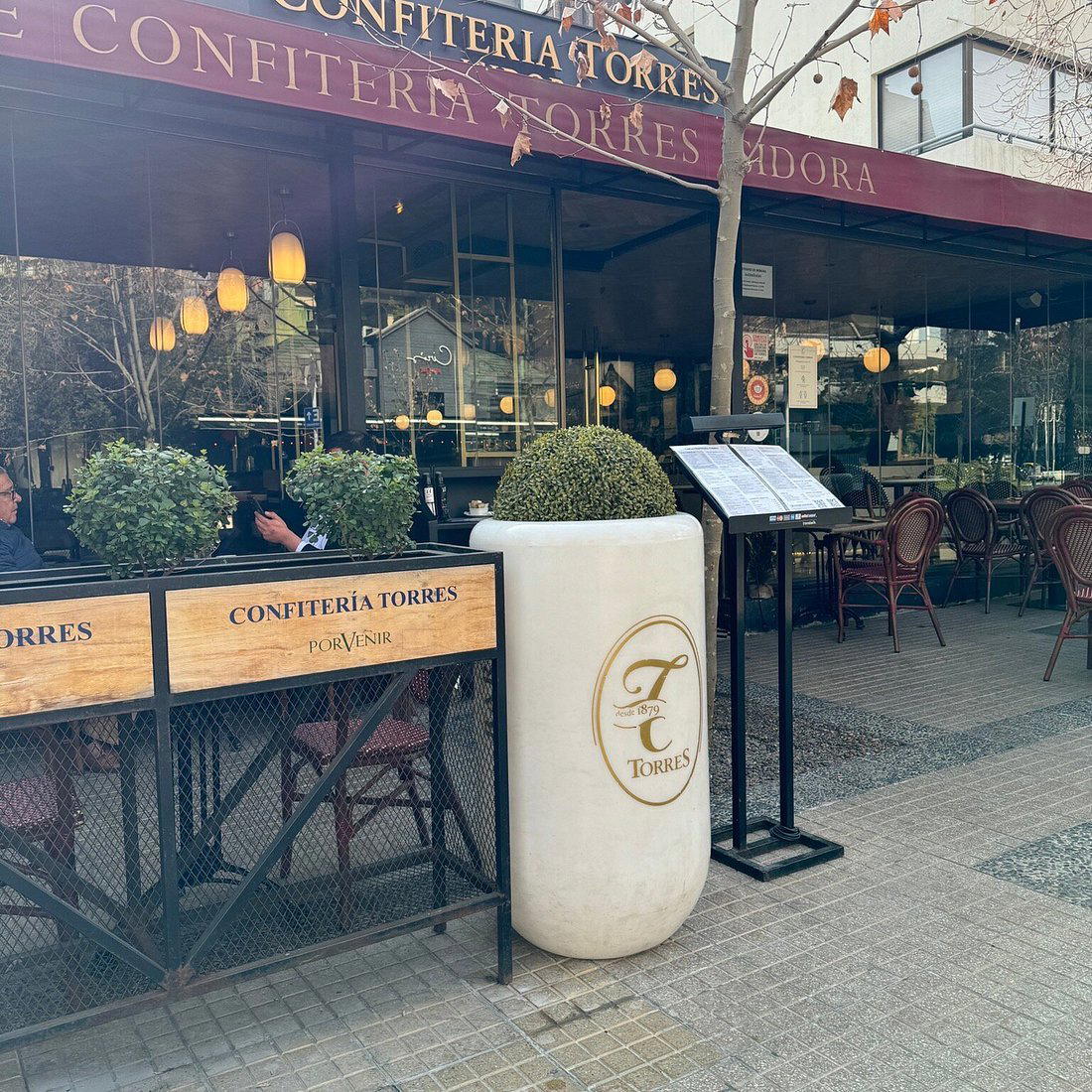
Santiago moves fast along Av. Alameda Libertador Bernardo O'Higgins, the wide boulevard that cuts through the city's historic core. Most pedestrians pass the facade of Confitería Torres at number 1570 without pausing. That indifference is, in a way, the point: the oldest surviving confiteria in Chile does not compete for attention the way a contemporary restaurant does. It has been there long enough that the city has simply absorbed it, the way cities absorb their central train stations and their oldest pharmacies — as infrastructure rather than attraction.
The confiteria format itself deserves some context before the venue does. Across Latin America in the late nineteenth and early twentieth centuries, the confiteria occupied a social tier between the pastry shop and the full restaurant: a place where the educated and professional classes could eat a proper midday meal, drink coffee, and conduct the kind of conversation that required a tablecloth. Buenos Aires still has a handful of these houses operating under official heritage protection. Santiago has fewer, and Confitería Torres is the most cited survivor in the capital.
The Booking Question — and Why It Matters Less Than You Expect
At Boragó (Modern Chilean), Chile's most internationally discussed tasting-menu restaurant, reservations can run weeks out and require forward planning from international visitors. At 99 Restaurante, the omakase-influenced format limits covers and creates genuine scarcity. Confitería Torres occupies the opposite end of that access spectrum: it is a historic café operating in a high-footfall corridor of the city, and the primary logistical question is not how to secure a table but whether you know enough about the venue's history to understand what you are sitting inside.
That distinction matters. The difficulty at Confitería Torres is not logistical, it is interpretive. Visitors who arrive expecting the tasting-menu precision of Demencia or the seafood sourcing rigour of La Calma by Fredes will be reading the room incorrectly. The confiteria tradition does not operate on those terms. What it offers instead is a functioning archive, a place where the physical environment, the format, and the menu together constitute a document of Chilean bourgeois dining culture across the better part of two centuries.
Practically, this means Confitería Torres is accessible without advance reservation in the way that most historic cafés operating in busy urban corridors are. Timing, though, carries weight: the midday service on weekdays draws a clientele with genuine local roots, office workers, lawyers from nearby courts, civil servants from government buildings along the Alameda, rather than the tourist traffic that dominates at weekends. If the social fabric of the place matters to you as much as the food does, a Tuesday or Wednesday lunch between one and two in the afternoon is where that fabric is most intact.
What Confitería Torres Represents in Santiago's Dining Map
Santiago's contemporary restaurant scene has developed considerable range in recent years. The city now has credible entries across modern Chilean, French-Chilean, and seafood-led formats, with venues like Ambrosia (French-Chilean) and Peumayen in Providencia anchoring different segments of that market. Against that backdrop, Confitería Torres occupies a position that none of those venues can replicate: it predates the contemporary dining conversation entirely, and its value is not culinary in the sense that food critics apply to tasting menus.
The comparison that clarifies this is not local but international. Grand old café-restaurants in European capitals, the kind that appear in literature, host political negotiations, and serve food that is competent rather than ambitious, have long been understood as a distinct category from fine dining. They are civic institutions that happen to serve lunch. Confitería Torres functions within that tradition, applied to Chilean republican history rather than Viennese or Parisian equivalents. For travellers building a Santiago itinerary that extends beyond the contemporary dining circuit, it offers something that D.O. Restoran in Lo Barnechea or a visit to Viña Concha y Toro in Pirque cannot: direct contact with the capital's institutional dining past.
Planning Your Visit
The Alameda address, number 1570, places Confitería Torres in a stretch of the boulevard that runs between the Universidad de Chile metro station and the Moneda area, making it straightforwardly reachable by public transit from most central Santiago accommodation. The venue does not publish a website or phone number through standard channels, which is itself a kind of data point: this is not a restaurant built around reservation management or online discoverability. Walk-in access is the model, and the venue's longevity suggests that model has not been a constraint on its operation.
Visitors building a longer Chilean itinerary around dining experiences can extend naturally from Santiago to the regions. The coastal end of that circuit might include Pasta e Vino Ristorante in Valparaíso or Aquí Jaime in Concón. For wine-country access, Lapostolle Residence in Santa Cruz and Rosario in Rengo anchor the Colchagua corridor. Further north, Awasi Atacama in San Pedro de Atacama and CasaMolle in El Molle represent the premium desert and valley alternatives. South, andBeyond Vira Vira in Araucanía rounds out the geographical spread for visitors treating Chile as a culinary geography rather than a single-city stop.
For the full Santiago picture across formats, price points, and neighbourhoods, EP Club's full Santiago restaurants guide maps the contemporary scene in detail, and situates historic venues like this one within it.
Frequently asked questions
What's Confitería Torres's location?
Confitería Torres is located at Av. Alameda Libertador Bernardo O'Higgins 1570, 8330199 Santiago, Región Metropolitana, Chile, Santiago.
Is Confitería Torres one of the oldest operating cafés in Santiago?
Confitería Torres is widely cited in Santiago as one of the city's longest-running confiterías, with its location on Av. Alameda Libertador Bernardo O'Higgins tying it to the historic urban core that predates much of modern Santiago's development. The confitería format it represents — counter service, pastry cases, and coffee — is a Chilean institution with roots in the 19th century.
What should I eat at Confitería Torres?
That said, traditional Chilean confiterías of this type typically anchor their offer around pastries, sandwiches, and coffee service built for mid-morning and afternoon visits. The Alameda 1570 address places Confitería Torres squarely in the city's historic corridor, where this format of all-day counter service has defined the neighbourhood's rhythm for generations. Order whatever the day's display case shows — the logic of the confitería format is freshness over fixed menus.
How hard is it to get a table at Confitería Torres?
At peak morning and lunchtime hours on weekdays, the foot traffic between Universidad de Chile and Plaza Italia keeps counter seats moving quickly. Arriving before 9am or after 2pm typically eases the wait at venues of this type in Santiago centro.
Comparable Spots
Comparable venues nearby, for context on price, style, and recognition.
| Venue | Cuisine | Price | Notes |
|---|---|---|---|
| Confitería TorresThis venue — the venue you are viewing | Traditional Chilean | $20–30 | Not listed |
| Las Cabras - Fuente de Soda | Chilean Fuente de Soda | Not listed | Barrio Plaza la Alcaldesa |
| Liguria | Traditional Chilean Gastropub | $20–30 | Providencia |
| Restaurante "El Rápido" | Traditional Chilean Empanadas | $1–10 | Santiago Centro |
| Av. Italia | International Fusion with Italian, Peruvian & Venezuelan influences | $10–20 | Barrio Italia, Providencia |
| Blue Jar | Modern Fusion with Chilean Influences | $10–20 | La Moneda |