Bee Cheng Hiang (美珍香) occupies a retail unit on the sixth floor of Hong Kong International Airport's Terminal 1, where the Singaporean bak kwa brand's air-travel format distills a decades-long tradition of dried pork products into a compact grab-and-go proposition. For travellers moving between gate and departure lounge, it represents one of the few places in the airport where a genuine regional food heritage intersects with the convenience format.
Pearl is the En Primeur Club membership app — saves, bookings, and concierge access live there. Same editors, same standards.
- Address
- Shop No. 162, West Hall, 6/F, Terminal 1, Hong Kong Internationsl Airport
- Directions
- Get directions
 Saves & bookings on Pearl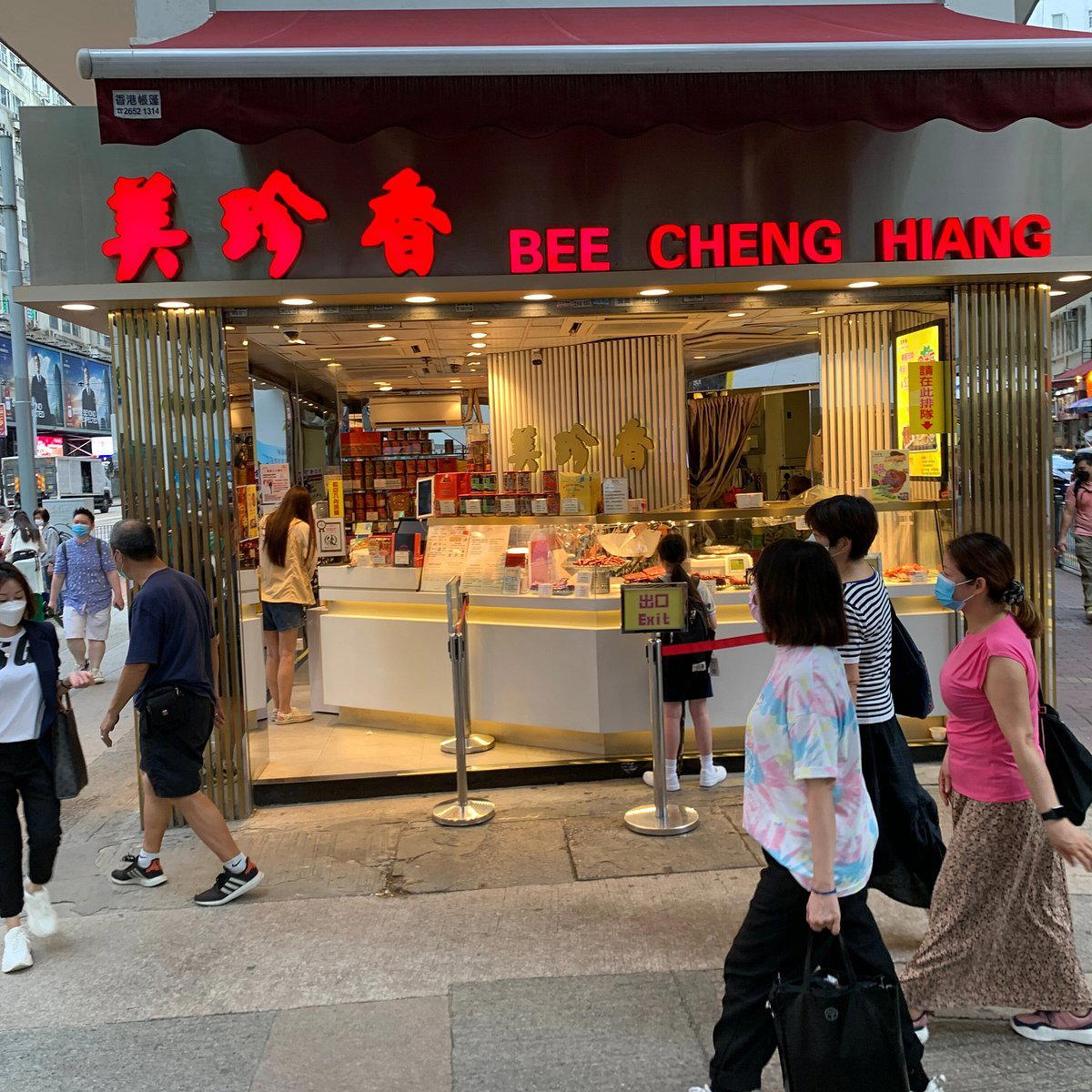
A Regional Food Tradition at Altitude
Hong Kong International Airport's sixth floor is home to Bee Cheng Hiang (美珍香), a Singaporean bakkwa specialist in Terminal 1 West Hall. Bee Cheng Hiang (美珍香) occupies Shop 162 within that context, and understanding what it sells requires some familiarity with what bak kwa actually is and why it carries the cultural weight it does across the Hokkien Chinese diaspora.
What the Product Range Reveals About the Category
Bak kwa, the Hokkien term for a type of dried, sweetened, and grilled pork, sits in a specific position within Chinese preserved-meat traditions. Unlike Cantonese lap cheong sausage or wind-dried duck, which require cooking before eating, bak kwa is ready to eat and carries a texture closer to a grilled jerky than a preserved charcuterie product. The preparation involves mincing or slicing pork, seasoning it with sugar, soy, and spice, spreading it thin, partially drying it, then finishing it over charcoal or a grill to produce the caramelised, slightly charred edges that define the product. The result is intensely savoury and sweet simultaneously, with a moisture content that places it between jerky and fresh-grilled meat.
For Bee Cheng Hiang specifically, the product architecture at airport retail typically centres on pre-packaged formats suited to air travel: vacuum-sealed portions, gift-box configurations, and multi-flavour sets. This packaging logic tells you something important about the brand's understanding of who buys at this location. The airport customer is not the daily neighbourhood buyer picking up a few slices by weight; they are a traveller seeking either a personal treat for the flight or a gift that can clear customs without the complications of fresh or liquid products. The menu, in that sense, is not structured around freshness or immediacy but around transportability and shelf coherence.
The Brand's Position Within Its Competitive Set
Bee Cheng Hiang was founded in Singapore in 1933, making it one of the older commercial operators in the bak kwa category. The brand has since expanded across Asia, with locations in Singapore, Malaysia, Hong Kong, and further afield. In the airport retail context, this breadth of footprint matters: a traveller encountering the brand at Hong Kong International Airport is likely to have seen it in Changi, or in a Singapore street context, which adds a layer of recognition that smaller regional producers cannot replicate.
That recognition, however, also defines the brand's ceiling in terms of perceived exclusivity. Bee Cheng Hiang occupies a mass-premium tier within the bak kwa market rather than an artisan or specialist niche. In Singapore, smaller producers operating from traditional shophouses compete for the specialist end of the category, often with shorter shelf lives and more limited production. Bee Cheng Hiang's strength lies in consistency, reach, and the trust that comes from nine decades of commercial operation rather than in small-batch production signals.
Hong Kong's own Cantonese preserved-meat tradition, particularly the dried sausage and lap mei culture visible in the hanging rows of cured goods in districts like Sheung Wan, represents a parallel but distinct preserved-pork heritage. Bak kwa is not native to Hong Kong in the way it is to Singapore and the Hokkien Fujianese communities there, which gives the airport unit an interesting position: it is, for many Hong Kong buyers, a purchase that crosses a cultural boundary as much as a geographical one, acquiring something associated with Singapore's Chinese food identity rather than Hong Kong's own.
Planning Your Visit: Format and Access
The unit is located post-security in Terminal 1's West Hall, meaning access requires a valid boarding pass for a departure from Hong Kong International Airport. The sixth-floor positioning places it within the main departures retail corridor rather than in the gate areas themselves, so it is accessible to a wide range of passengers before they move to their individual gates. For travellers connecting through Hong Kong without leaving the terminal, the location is reachable without immigration processing, though this depends on individual airline and terminal routing.
No advance booking is applicable to a retail unit of this format; availability is walk-in. The practical consideration for buyers is timing: airport retail of this type tends to be busiest during peak departure windows, typically mid-morning and early afternoon, when multiple long-haul flights are boarding. Arriving at the retail floor with adequate time before a gate call allows for unhurried selection, particularly if gift-box formats requiring more consideration are on the agenda.
The city's fine-dining tier includes multiple-Michelin-starred rooms such as 8 1/2 Otto e Mezzo Bombana, Amber, and Caprice, while more intimate innovative formats like Ta Vie and long-standing Cantonese institutions such as Forum represent the depth of the city's restaurant culture. Gaia in Central and Western to Hoi Tin Garden in Tuen Mun and further-flung options like Gangstas in the Islands district.
Former Jumbo Floating Restaurant in Aberdeen to local specialists like King of Soybeans in Wong Tai Sin, Coconut Soup in Yau Tsim Mong, and Habib's Indian and Middle Eastern Food in Kwun Tong. For those travelling beyond Hong Kong, Le Bernardin in New York City and Atomix in New York City sit at the other end of the format spectrum entirely, while closer to home, I Love Istanbul in Tsuen Wan, One-ThirtyOne in Tai Po, and Lei Garden in Sha Tin add further texture to the city's distributed dining map.
Where the Accolades Land
Comparable venues nearby, for context on price, style, and recognition.
| Venue | Cuisine | Price | Notes |
|---|---|---|---|
| Bee Cheng Hiang (美珍香)This venue — the venue you are viewing | Singaporean Bakkwa Specialist | $ | Not listed |
| Dim Sum and the Art of Chinese Tidbits | Traditional Cantonese Dim Sum | $$ | Wan Chai |
| Hoi Kwong Seafood Restaurant (海港食家) | Traditional Cantonese Seafood | $$ | Ap Lei Chau |
| Lin Heung Tea House | Traditional Cantonese Dim Sum | $ | Central |
| Wing Kee Noodle | Hong Kong Cart Noodles | $ | Wan Chai |
| Joy Hing Roast Meat | Cantonese Roasted Meats (Siu Mei) | $ | Wan Chai |
Continue exploring
More in Hong Kong
Restaurants in Hong Kong
Browse all →
Bars in Hong Kong
Browse all →
At a Glance
- Casual Hangout
- Standalone
Casual specialty food shop with a bustling street-food atmosphere focused on freshly prepared meat snacks.