Our verdict
Azeitona sits on Beckstraße in Hamburg's Schanzenviertel, a neighbourhood where casual Portuguese-inflected dining has carved a distinct niche alongside the district's broader international restaurant culture.

Pearl is the En Primeur Club membership app — saves, bookings, and concierge access live there. Same editors, same standards.
- Address
- Beckstraße 17, 20357 Hamburg, Germany
- Phone
- +494018007371
- Hours
- Mon–Thu 12–11 PMFri–Sat 12 PM–2 AMSun 12–11 PM
- Website
- azeitona.de
- Directions
- Get directions
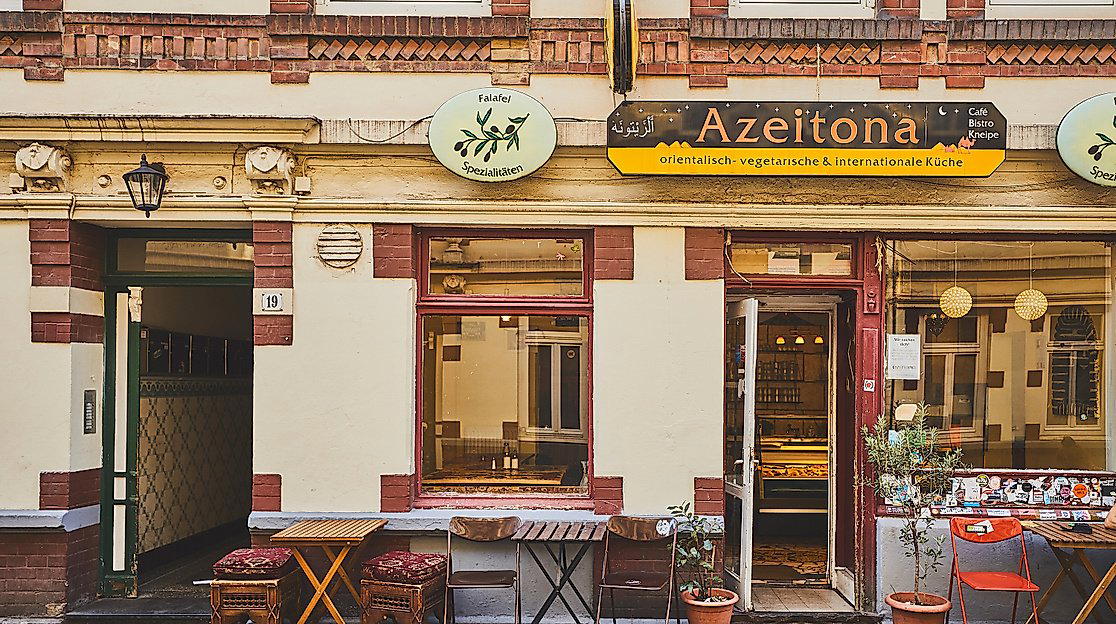
Beckstraße and the Schanzenviertel's Appetite for the Peripheral
Hamburg's Schanzenviertel has long operated as the city's pressure valve for restaurants that don't fit the harbour-facing fine-dining narrative. The streets around Schulterblatt and Beckstraße attract a different kind of operator: smaller rooms, less formal formats, and kitchens that draw from culinary traditions underrepresented at the waterfront. Portuguese and Iberian cooking belongs firmly in that category in Hamburg, a city whose restaurant conversation is dominated by creative tasting-menu formats at venues like The Table Kevin Fehling and Restaurant Haerlin, and by Scandinavian-adjacent modernism rather than Atlantic Peninsula tradition. Azeitona, on Beckstraße 17, occupies this less-trafficked corner of the city's dining map.
The name itself signals intent. Azeitona is the Portuguese word for olive, a staple that carries the weight of an entire culinary culture: preserved, brined, pressed into oil, served at the start of every meal from Lisbon to Porto. For Hamburg, where Mediterranean cooking at the formal end is more likely to read as modern Italian or French-inflected, a Portuguese-named address on a residential Schanzenviertel street represents a deliberate positioning away from the mainstream. Whether that positioning is backed by a focused kitchen programme or a broader pan-Iberian approach is something visitors will need to confirm on arrival, given the limited public record available for this address.
What Planning a Visit Actually Requires
The editorial angle here is worth stating plainly: Azeitona is an address that requires more pre-visit homework than most. The venue carries no publicly listed phone number, no website, and no searchable booking platform presence in the standard databases. That combination places it in a category of Hamburg restaurants that either operate on walk-in culture exclusively, rely on word-of-mouth reservation systems, or are in a transitional phase of their public profile. None of those scenarios is unusual for a Schanzenviertel address — the neighbourhood has always had a higher proportion of informal operators than, say, the Alster lakeside strip where Lakeside operates.
For visitors planning a Hamburg itinerary that includes Azeitona, the practical advice is to build in flexibility. If the venue operates on a walk-in basis, early evening arrival on a weekday will typically offer better odds than a Friday or Saturday peak. If a reservation system exists but sits outside the standard booking aggregators, a visit to the address in person during off-hours — or a direct approach through social media, is more productive than waiting for a booking link to appear. This is a different kind of planning problem than the one posed by Hamburg's high-demand tasting-menu counters, where lead times of four to eight weeks are common. At Azeitona, the challenge is information scarcity rather than seat scarcity.
Contrast this with the booking dynamics at Hamburg's established creative-format restaurants. 100/200 Kitchen and bianc both operate within well-documented reservation frameworks, with pricing structures and format details publicly available. For travellers used to that level of pre-visit clarity, Azeitona asks for a different posture: willingness to show up with less certainty, which is itself a reasonable expectation for a neighbourhood-scale restaurant on a residential street.
The Broader German Context for Iberian Cooking
To understand where an address like Azeitona sits, it helps to look at how Portuguese and Iberian cooking has fared across Germany's major restaurant cities. At the high end, the conversation is almost entirely French, Japanese, or modern German, with Michelin-recognised addresses from Schwarzwaldstube in Baiersbronn to Aqua in Wolfsburg operating within European frameworks that rarely intersect with Atlantic Peninsula traditions. Even in cities with stronger international dining cultures, like Berlin, where CODA Dessert Dining has built a reputation on an entirely different axis, or Munich, where JAN has drawn sustained recognition, Portuguese cooking remains a niche rather than a movement.
That makes Hamburg's Schanzenviertel a plausible home for an Iberian-inflected address precisely because the neighbourhood doesn't measure itself against the national fine-dining hierarchy. The Schanzenviertel rewards restaurants that read their immediate neighbourhood accurately, and a Portuguese-named address in a district with a high concentration of international residents and internationally-minded locals has a logical constituency.
For reference points further afield, the format question, how an Iberian or Mediterranean-inflected room should position itself in a European city, has been answered differently in different markets. Le Bernardin in New York City represents one answer at the absolute formal end of seafood-driven European cooking. Lazy Bear in San Francisco shows how a communal format can reframe expectations entirely. Neither is a direct comparator for a Schanzenviertel address, but both illustrate the range of solutions available when a kitchen commits to a clear identity and communicates it through format as well as menu.
Planning Practical Details
Azeitona's address is Beckstraße 17, 20357 Hamburg, placing it in the western Schanzenviertel, walkable from the Sternschanze S-Bahn and U-Bahn station in under ten minutes. The neighbourhood is dense with restaurant and bar options, so a visit to Azeitona can sit naturally within a broader Schanzenviertel evening that takes in the district's street-level energy before or after the meal. Given the absence of a listed website or phone number, potential visitors should approach planning with the assumption that the most reliable current information will come from in-person enquiry or social media channels rather than from aggregator platforms. No dress code, pricing structure, or hours data is available in the public record, so arriving with flexible expectations on all of those dimensions is advisable. For Hamburg's wider restaurant context, the EP Club Hamburg restaurants guide covers the full range from neighbourhood addresses to the formal tier, including venues like ES:SENZ, Schanz, Waldhotel Sonnora, and Bagatelle for broader German fine-dining context.
Frequently asked questions
Where is Azeitona in Hamburg?
Azeitona is located at Beckstraße 17, 20357 Hamburg, Germany, Hamburg.
Is Azeitona in Hamburg a good option for Portuguese cuisine in Germany?
Portuguese cooking has found only a thin foothold in Germany's urban restaurant culture compared to other Iberian traditions, making Schanzenviertel's Azeitona at Beckstraße 17, Hamburg, one of a small number of addresses working in this category in the city.
What do people recommend at Azeitona?
The address on Beckstraße 17 in Hamburg's Schanzenviertel draws visitors interested in Portuguese and Iberian cooking outside the city's harbour-facing restaurant circuit. Arriving with an open approach to the kitchen's current direction is the practical way to go.
How far ahead should I plan for Azeitona?
Azeitona holds no publicly listed booking channel, phone number, or website, which makes advance planning harder than for most Hamburg addresses. The Schanzenviertel is a dense dining neighbourhood where smaller rooms fill quickly on weekends. Arriving early or making contact through the venue directly in person is the most reliable approach until booking details become publicly documented.
What's Azeitona best at?
Azeitona occupies a specific gap in Hamburg's restaurant scene: Iberian and Portuguese cooking in the Schanzenviertel, a neighbourhood that has consistently supported restaurants working outside the city's mainstream fine-dining format. Portuguese cuisine remains genuinely underrepresented across Germany's major cities relative to Spanish and Italian traditions, which gives an address like this a clear positional reason to exist.
Similar Picks
A quick peer list to put this venue’s basics in context.
| Venue | Cuisine | Price | Awards | Notes |
|---|---|---|---|---|
| AzeitonaThis venue — the venue you are viewing | Lebanese Vegetarian Falafel | $10–20 | Not listed | Not listed |
| The Table Kevin Fehling | Avant-Garde Fusion Fine Dining | $200–300 | 3 Michelin Stars · La Liste Top Restaurants | Creative |
| bianc | Modern Mediterranean Fine Dining | $200–300 | 2 Michelin Stars · La Liste Top Restaurants | Modern Mediterranean, Mediterranean Cuisine |
| Lakeside | Modern European Fine Dining | $200–300 | 2 Michelin Stars · La Liste Top Restaurants | German Lakeside |
| Heimatjuwel | Modern Regional German Vegetarian Fine Dining | Not listed | 1 Michelin Star · We're Smart World 3 Radishes | German, Creative |
| Landhaus Scherrer | Michelin-Starred North German Fine Dining | $150–200 | 1 Michelin Star · Star Wine List | Modern European, Classic Cuisine |