
Awaji Okina places rural soba culture at the centre of an Awaji meal, with buckwheat noodles served in a low-capacity house setting in the island’s Oda area. Its selection for Tabelog 100 Soba WEST 2025 gives the room a clear credential, but the appeal is broader: this is a modestly priced, ingredient-led counterpoint to Awaji’s higher-spend sushi and seafood addresses.
Pearl is the En Primeur Club membership app — saves, bookings, and concierge access live there. Same editors, same standards.
- Address
- 1157 Oda, Awaji, Hyogo 656-1732, Japan
- Phone
- +81 799-70-4201
- Website
- awajiokina.com
 Saves & bookings on Pearl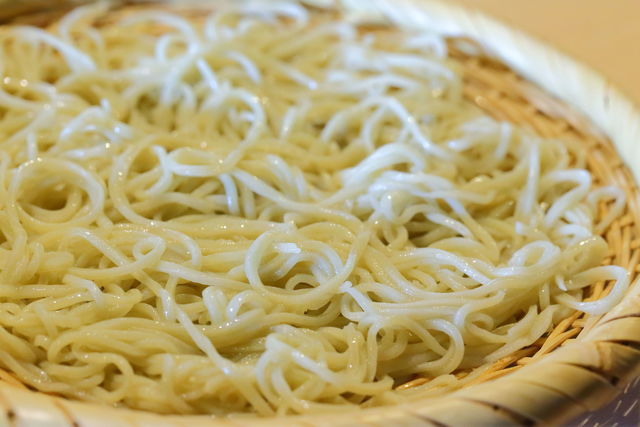
Awaji soba is shaped by the island before the bowl. Inland roads climb from the coast, the pace slows, and the meal feels less like a sightseeing stop than a reminder that Japanese noodle culture belongs to rural craft as much as city queues. Awaji Okina clarifies a particular value: small room, short service window, buckwheat as the point, and an ocean-view mountain setting tied to place rather than spectacle.
Awaji dining is often read through seafood, onions, beef, and destination sushi, making soba a quieter but revealing lens. Buckwheat noodles reward restraint: flour quality, water, cutting, boiling, and timing matter more than ornament. The category shows how regional Japan eats well outside luxury formats. A soba meal can remain modest while demanding the discipline high-end counters turn into theatre. The island’s premium end includes sushi at places such as Sushiya Nobu, while Awaji Okina sits in a more everyday bracket without feeling casual in craft.
Awaji soba works because the ingredient has nowhere to hide
Visitors often misread soba as a simple noodle lunch. In serious shops, it is a test of sourcing and handling. Buckwheat has less elasticity than wheat, so the maker has fewer ways to hide weak flour, uneven hydration, or imprecise cutting. Minimalism is not an aesthetic pose; it is a technical constraint. Dipping sauce, hot broth, or sake can frame the meal, but texture and aroma remain the argument.
Awaji Okina’s recognition matters. Inclusion in Tabelog 100 Soba WEST 2025 places it on a regional list devoted to buckwheat noodle houses, not a general restaurant ranking. Soba specialists are judged against other soba specialists, not tasting-menu restaurants, hotel dining rooms, or seafood counters. The accolade signals category credibility, and the Tabelog score of 3.53 adds a public benchmark in a market where local diners reward consistency over novelty.
The sourcing angle fits Awaji. The island sits between Honshu and Shikoku and has long traded on agricultural identity as much as coastline. Ingredient-led dining here does not need luxury language; it needs clarity about what is being served and why the place matters. Soba provides that clarity, keeping the kitchen’s focus narrow and giving travellers a meal connected to rural Hyogo without a long tasting format.
A small house restaurant in a larger island dining circuit
The room’s scale shapes expectations. With 18 seats, around one large table and two four-seat tables, this is not a long, lingering restaurant built on multiple courses and wine pairings. It belongs to the Japanese tradition of destination noodle shops where timing, turnover, and appetite align. Listed as a house restaurant with an ocean view, it reads differently from an urban soba counter: the craft is compact, while the geography frames the experience.
That smallness affects planning. Reservations are unavailable, so treat the meal as part of a daytime Awaji route rather than a formal evening anchor. The shop opens for lunch only and closes on Mondays, with public-holiday substitutions noted. Arrive flexibly, expect demand within a narrow window, and build the day around the island rather than a late seating. Parking for 10 or more vehicles matters where a car remains the natural access mode.
Against higher-spend island dining, the value equation is direct. Awajishima Nobu sits in a sushi bracket around JPY 20,000 to JPY 29,999, while nearby drinking and casual formats such as Tachinomi Dokoro Donbee and Tachinomi Dokoro Tanakaya occupy lower evening ranges. The restaurant is different again: lunch-focused, soba-specific, and priced for a short, ingredient-centred meal. It suits travellers wanting one serious local food experience without turning the day into a reservation campaign.
How to place it within an Awaji itinerary
Awaji rewards travellers who do not treat every meal as a trophy booking. The island’s appeal is cumulative: coastal roads, farmland, seafood markets, family-friendly restaurants, and small specialist rooms that need a day with room to breathe. Soba fits because it is precise but not heavy. It can sit before an afternoon drive, after a morning coastal stop, or as a counterweight to a richer dinner elsewhere.
Families should note that children are welcomed, including babies, preschoolers, and school-age children. Private rooms are unavailable, and the restaurant is non-smoking, so the format is open-room and low fuss rather than secluded. Payment is easier than at many rural specialists: major credit cards, transportation IC cards, iD, QUICPay, and PayPay are accepted. The official access note is practical on Awaji: search by address rather than phone number in car navigation, since some systems can misdirect drivers toward nearby farmland.
For planning, pair this stop with the full Awaji restaurants guide, then build the rest of the trip through Awaji hotels, Awaji bars, Awaji wineries, and Awaji experiences. Readers comparing Japanese regional formats beyond the island can also scan -Grilled beef Sukiyaki- KAMAKURA TANUKIAN 鎌倉 たぬき庵 in Kamakura, . 鮪と炭火焼き うお炭 秋葉原店 in Tokyo, .cafe in Osaka.know in Kumamoto, (Shoku) Vietnam in Kawasaki, [Curry Senmon Ten] Maruyama Kyoju. in Sapporo, [ki:] in Kyoto, #肉といえば松田 奈良本店 in Kashihara, 1/3 HAMBURGER FACTORY in Kanazawa, 1000 in Yokohama, Jōdo Saké Bar in Los Angeles, and Onigiri Time in Pasadena.
Quick Comparison
Comparable venues by cuisine and price in the same metro.
| Venue | Cuisine | Price | Notes |
|---|---|---|---|
| Awaji OkinaThis venue — the venue you are viewing | Traditional Soba Specialty Shop | $$ | Not listed |
| Sushiya Nobu | Awaji Island Omakase Sushi | $$$$ | Awaji City |
| Boteyan (ぼてやん多奈加) | Square Okonomiyaki Specialist | $$ | Toyama Station area |
| Jiyuken | Japanese Izakaya with Western Fusion | $$ | Motomachi |
| レストラン横倉 | Western-Japanese Ski Resort Fare | $$ | Zao Onsen |
| Maruyoshi Shokudo | Traditional Miyako Soba | $$ | Gusukube |
Recognition history
Dated appearances from independent guides and award organizations, with the underlying list record or original source where available.
Tabelog 100 #25 · No. 25
Tabelog · Tabelog 100 - Soba - WEST - 2025
Continue exploring
More in Awaji
Restaurants in Awaji
Browse all →
Hotels in Awaji
Browse all →
Wineries in Awaji
Browse all →
At a Glance
- Quiet
- Classic
- Cozy
- Solo
- Date Night
- Casual Hangout
- Standalone
Current opening hours
- Monday
- Closed
- Tuesday
- 11 AM–2 PM
- Wednesday
- 11 AM–2 PM
- Thursday
- 11 AM–2 PM
- Friday
- 11 AM–2 PM
- Saturday
- 11 AM–2 PM
- Sunday
- 11 AM–2 PM
Hours can change for holidays and private events. Last verified .
Calm and understated, with a simple, classic soba-ya feel focused on the food rather than décor; a quiet atmosphere suited to savoring handmade noodles in peace.