Tabelog 100 #22
Our verdict
AJANTA gives Tokyo’s Indian dining history a rare long view: a Kojimachi address tied to South Indian cooking, curry culture, vegetarian options, and a postwar opening date that predates the city’s current specialist boom. Its repeated Tabelog 100 selections place it in a competitive ethnic-cuisine tier rather than a novelty category.

Pearl is the En Primeur Club membership app, where members save venues, book tables and use the concierge.
The menu
What to order
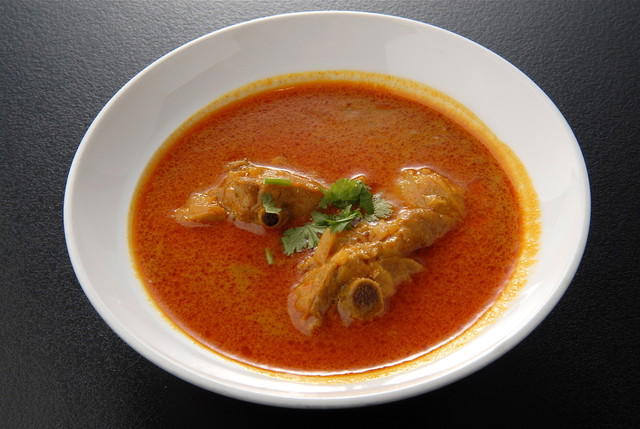
- Mutton Curry
- Chicken Curry
- Keema Curry / Keema Matar
- Non-Vegetarian Thali
Approaching Kojimachi, the mood is more administrative Tokyo than restaurant theatre: office blocks, embassy-adjacent calm, and the clipped rhythm of a district that eats around workdays rather than nightlife. That setting matters. Indian dining in Tokyo is often pulled in two directions, casual curry lunch on one side and polished tasting-menu ambition on the other. AJANTA belongs to an older lane, where the measure is continuity, range, and a kitchen’s ability to make Indian curry feel embedded in the city rather than imported as a trend.
Tokyo’s appetite for curry has never been narrow. Japanese curry shops, hotel Indian rooms, Nepalese-run neighbourhood restaurants, and regional Indian specialists all occupy different price and expectation bands. The serious question for a traveller is not simply where to find spice, but which version of the city’s curry culture a room represents. This one is notable because it connects Indian and Indian-curry categories with a long operating history: its opening date is listed as 1957, giving it a longer arc than many of the capital’s current ethnic-cuisine names.
South Indian roots in a city fluent in curry
South Indian cooking carries a different grammar from the butter-chicken shorthand that still defines much international Indian dining. Rice, lentils, vegetables, fermented batters, coconut, tamarind, and layered heat sit closer to the centre of the tradition. Tokyo diners have become far more literate in those distinctions, but the city’s older Indian rooms helped build that literacy before regional specificity became a selling point.
The relevant credential here is not a celebrity chef narrative. It is the restaurant’s place inside a category that Tabelog separates from general fine dining: Asian cuisine and ethnic cuisine. Selection for Tabelog 100 in that field in 2024, along with prior appearances in Asian, ethnic, and curry categories, signals a restaurant judged against Tokyo’s specialist kitchens rather than against hotel dining rooms or luxury omakase counters. A Tabelog score of 3.68 also places it in the serious enthusiast tier, where Japanese diners tend to reward consistency, value, and category authority over spectacle.
The vegetarian note is worth taking seriously. Tokyo can be difficult for plant-led dining when broths, stocks, and hidden animal products enter the conversation, but Indian cooking offers a deeper vegetarian framework than many local restaurant categories. AJANTA lists vegetarian options and a vegetable focus, which makes it more relevant for mixed groups than a narrow meat-led curry counter. That does not turn the experience into wellness dining; it simply reflects a cuisine with a long vegetarian repertoire.
What the recognition says about the room
Tabelog’s Hyakumeiten lists are useful in Japan because they often identify genre strength rather than international glamour. For travellers accustomed to Michelin-led planning, that distinction matters. A repeated Tabelog 100 selection in curry or Asian and ethnic cuisine points to local-market credibility: the kind of place Japanese diners file under reliable, category-defining, and worth crossing a few train stops for, not necessarily the kind designed for overseas press photography.
In the immediate comparison set, that puts the restaurant in a different bracket from SOLEIL, No.4, or Petit A La Campagne, where the price bands and genre cues point elsewhere in Tokyo’s casual-dining field. Unagi Akimoto, with a higher listed spend, belongs to another Japanese tradition entirely. The useful comparison is structural: Tokyo lets modestly priced specialist restaurants sit beside much more expensive heritage formats, and local rating culture often treats both with equal seriousness when they execute their category well.
The drink data also suggests a Japanese dining-room adaptation rather than a purist transplant. Sake, shochu, wine, and cocktails appear alongside Indian and curry categories, which is typical of Tokyo’s more flexible ethnic restaurants. The city often absorbs foreign cuisines by pairing them with local drinking habits and group-dining needs. That can soften edges in less disciplined rooms; in stronger ones, it makes the cuisine easier to fold into everyday Tokyo eating without reducing it to lunch-counter utility.
For a wider read on the city, place this stop beside the breadth of Our full Tokyo restaurants guide, then compare the way dining culture intersects with Our full Tokyo hotels guide, Our full Tokyo bars guide, Our full Tokyo wineries guide, and Our full Tokyo experiences guide. Tokyo’s range is the point: a curry room in Kojimachi, a yakitori address such as 124. KAGURAZAKA (Yakitori), a Shinjuku specialist like 12/10 Shinjuku ten, and an Akihabara grill such as. 鮪と炭火焼き うお炭 秋葉原店 all speak to different versions of precision.
How to read it against Japan's wider dining map
Japan’s restaurant culture is unusually good at preserving specialisation. Curry has its own fan base, its own ranking logic, and its own geography, from Tokyo business districts to Sapporo counters and Kansai hybrids. A traveller using AJANTA as a reference point can then read related categories with more nuance: 3 Chome no Curry Ya San for another Tokyo curry address, [Curry Senmon Ten] Maruyama Kyoju. in Sapporo for a northern specialist, or (Shoku) Vietnam in Kawasaki for the way regional Asian cuisines sit in the broader urban orbit.
The same map extends beyond curry. 2D Cafe shows Tokyo’s appetite for visual formats, while -Grilled beef Sukiyaki- KAMAKURA TANUKIAN 鎌倉 たぬき庵 in Kamakura and [ki:] in Kyoto pull the lens toward older Japanese dining codes. Farther out.cafe in Osaka.know in Kumamoto, Jōdo Saké Bar in Los Angeles, and Onigiri Time in Pasadena show how Japanese and Asian dining references travel, mutate, and return in different forms.
The practical reading is simple: this is not the Tokyo meal for ceremony, counter silence, or luxury pacing. It is a category meal with historical weight, vegetarian usefulness, and local recognition in a city that takes curry far more seriously than outsiders often assume. For travellers building a dining schedule around sushi, kaiseki, tempura, and bars, a Kojimachi Indian table adds context. It shows how Tokyo absorbs foreign foodways, keeps them in daily rotation, and then judges them with the same obsessive categorisation it applies to ramen or unagi.
Frequently asked questions
What does dinner at AJANTA typically cost?
Pricing at AJANTA is listed as JPY 3,000 - JPY 3,999 JPY 1,000 - JPY 1,999.
When is AJANTA open?
Hours at AJANTA: Mon: 10 AM–10:30 PM; Tue: 10 AM–10:30 PM; Wed: 10 AM–10:30 PM; Thu: 10 AM–10:30 PM; Fri: 10 AM–10:30 PM; Sat: 10 AM–10:30 PM; Sun: 10 AM–9:30 PM.
What part of town is AJANTA in?
AJANTA is located in Tokyo.
What's AJANTA best at?
AJANTA is strongest on Indian curry with South Indian roots, plus vegetarian options, which fits its Tabelog 100 selection for Tokyo Asian cuisine / Ethnic cuisine in 2024. The Kojimachi restaurant has operated since 1957, and its price range runs from JPY 1,000–JPY 1,999 at lunch to JPY 3,000–JPY 3,999 at dinner.
Where It Fits
Comparable venues to anchor price and recognition.
| Venue | Cuisine | Price | Awards | Notes |
|---|---|---|---|---|
| AJANTAThis venue (the venue you are viewing) | Long-established Pure Indian Curry House | $20–30 | Tabelog 100 #22 | Not listed |
| KHAN KEBAB BIRYANI | Halal Indian & Pakistani Curries, Kebabs and Biryani | $20–30 | Tabelog 100 #96 | Chūō |
| MarieIranganee | Sri Lankan Curry | $20–30 | Tabelog 100 #69 | Shibuya |
| spice kitchen moona | Spice-driven Indian & Asian curry bar | $20–30 | Tabelog 100 #11 | Setagaya |
| Spicy Curry House Ginza Hangetsu | Indian Curry House | $1–10 | Tabelog 100 #14 | Chūō |
| raffles curry | Indian Curry | $10–20 | Tabelog 100 #37 | Taitō |
Recognition history
Dated appearances from independent guides and award organizations, with the underlying list record or original source where available.
Tabelog 100 #22 · No. 22
Tabelog · Tabelog 100 - Asian cuisine / Ethnic cuisine - TOKYO - 2024