
Tabelog 100 #14
Our verdict
Ginza’s curry counter culture operates on speed, compact rooms, and sharper value than the district’s luxury reputation suggests. Spicy Curry House Ginza Hangetsu fits that lane: a 13-seat curry and Indian curry address selected for Tabelog Curry TOKYO 100 in 2023 and 2024, with lunch and dinner budgets in the JPY 1,000–1,999 range.

Pearl is the En Primeur Club membership app, where members save venues, book tables and use the concierge.
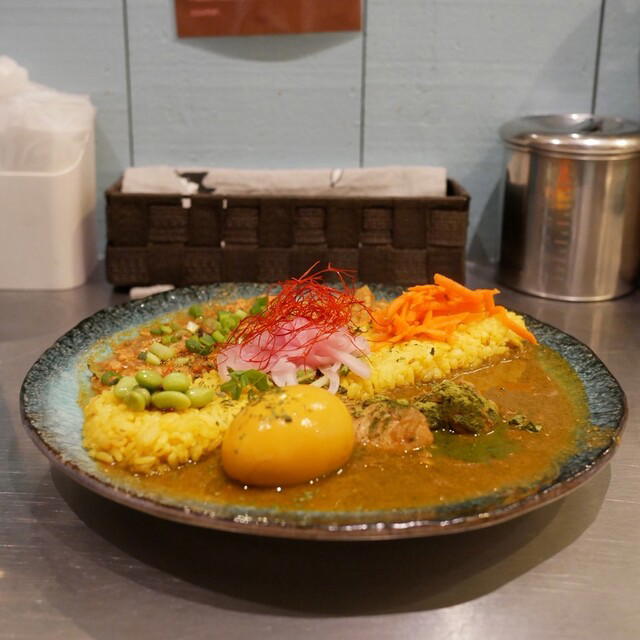
Tokyo’s polished retail blocks can make casual eating feel like an afterthought, but the better curry rooms in the city work by compression: small footprints, quick turnover, and menus that tell diners exactly what the kitchen wants them to order. Spicy Curry House Ginza Hangetsu belongs to that compact category rather than the ceremonial Tokyo dining circuit. The signal is not luxury theater; it is a focused curry address, curry and Indian curry as the stated categories, and a price band that keeps the meal closer to an everyday Tokyo lunch than an expense-account dinner.
That contrast matters. Tokyo is often framed through sushi counters, kappo rooms, and department-store dining floors, yet curry has its own local hierarchy, with specialist shops judged on consistency, spice structure, rice balance, and service rhythm. Recognition in the 2024 Tabelog Hyakumeiten context places Hangetsu inside that specialist conversation. The Tabelog score of 3.75 gives another useful signal: this is not simply a general-purpose curry stop drifting on convenience, but a small-format address with enough repeat attention to sit among Tokyo’s recognized curry rooms.
A compact curry menu in a district built for longer meals
Menu architecture is the point here. Tokyo curry shops often reveal their priorities through restraint: fewer categories, a defined spice lane, and service designed around a small number of choices rather than a sprawling list. Hangetsu’s public categorization as curry and Indian curry puts it in the city’s hybrid zone, where Japanese curry culture meets South Asian spice vocabulary without becoming a full Indian restaurant format. That middle ground is one reason Tokyo curry remains more interesting than its casual price tag suggests.
In Tokyo, that structure reads differently than it would in a purely student-oriented or transit-only setting. The surrounding dining culture often rewards high ceremony, but curry at this scale rewards decisiveness. A compact room changes the meal’s tempo: diners arrive, choose, eat, and move on. For travelers mapping Tokyo by category, this is a useful corrective to the idea that the city’s best meals only work through expensive reservations. Tokyo also has casual specialists that trade on focus rather than plushness.
The price band sharpens that argument. Lunch and dinner sit at JPY 1,000–1,999, which makes the experience accessible by Tokyo standards. The key comparison is not with omakase counters such as Sushi Taichi or Ginza Sushi Ko Honten, where the format and spend follow a different social script. It is with other tightly defined single-category rooms: soba specialists, curry counters, ramen shops, and yakitori rooms where the value lies in repetition and control.
What the recognition says about Tokyo curry now
Tabelog’s specialist recognition is useful because it separates curry from the broader restaurant awards conversation. Michelin-style recognition often favors service structure, wine programs, and tasting-menu ambition; curry rankings reward a more democratic form of obsession. A shop can be small, casual, and inexpensive while still drawing serious attention from local diners. That dynamic is central to Tokyo’s food culture: excellence is not tied to tablecloths, and price is not a clean proxy for discipline.
Hangetsu also sits within a changing generation of Tokyo curry shops rather than needing to be understood through old-guard dining alone. The city’s curry scene has become more fragmented: Japanese-style curry, spice curry, Indian-influenced curry, soup curry, and regional interpretations now compete within the same search category. In that context, a Tokyo shop recognized in 2024 has cleared a meaningful local filter.
There is a practical editorial point for visitors: this is a category meal, not an all-purpose destination dinner. It makes sense when the day is built around Tokyo and when the desired meal is focused rather than leisurely. It is less suited to diners seeking private rooms, a long tasting format, or a reservation-led evening. The focused format is part of the appeal and part of the constraint.
How to place it in a Tokyo itinerary
Tokyo rewards planning by food category rather than by prestige alone. A strong trip might include a sushi counter, a yakitori room, a soba stop, and a curry specialist, each judged by different rules. Within Tokyo, Hangetsu adds the curry slot without requiring the day to be organized around a formal dining reservation. Treat it as a focused specialist stop: quick, category-specific, and best understood on its own terms rather than as a substitute for a long evening meal.
For a wider restaurant map, use Our full Tokyo restaurants guide. Nearby or category-adjacent reading can include other Tokyo curry rooms, soba specialists such as Ginza Kagari - Soba, sushi counters such as Ginza Sushi Ko Honten and Sushi Taichi, and other focused Tokyo dining rooms. For broader Tokyo planning beyond restaurants, see our full Tokyo hotels guide, our full Tokyo bars guide, our full Tokyo wineries guide, and our full Tokyo experiences guide.
Readers comparing Japanese dining categories beyond this specific curry stop can also think in broader terms: focused casual formats, specialist counters, and compact kitchens are not limited to one city or one cuisine. For Japanese food culture abroad, similarly focused formats can show how narrow concepts translate outside Japan without needing the same local dining context.
Frequently asked questions
What's Spicy Curry House Ginza Hangetsu's location?
Tokyo.
How much does it cost to eat at Spicy Curry House Ginza Hangetsu?
Pricing at Spicy Curry House Ginza Hangetsu is listed as JPY 1,000 - JPY 1,999 JPY 1,000 - JPY 1,999.
Can I walk in to Spicy Curry House Ginza Hangetsu?
Plan for a focused, casual curry meal rather than a long reservation-led evening. Its 2024 Tabelog Hyakumeiten recognition can make it a popular specialist stop.
What is Spicy Curry House Ginza Hangetsu known for?
Spicy Curry House Ginza Hangetsu is known for curry and Indian curry in Tokyo, with a Tabelog score of 3.75 and 2024 Tabelog Hyakumeiten recognition.
Style and Standing
Comparable venues to anchor price and recognition.
| Venue | Cuisine | Price | Awards | Notes |
|---|---|---|---|---|
| Spicy Curry House Ginza HangetsuThis venue (the venue you are viewing) | Indian Curry House | $1–10 | Tabelog 100 #14 | Not listed |
| BLOCK HOUSE Suiyou Curry | Creative Indian-style curry house (Wednesday-only) | $20–30 | Tabelog 100 #62 | Shibuya |
| Minami Indian Nandori | South Indian Meals & Tiffin | $20–30 | Tabelog 100 #97 | Arakawa |
| negombo33 Kouenji | Indian-style curry & café | $10–20 | Tabelog 100 #55 | Suginami |
| Ooiwa Shokudo | South Indian curry & Sri Lankan-style spice dishes | $20–30 | Tabelog 100 #79 | Suginami |
| KHAN KEBAB BIRYANI | Halal Indian & Pakistani Curries, Kebabs and Biryani | $20–30 | Tabelog 100 #96 | Chūō |
Recognition history
Dated appearances from independent guides and award organizations, with the underlying list record or original source where available.
Tabelog 100 #14 · No. 14
Tabelog · Tabelog 100 - Curry - TOKYO - 2024
Continue exploring
More in Tokyo
Restaurants in Tokyo
All restaurants in Tokyo →
Bars in Tokyo
All bars in Tokyo →
Details
- Cozy
- Modern
- Intimate
- Solo
- Casual Hangout
- After Work
- Standalone
- Beer Program
- Street Scene
- A La Carte
- Beer
- Vegetarian Friendly
A cozy, modern, hidden-gem atmosphere with a small counter-focused layout and an understated backstreet location in Ginza.