
Tabelog 100 #100
Our verdict
き田たけ うどん sits in Naniwa Ward, a part of Osaka that takes udon seriously at street level rather than in formal dining rooms. The kitchen operates within a broader Osaka tradition that prizes dashi clarity and noodle texture over spectacle. For travellers mapping the city's noodle culture, it belongs on the same circuit as the neighbourhood's everyday institutions.

Pearl is the En Primeur Club membership app, where members save venues, book tables and use the concierge.
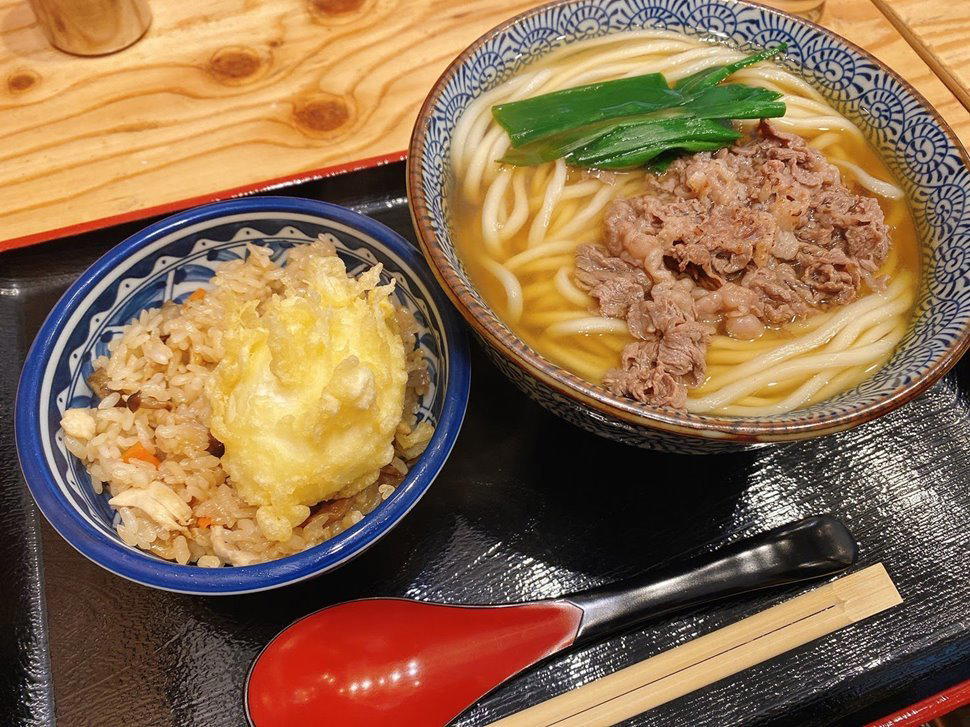
The menu
What to order
- Chikuwa-tama-ten-bukkake udon
- Aburi niku bukkake
- Ebi ten
- Tori hiyashi
Naniwa Ward and the Discipline of the Bowl
There is a particular kind of Osaka eating that happens without ceremony: a counter, a ceramic bowl, a broth built over hours, and a queue that tells you everything you need to know before you walk through the door. Naniwa Ward has long been home to this format. The neighbourhood sits south of Shinsaibashi and carries none of the tourist density of Dotonbori, which means its restaurants operate for a local clientele that returns regularly and holds standards accordingly. き田たけ うどん, addressed at 2 Chome-4 Nanbanaka, is embedded in that environment, a shop that functions as a neighbourhood institution rather than a destination engineered for outside audiences.
Udon in Osaka occupies a different register than the thick, firm Sanuki style associated with Kagawa Prefecture or the chewy, wheat-forward bowls of Tokyo's more recent specialist wave. Osaka dashi tradition leans lighter: kombu-forward, restrained in saltiness, built to carry the noodle rather than compete with it. The city's udon culture has historically prized the broth as the primary event, with toppings kept functional rather than decorative. き田たけ うどん operates within that grammar, in a part of the city where that grammar is still the default.
Sustainability as Structural Logic, Not Marketing Language
The conversation around food sustainability in Japan often centres on fine dining operations, where sourcing narratives are built into tasting menu commentary and seasonal rotation is announced as a virtue. But the structural sustainability of traditional Japanese noodle culture predates that conversation by centuries. Udon, at its core, is a format designed around minimal waste: the dashi base is drawn from kombu and katsuobushi that can be repurposed (dashi-gara makes an excellent tsukudani), noodles are made to specification and portioned tightly, and the menu depth is kept narrow enough that ingredient waste is structurally limited.
In a neighbourhood like Naniwa Ward, where shops operate on thin margins and high daily turnover, waste reduction is not an ethical position, it is an economic requirement that happens to align with environmental logic. A kitchen running a focused udon menu has less room for spoilage than a multi-course operation with a broad mise en place. The discipline of the format enforces a kind of built-in efficiency that larger, more elaborate kitchens have to engineer deliberately. This is the sustainability argument that rarely gets articulated for everyday Japanese noodle shops, precisely because it doesn't require articulation: it's baked into the operating model.
Sourcing within this format is similarly constrained by tradition. Osaka's udon dashi depends on quality kombu, historically from Hokkaido, traded down through the old konbu-kaido routes that made Osaka a distribution hub for centuries. That supply chain relationship between Osaka kitchens and northern Japanese kelp producers is one of the longer-standing food-system partnerships in Japan's culinary geography. A shop drawing on those materials is participating in a supply structure with deep regional roots, even if no one is writing it on a chalkboard above the counter.
Where き田たけ うどん Sits in Osaka's Noodle Tier
Osaka's noodle scene has two broad tiers: the casual counter, where a bowl lands in under three minutes and the price sits well below 1,000 yen for most orders, and the specialist shop, where the dashi has a named provenance, the noodle thickness is a deliberate choice, and the queue extends outside the door by 11:30 on weekday mornings. き田たけ うどん addresses in Naniwa Ward position it in the latter category, this is not a chain outpost or a convenience-format bowl, but a dedicated shop in a neighbourhood that sustains dedicated shops.
For context on the Osaka dining range: the city's high end extends to kaiseki and contemporary French operations including HAJIME in Osaka and the kaiseki tradition represented by venues like Ajikitcho Bunbuan, while the mid-range is occupied by standing bars, kushikatsu counters, and specialist noodle shops. き田たけ うどん operates in the specialist noodle segment, which sits between convenience-format eating and the structured omakase tier. Across the broader Kansai region, the same noodle-first seriousness appears at Gion Sasaki in Kyoto and extends further in specialist formats across Japan from Harutaka in Tokyo to Goh in Fukuoka.
Within Osaka's own restaurant circuit, the noodle category sits alongside the kushikatsu and teppanyaki traditions as a primary local identifier. Venues like Ajihei Sonezaki, Aka to Shiro, Az, and Calendrier represent the city's more formal dining current, but the everyday eating culture that actually defines Osaka's reputation is carried by neighbourhood specialists like this one. The same is true of regional counterparts including akordu in Nara and destination venues further north such as 三本杉 川島製 in Nanao, 夕佳亭乃 in Sapporo, and 湖隣庵 in Takashima, each of which demonstrates how Japan's most durable food formats persist through regional specificity rather than national standardisation.
The Naniwa Context
Naniwa Ward is worth understanding before arriving. It is not a tourist district in the way that Dotonbori or the Shinsekai area draw foot traffic, which means the streets immediately around き田たけ うどん's address on Nanbanaka run primarily for commuters and locals. The nearest major rail access is Namba Station, served by multiple lines including the Osaka Metro Midosuji Line. From Namba, the ward is walkable in under ten minutes depending on the specific street. This positioning, adjacent to a major transit hub but slightly removed from the retail and restaurant clusters that surround it, is precisely the kind of location that sustains a neighbourhood-facing specialist. The rent structure allows a shop to focus on the bowl rather than the foot traffic conversion economics that shape Dotonbori menus. For restaurants with a similar relationship to their immediate geography, the Birdland in Sakai and 庄羽屋 in Nishikawa Machi offer useful comparative reference points for how Japan's mid-city specialists position themselves outside central tourist corridors.
The broader Osaka dining picture, including the full range from neighbourhood specialists to multi-Michelin operations, is documented in our full Osaka Shi restaurants guide. For those building a multi-city Kansai itinerary, cross-referencing Osaka's noodle and everyday dining culture against Kyoto's more formal kaiseki circuit gives a sharper picture of how the two cities divide the region's culinary identity between them.
Know Before You Go
- Address: 2 Chome-4 Nanbanaka, Naniwa Ward, Osaka, 556-0011, Japan
- Access: Namba Station (Osaka Metro Midosuji Line and multiple other lines) is the closest major rail hub; the ward is walkable from the station
- Format: Neighbourhood udon specialist; expect counter or table seating in a compact space
- Booking:; walk-in is the standard approach for this category of Osaka noodle shop
- Leading timing: Arrive at or before the lunch opening to avoid queues; mid-afternoon visits typically see shorter waits
- Price tier: Consistent with Osaka's neighbourhood udon market; expect accessible pricing well below the city's formal dining bracket
- Phone/Website:
Is き田たけ うどん reservation-only?
This is consistent with the broader casual-specialist tier in Naniwa Ward, where the turnover pace is fast enough that reservations are rarely necessary. Arriving at or just before the opening hour remains the practical strategy for avoiding a wait, particularly at lunch.
What is the signature at き田たけ うどん?
In the Osaka udon category broadly, the dashi-forward broth is always the structural signature, the noodle and toppings are in service of it. For this shop specifically, the strongest guide is the menu itself on arrival, or the dishes that appear most frequently on local review platforms in Japanese.
Can き田たけ うどん adjust for dietary needs?
Traditional Japanese udon dashi is typically made with katsuobushi (bonito flake), which means the base broth is not vegetarian by default. Osaka's broader dining scene, including Le Bernardin in New York City and Atomix in New York City, shows that even tightly formatted operations often accommodate dietary needs when given advance notice.
How does き田たけ うどん compare to other udon shops in Naniwa Ward?
Naniwa Ward supports a cluster of udon and noodle specialists that serve a predominantly local clientele, which means the competitive standard is set by repeat customers rather than tourist traffic. き田たけ うどん's address on Nanbanaka places it within walking distance of Namba's transit hub while remaining outside the higher-footfall corridors that tend to dilute kitchen focus. Within Osaka's noodle tier, this positioning is associated with shops that maintain consistent dashi quality and noodle craft across daily service rather than engineering for first-impression impact.
Frequently asked questions
Where is き田たけ うどん in Osaka Shi?
き田たけ うどん is located at 2 Chome-4 Nanbanaka, Naniwa Ward, Osaka, 556-0011, Japan, Osaka Shi.
Is き田たけ うどん worth visiting if you're staying near Dotonbori?
き田たけ うどん is located at 2 Chome-4 Nanbanaka in Naniwa Ward, which sits adjacent to the Namba area but draws a predominantly local clientele rather than the tourist crowds concentrated around Dotonbori. That separation matters: the competitive standard at Naniwa Ward counters is set by repeat neighbourhood customers, not visitor expectations. Guests willing to walk a few minutes past the main tourist corridor will find a more grounded version of Osaka's udon eating culture.
Is き田たけ うどん reservation-only?
The neighbourhood udon format in Osaka's Naniwa Ward operates almost universally on a walk-in basis, serving a local clientele rather than tourist foot traffic. Arriving at off-peak hours is the practical strategy for avoiding a queue.
What's the signature at き田たけ うどん?
In the Osaka udon category, the dashi broth is structurally the defining variable, lighter and more restrained than Kagawa-style udon, and that holds true for counters operating in Naniwa Ward. The noodle gauge and broth seasoning at any given shop are what distinguish one address from the next.
Can き田たけ うどん adjust for dietary needs?
Traditional Osaka udon dashi is built on katsuobushi (bonito flakes) and kombu, making it unsuitable for vegetarians without specific substitution.
Quick Comparison
Comparable venues nearby, for context on price, style, and recognition.
| Venue | Cuisine | Price | Awards | Notes |
|---|---|---|---|---|
| き田たけ うどんThis venue (the venue you are viewing) | Traditional Udon | $10–20 | Tabelog 100 #100 | Not listed |
| Yoshino Sushi | Traditional Osaka Hakozushi | $10–20 | Not listed | Chūō |
| 老松喜多川 | Traditional Kaiseki Omakase | $150–200 | 1 Michelin Star | Kita |
| Yomogi | Elegant Japanese Udon with Kaiseki Influences | $50–100 | Michelin Bib Gourmand | Fukushima |
| Usamitei Matsubaya | Historic Osaka Udon & Soba Shop | $10–20 | Tabelog 100 #15 | Chūō |
| 本湖月 | Traditional Kaiseki | $500+ | La Liste Top Restaurants · Tabelog Chef's Gold #4 | Chūō |
Recognition history
Dated appearances from independent guides and award organizations, with the underlying list record or original source where available.
Tabelog 100 #100 · No. 100
Tabelog · Tabelog 100 - Udon - WEST - 2024
Continue exploring
More in Osaka
Restaurants in Osaka
All restaurants in Osaka →


Bars in Osaka
All bars in Osaka →


Hotels in Osaka
All hotels in Osaka →




Wineries in Osaka
Browse all →
Details
- Rustic
- Cozy
- Casual
- Casual Hangout
- Solo
- Open Kitchen
- Sake Program
- A La Carte
- Counter Dining
- Sake
Current opening hours
- Monday
- Closed
- Tuesday
- 11 AM–3 PM
- Wednesday
- 11 AM–3 PM
- Thursday
- Closed
- Friday
- 11 AM–3 PM
- Saturday
- 11 AM–3 PM
- Sunday
- 11 AM–3 PM
Hours can change for holidays and private events. Hours as of .
Warm wood-toned interior converted from a garage with intimate counter and table seating; casual daytime lunch atmosphere with lines forming before opening.