

Michelin Selected · Mr & Mrs Smith Seal of Approval
A historic residence on Via della Fontanella di Borghese, steps from the Pantheon and Piazza Navona, Residenza Napoleone III occupies a palazzo in one of Rome's most architecturally dense neighbourhoods. The property sits in the smaller, character-led tier of Roman accommodation, where the building's history and location do more work than branded amenities. It draws guests who return for the address as much as the rooms.

Pearl is the En Primeur Club membership app, where members save venues, book tables and use the concierge.
A Palazzo Address in the Historic Core
Rome's accommodation market divides, broadly, into two registers. The first is the international luxury circuit: the Bulgari Hotel Roma, the Hotel Eden, the Hassler Roma, properties where a significant part of what you are paying for is the infrastructure of a global hospitality group. The second is smaller, more place-specific, and tends to cluster inside the historic centre's medieval street grid: residenze, converted noblemen's apartments, and palazzo floors that operate closer to a private house than a hotel. Residenza Napoleone III belongs to the latter category, on Via della Fontanella di Borghese in the Rione Campo Marzio, a street whose name alone signals how deeply this quarter is layered with Roman history.
The neighbourhood context matters here more than it would at a branded property. Via della Fontanella di Borghese runs between the Tiber bend and the Corso, a few minutes' walk from Piazza Navona and fewer still from the Pantheon. These are not approximations: the addresses in this specific block of Campo Marzio carry a density of accumulated civic history that the city's peripheral luxury developments cannot replicate. Guests who stay in this quarter repeatedly cite the simple act of leaving the building as part of why they return. The streets are lived-in at all hours, with the kind of neighbourhood rhythm, a morning market on Largo della Fontanella di Borghese known for antique prints and maps, the coffee bars on Via della Croce, that Rome's tourist-facing zones have largely lost.
What Brings Regulars Back
Among Rome's smaller character properties, the ones that build genuine repeat clientele tend to share a quality that is easier to describe in negatives: they are not lobbies, they are not concierge desks, they are not brand experiences. Hotel Vilòn and Portrait Roma sit at the higher-end of that more intimate tier; Hotel Locarno and Maalot Roma occupy adjacent spaces. Residenza Napoleone III positions itself differently from all of these: the name signals a residential model, palazzo rooms rather than hotel floors, and an experience structured around the address itself.
For a particular kind of traveller, the residential format is precisely the point. Rome's centro storico residenze attract guests who have, in many cases, stayed in the city's larger hotels, decided that what they actually want is a set of rooms inside a genuine historic building on a street with no tour-group foot traffic, and returned accordingly. The unwritten logic of the regulars' return is direct: the Napoleone III address puts the Pantheon at a seven-minute walk and Piazza del Popolo at roughly twenty, positions you within the antique-market corridor between Campo Marzio and Via Giulia, and does so without the formality of a hotel check-in or the anonymity of a chain property.
Properties in this category across Italy, from Aman Venice to Castello di Reschio in Umbria, have demonstrated that the residential model commands loyalty precisely because it resists the standardisation that makes large hotels interchangeable. The guest who books a residenza in the historic core of Rome is making a different kind of decision than the guest choosing between the JK Place Roma and a Rocco Forte property: they are betting on the building and the street, not on a brand's consistency guarantee.
Campo Marzio as a Base
The case for this specific location rests on a few concrete facts. The Rione Campo Marzio is one of the least disrupted quarters of central Rome in terms of its street pattern, which means the urban texture around Via della Fontanella di Borghese remains substantially as it was in the nineteenth century, when the building's namesake occupied Rome's political imagination. The proximity to the Borghese print market, operating most mornings along the Largo, gives the address a neighbourhood anchor that functions independently of tourism; regulars who know the market treat it as a reason to be out early, which structures a Rome morning differently than a hotel breakfast buffet would.
Dining in the area ranges from the trattorias on the side streets off Via della Scrofa to the more formal rooms near Piazza Navona. Rome's restaurant culture in this zone leans traditional: cacio e pepe, coda alla vaccinara, the Roman Jewish kitchen bleeding in from the Ghetto direction. Visitors staying in Campo Marzio who want to move further afield have the Spagna metro stop within a reasonable walk and the Trastevere quarter accessible via the Ponte Sisto on foot. For reference on broader Rome planning, our full Rome restaurants guide maps the city's dining zones by neighbourhood character.
Italy's smaller character-property tier spans a wide range of settings and scales. At the coastal end, Il San Pietro di Positano and Borgo Santandrea operate on cliffside drama. In agriturismo territory, Casa Maria Luigia in Modena and Rosewood Castiglion Del Bosco in Montalcino structure the experience around landscape and produce. Urban palazzo residences like Napoleone III operate on different logic entirely: the setting is the city itself, and the building is a frame for accessing it rather than an escape from it. That distinction shapes who the property appeals to, and why the regulars who return do so specifically, not incidentally.
Compared to the full-service boutique tier represented by Four Seasons Hotel Firenze or Portrait Milano, a residenza format trades amenity breadth for spatial character and neighbourhood immersion. For guests who have already done Florence or Milan at the leading hotel tier and want Rome's historic core on different terms, that trade is often exactly what they are looking for.
Planning Your Stay
Residenza Napoleone III sits at 56 Via della Fontanella di Borghese in the 00186 postal zone, the administrative heart of historic Rome. Given the residential format, prospective guests should confirm booking channels, room availability, and any current operational details directly, as residenze in this category often operate with limited online presence and booking through direct contact rather than global platforms. Arriving by taxi to the Fontanella di Borghese address is the most practical approach from either Roma Termini or Fiumicino; the street is within the ZTL restricted zone, so private car access requires advance attention to permit requirements. Spring and autumn remain the most temperate seasons for a Campo Marzio stay, with October in particular offering cooler temperatures and thinner crowds at the Pantheon and surrounding piazzas.
Credentials Lens
| Venue | Awards |
|---|---|
| Residenza Napoleone IIIThis venue (the venue you are viewing) | Michelin Selected · Mr & Mrs Smith Seal of Approval |
| Bulgari Hotel Roma | 3 Michelin Keys · World's 50 Best #32 |
| Rocco Forte Hotel De La Ville | 2 Michelin Keys · Forbes 5-Star |
| Rocco Forte Hotel de Russie | 2 Michelin Keys · La Liste Top Hotels |
| Singer Palace Hotel | 1 Michelin Key · Virtuoso Luxury Hotel Partner |
| Six Senses Rome | 1 Michelin Key · Virtuoso Luxury Hotel Partner |
Recognition history
Dated appearances from independent guides and award organizations, with the underlying list record or original source where available.
Michelin Selected
Michelin
Mr & Mrs Smith Seal of Approval
Mr & Mrs Smith
Continue exploring
More in Rome
Hotels in Rome
All hotels in Rome →
Bars in Rome
All bars in Rome →
Restaurants in Rome
All restaurants in Rome →

Details
- Ornate
- Elegant
- Historic
- Romantic
- Intimate
- Sophisticated
- Romantic Getaway
- Honeymoon
- Anniversary
- Weekend Escape
- Historic Building
- Terrace
- Panoramic View
- Wi Fi
- Room Service
- Concierge
- Laundry Service
- Airport Transfer
- Street Scene
- Skyline
- Elevator
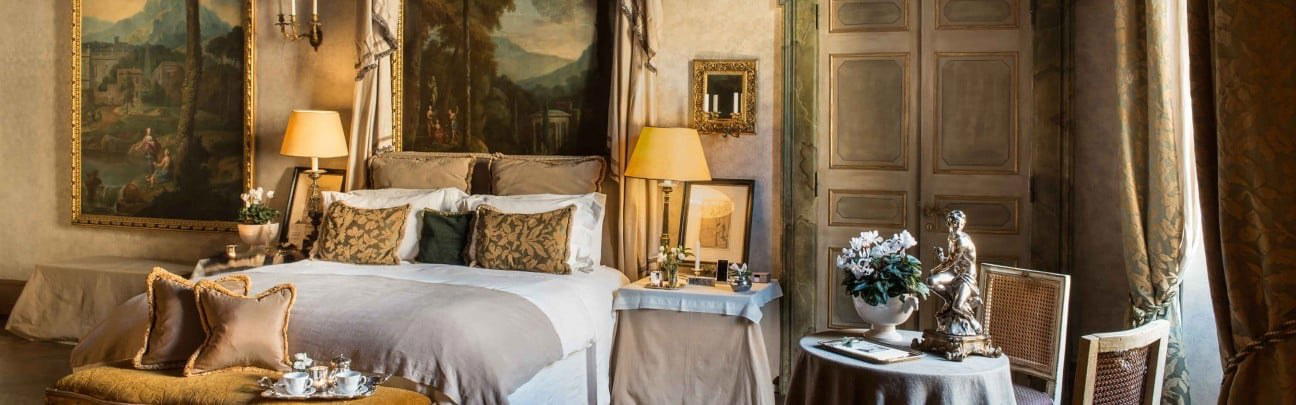
Ornate baroque grandeur with gilded mirrors, hand-painted ceilings, 16th-century tapestries, frescoes, chandeliers, and candlelit salons blending historic splendor with modern comforts.