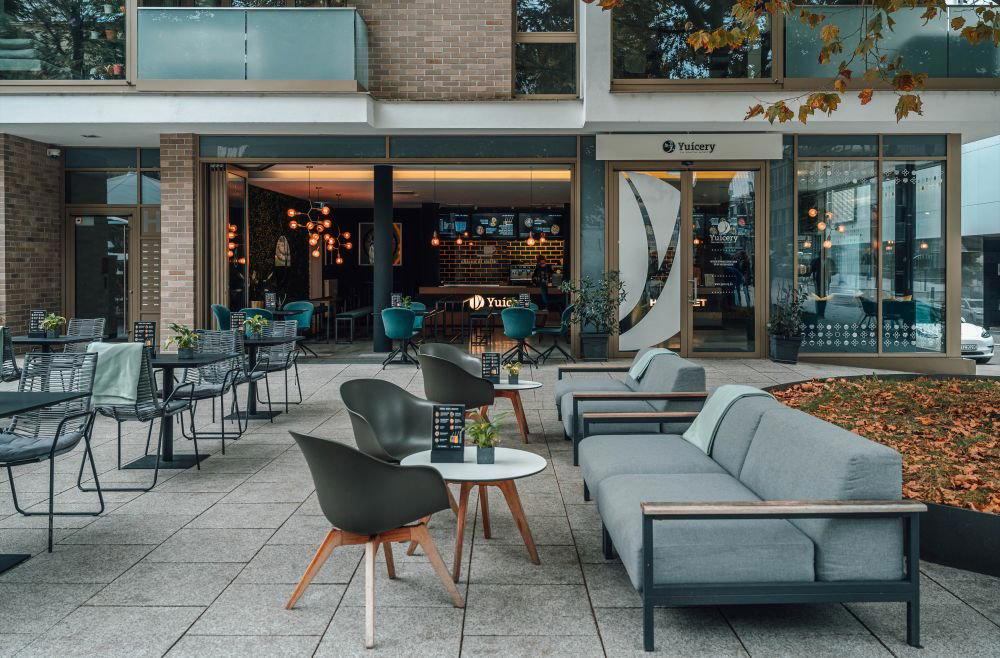
The name, a phonetic compression that merges a proper noun with a category marker, suggests a menu that foregrounds juice, raw preparations, or ingredient-forward formats rather than classical cooking sequences. This kind of nomenclature has become a shorthand in European urban dining for a particular menu philosophy: one built around plant-led preparations, cold-pressed extractions, and layered textures rather than protein-centred plating. Whether Yuícery executes within that broader category or subverts it is the operative question for any first visit.
What menu architecture tells you, before a single dish arrives, is where the kitchen places its emphasis. A menu organised around liquid preparations, juices, smoothies, cold-pressed combinations, implies that the sourcing of produce and the precision of extraction matter more than heat and transformation. This is a technically demanding approach in its own right: the margin for error in a cold-pressed drink is narrower than in a cooked dish, because there is nowhere to hide an off-note. Venues operating in this format across Germany, from CODA Dessert Dining in Berlin to more informal urban concepts, have demonstrated that a constraint-led menu can generate as much critical interest as an expansive one, provided the execution is rigorous.
Stuttgart's Dining Context
Baden-Württemberg carries one of the densest concentrations of Michelin-recognised restaurants in Germany, a fact that shapes expectations even for venues operating outside the award system. The Black Forest corridor running south of Stuttgart includes rooms like Schwarzwaldstube in Baiersbronn, and the broader region extends to ES:SENZ in Grassau and Vendôme in Bergisch Gladbach. Within that regional context, Stuttgart proper has had to define its own identity rather than simply trading on the surrounding density. The city's dining rooms have trended toward precision-led modern cooking, with Hegel Eins representing the modern cuisine strand of that trend.
Against this background, a venue that operates in a format adjacent to juice bars and health-focused cafés occupies an interesting position. The risk is that it reads as a lifestyle concept rather than a dining destination. The opportunity is that it addresses a real gap: Stuttgart's lunch-hour population, its gym-adjacent consumer base, and a growing tier of diners who want precision and quality of ingredient without the full architecture of a tasting menu evening. Cities with comparable demographics, including Munich, where JAN has demonstrated the appetite for technically serious formats, have shown that demand for this tier is real and underserved.
The address on Hospitalstraße reinforces the daytime-leaning hypothesis. The street connects the city centre to the hospital quarter, which creates a steady footfall of professionals, visitors, and residents who may not be looking for an evening reservation but who will pay for quality at lunch. Venues that succeed in this slot in German cities tend to do so through menu legibility, clear categories, transparent ingredient sourcing, and a price-to-portion logic that rewards return visits rather than one-off occasions.
How Yuícery Compares Within Its comparable set
The relevant peer comparison for Yuícery is not Stuttgart's Michelin tier. The more instructive frame is the emerging category of urban European venues that have built serious reputations around constrained, ingredient-focused menus: Le Bernardin in New York City established decades ago that a single-focus menu (fish, in that case) could anchor a room at stronger examples from the critical register. Atomix in New York City has more recently shown that a disciplined format with explicit educational intent can generate sustained critical interest. The principle transfers across formats: a juice and plant-led menu that is executed with the same seriousness as a classical kitchen can hold its own in a city where the broader culinary standard is high.
Whether Yuícery is making that argument successfully is something that booking data and repeat visitor patterns would confirm more reliably than any external assessment. What is clear from the address, the name, and the city context is that the concept is positioned to address a specific need rather than to compete directly with Waldhotel Sonnora or Victor's Fine Dining by Christian Bau in the formal tasting-menu bracket. That clarity of positioning is itself an editorial signal: the room knows what it is trying to do, which is the prerequisite for doing it consistently.
Visitors arriving from Hamburg, where Restaurant Haerlin anchors the formal end of the city's dining register, or from the Moselle valley, where Schanz operates in a similarly focused mode, will find Yuícery a different register entirely, lighter, faster, more daytime in its rhythm. That is not a limitation; it is the point.
Know Before You Go
Address: Hospitalstraße 19, 70174 Stuttgart, Germany
Phone: not listed
Website: not listed
Booking: Contact details not confirmed; visit in person or search for current reservation options via Stuttgart dining platforms
Awards: No award record available at time of publication
Getting there: Stuttgart city centre is served by the S-Bahn network and U-Bahn lines; Hospitalstraße is walkable from Stuttgart Hauptbahnhof within approximately ten minutes
Timing: Given the address and format, daytime visits are likely the primary slot; confirm current hours before travelling
For broader context on Stuttgart's dining scene, including the full range of options from neighbourhood bistros to the city's Michelin-tier rooms, see our full Stuttgart restaurants guide.