Our verdict
Yakiniku Dan Asakusa belongs to Tokyo’s more casual side of beef culture, where grilling at the table is less ceremony than shared rhythm. In Asakusa, the format reads differently from Ginza counters or hotel dining: sociable, late-day, and tied to a neighbourhood where old Tokyo tourism and local eating habits overlap.

Pearl is the En Primeur Club membership app, where members save venues, book tables and use the concierge.
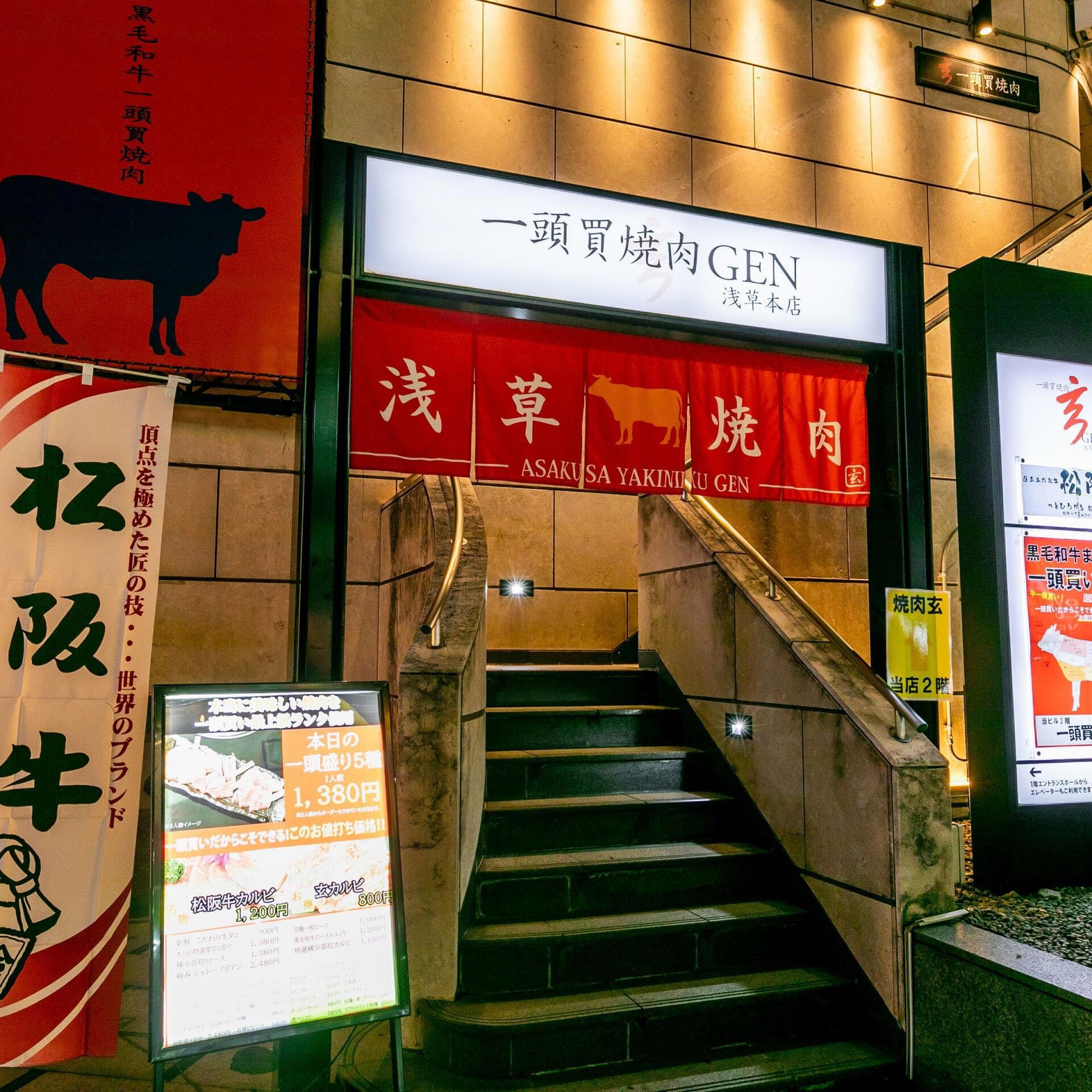
Asakusa changes register after the temple crowds thin: souvenir shutters drop, side streets smell of charcoal and sauce, and dinner shifts from spectacle to proximity, with small groups over grills, beer on crowded tables and smoke folded into the room. Yakiniku Dan Asakusa belongs to that evening neighbourhood, where beef is not a hushed luxury object but something handled communally, cooked piece by piece and judged by timing.
That distinction matters in Tokyo. The city’s beef culture runs from high-control wagyu tasting rooms to old-school sukiyaki houses and unfussy grill rooms. Yakiniku occupies the middle ground, borrowing from Korean barbecue technique, Japanese beef grading culture and izakaya pacing, then turning dinner into decisions: how long to sear, whether to salt or sauce, when to move from leaner cuts to richer ones. Social by design, it suits Asakusa: less polished than luxury districts, more grounded in repeatable neighbourhood dining.
Asakusa beef culture is built around the grill, not the chef's monologue
Tokyo’s high-end restaurant conversation often centres on authorship: the sushi master, the kaiseki counter, the French-trained chef. Yakiniku resists that script. The diner does part of the work, shifting the meal’s authority. A restaurant can buy well, cut well, season carefully and pace the table, but the final seconds on the grill belong to the guest. That makes the category more democratic than much premium Tokyo dining, even when the beef is serious.
In Asakusa, the appeal sharpens by contrast. The district has a dense visitor circuit around Sensō-ji, yet its restaurant culture extends beyond sightseeing meals. Long-running formats, sweets counters, tempura, soba, sukiyaki and grill rooms sit close together, feeding residents, domestic travellers and international visitors. Compared with Yonekyu Honten, a Tokyo reference point for beef sukiyaki at a clearly listed JPY 6,000–7,999 dinner bracket, local yakiniku generally feels more elastic: less formal sequencing, more table-level control, and a meal that expands or contracts with appetite.
That elasticity suits Asakusa. Yakiniku can handle a post-temple dinner, a group meal after eastern Tokyo, or a later casual sitting with a specific craving. The room’s job is not to silence the city outside; it lets it in through conversation, heat and plates passed steadily across the table.
The draw is timing, smoke and shared control
Yakiniku rewards attention without demanding reverence. Thin cuts punish distraction; fattier pieces need patience; offal, when ordered, asks for confidence and tolerance for chew and char. These are not signature-dish claims but the cuisine’s grammar. Pleasure comes from managing heat and sequence, knowing table-cooked beef has a narrower margin than a steak finished in the kitchen.
Tokyo’s restaurant hierarchy can push diners toward scarcity: tiny counters, fixed menus, monthly release dates, chef-led progressions. Yakiniku works from different values. The meal is structured, but conversational. A group can move from salt-seasoned cuts to sauced ones, pause for rice, return to the grill, then close without a tasting menu’s staged finality. That rhythm fits Asakusa, where dinner often follows a long walk rather than a dress-up itinerary.
Yakiniku Dan Asakusa should be read within that category, not against Michelin-led Tokyo. No awards are attached, and that absence is context, not weakness. The comparison is not a destination counter with a fixed culinary thesis, but the approachable, format-driven restaurants that make eastern Tokyo easier after dark. Nearby contrasts clarify it: Onigiri Asakusa Yadoroku represents stripped-down rice-ball tradition at a low price tier, while Fruit Parlour Goto belongs to Asakusa’s dessert-and-fruit culture at JPY 1,000–1,999. Yakiniku sits heavier, later and more communal.
For a broader Tokyo itinerary, the distinction is practical. A sushi counter or kaiseki room often anchors a night; yakiniku is better when the night needs flexibility: a mixed group, unpredictable hunger or a preference for participation over choreography. The trade-off is engagement. Overcook the beef and the restaurant cannot rescue the texture; crowd the grill and pacing suffers. The format gives control, but makes care visible.
Where it fits in a Tokyo food itinerary
Asakusa is often treated as a daytime cultural stop, but its value for food travellers grows when placed beside other Tokyo neighbourhoods rather than isolated as a temple district. Shinjuku absorbs late-night density, Ginza concentrates high-price counters, Kagurazaka mixes old geisha-quarter lanes with contemporary dining, and Akihabara has its own after-work logic. Eastern Tokyo offers older streets, tighter dining rooms and formats that need not announce luxury to justify a serious meal.
This address therefore fits a larger, category-aware plan. Use Our full Tokyo restaurants guide for the wider dining map, then compare formats rather than chase one hierarchy. For grilled and casual Japanese meals elsewhere, . 鮪と炭火焼き うお炭 秋葉原店, 12/10 Shinjuku ten and 124. KAGURAZAKA (Yakitori) show how charcoal, skewers and counter culture vary by neighbourhood. Lighter stops such as 2D Cafe and 3 Chome no Curry Ya San occupy different registers, which is the point: Tokyo eating is a sequence of formats, not a single ladder.
Travellers going beyond restaurants can pair that planning with Our full Tokyo hotels guide, Our full Tokyo bars guide, Our full Tokyo wineries guide and Our full Tokyo experiences guide. For regional comparisons across Japanese and Japanese-influenced dining, apply the same format lens to -Grilled beef Sukiyaki- KAMAKURA TANUKIAN 鎌倉 たぬき庵 in Kamakura.cafe in Osaka.know in Kumamoto, (Shoku) Vietnam in Kawasaki, [Curry Senmon Ten] Maruyama Kyoju. in Sapporo, [ki:] in Kyoto, Jōdo Saké Bar in Los Angeles and Onigiri Time in Pasadena.
The editorial case for Yakiniku Dan Asakusa rests not on ceremony, awards or chef mythology, but on cultural fit. In a city where premium dining often narrows the diner’s role, yakiniku gives part of the meal back to the table. In Asakusa, that feels appropriate: direct, sociable and tied to a neighbourhood that rewards eating after the obvious sightseeing ends.
Frequently asked questions
Is Yakiniku Dan Asakusa good for families?
Yes, it can suit families that are comfortable with a grill-led meal in Tokyo’s Asakusa district. The address, 2 Chome-13-4 Asakusa, places it in a part of the city that works well for mixed-age outings rather than formal counter dining.
What's the overall feel of Yakiniku Dan Asakusa?
Expect a focused yakiniku room where the table and grill set the pace, not a chef-driven tasting format. In Asakusa, that means a more social, hands-on dinner aligned with the venue’s 4–11 PM hours on most nights.
What days is Yakiniku Dan Asakusa closed?
Hours at Yakiniku Dan Asakusa: Mon: 4–11 PM; Tue: Closed; Wed: 4–11 PM; Thu: 4–11 PM; Fri: 4–11 PM; Sat: 3–11 PM; Sun: 3–11 PM.
What's Yakiniku Dan Asakusa's location?
Yakiniku Dan Asakusa is located in Tokyo.
What's Yakiniku Dan Asakusa best at?
Its strongest appeal is straightforward yakiniku: ordering beef for the grill and managing each cut at the table. That format suits diners who want control over timing and doneness in central Tokyo rather than a fixed-course experience.
Can Yakiniku Dan Asakusa adjust for dietary needs?
Dietary flexibility in yakiniku depends on the cuts and sides chosen, so planning around the grill format matters. The Asakusa location at 2 Chome-13-4 makes it practical to discuss needs ahead of the meal, especially if restrictions are specific.
Cost Snapshot
Comparable options at the same price tier.
| Venue | Cuisine | Price | Awards | Notes |
|---|---|---|---|---|
| Yakiniku Dan AsakusaThis venue (the venue you are viewing) | Japanese Yakiniku (BBQ) | $50–100 | Not listed | Not listed |
| Tori Tsune Shizen Do | Traditional Japanese chicken & oyakodon specialist | $50–100 | Tabelog 100 #84 | Chiyoda, Traditional Japanese chicken & oyakodon specialist |
| Yakiniku Toka | Modern nostalgic Wagyu yakiniku | $50–100 | Tabelog 100 #4 | Chūō, Modern nostalgic Wagyu yakiniku |
| Tori Aroma | Hinai Jidori Yakitori Omakase | $50–100 | Tabelog 100 #31 | Chiyoda, Hinai Jidori Yakitori Omakase |
| Omino Tsubaki | Yakitori Omakase | $100–150 | Tabelog 100 #74 | Chūō, Yakitori Omakase |
| o/sio | Yoshoku-Italian Fusion | $50–100 | Not listed | Chiyoda, Yoshoku-Italian Fusion |
Continue exploring
More in Tokyo
Restaurants in Tokyo
All restaurants in Tokyo →

Bars in Tokyo
All bars in Tokyo →

Details
- Cozy
- Intimate
- Group Dining
- Casual Hangout
- Open Kitchen
- Sake Program
- A La Carte
Current opening hours
- Monday
- 4–11 PM
- Tuesday
- Closed
- Wednesday
- 4–11 PM
- Thursday
- 4–11 PM
- Friday
- 4–11 PM
- Saturday
- 3–11 PM
- Sunday
- 3–11 PM
Hours can change for holidays and private events. Hours as of .
Great atmosphere with excellent service as per guest reviews.