

1 Michelin Star
Our verdict
Waketokuyama in Minami-Azabu holds a Michelin star and a place in Japan's most competitive kaiseki tier, where the menu rotates every ten days against the 72 micro-seasons of the traditional Japanese calendar. Chef Hiromitsu Nozaki's kitchen operates six evenings a week, producing a sequence of dishes built around what the season demands rather than what a fixed menu allows.

Pearl is the En Primeur Club membership app, where members save venues, book tables and use the concierge.
The menu
What to order
- Grilled Abalone with Seaweed Aroma
- Grilled Abalone with Liver Sauce
- Seasonal Clay Pot Rice
Where the Calendar Drives the Kitchen
Japanese kaiseki operates on a logic that most Western tasting-menu formats only approximate: the dish is not the point, the season is. At Waketokuyama in Minami-Azabu, that principle is taken further than most. The menu changes every ten days at most, calibrated not to quarterly seasons but to the 72 micro-seasons (shichijuniko) of the traditional Japanese lunisolar calendar, a system that divides the year into increments as granular as "the deer sheds its antlers" or "the cold sets in earnest." Each interval signals a different peak for different ingredients, and the kitchen responds accordingly. For a guest visiting in late October versus early November, the meal may share a format but almost nothing on the plate.
This approach sits at the opposite end of the spectrum from Tokyo's higher-priced kaiseki counters, RyuGin, operating at ¥¥¥¥, holds three Michelin stars and trades heavily on theatrical technique.
The Ingredient Logic Behind the Plate
The foundational discipline of kaiseki is restraint in how ingredients are treated, not substituted. The kitchen's role is to identify the precise moment an ingredient is at its most expressive and to intervene as little as necessary. Waketokuyama's ten-day rotation schedule means the team is in a near-constant cycle of sourcing, testing, and resetting the menu, a demanding operational model that most restaurants abandon in favour of longer menu cycles. What it produces, when executed well, is a dining experience tightly bound to the actual condition of Japan's seasons rather than a stylised version of them.
Tokyo's kaiseki scene draws from an extraordinarily wide sourcing geography. Mountain vegetables from Nagano, seafood from Hokkaido and the Sanriku coast, citrus and root vegetables from Kyushu, the leading kaiseki kitchens function as procurement operations as much as cooking operations. At this tier, ingredient sourcing is itself a credential, and the Michelin inspector commentary on Waketokuyama specifically notes the "abundant gifts of nature" as the framing device for the meal, not chef ego or technique-for-its-own-sake. That editorial choice by Michelin signals something about where the restaurant's identity sits.
For diners comparing Waketokuyama with kaiseki houses at similar or adjacent price points, Azabu Kadowaki represents the same Minami-Azabu neighbourhood but with a different stylistic register. Kagurazaka Ishikawa in the neighbouring district has built its reputation around a different sourcing philosophy, leaning on artisan producers from across Japan in a similarly intimate format. Both provide useful context for understanding where Waketokuyama sits in terms of tone and priority.
The Shape of an Evening Here
Waketokuyama opens six evenings a week, Monday through Saturday, with service from 5pm to 10:30pm. Sunday is the single day off. The kitchen is led by Chef Hiromitsu Nozaki, who took responsibility from the restaurant's founder. The Michelin record notes that the "customer-first policy and the flow of the meal remain unchanged" under the current leadership, which in kaiseki terms matters: the sequence of a kaiseki meal, the pacing, the logic of transition from one course to the next, is as much a part of the experience as any individual dish.
The guest experience at a restaurant operating on a ten-day rotation is necessarily different from one with a fixed seasonal menu. Return visits are genuinely distinct. The Michelin commentary specifically flags that "no two visits are the same," which for regulars and serious kaiseki followers is a reason to come back in a different micro-season rather than waiting for a full seasonal shift. That cycle of return visits is built into the restaurant's model. Proximity to the city's diplomatic quarter and international residential zones has historically made Minami-Azabu a natural home for this kind of serious, format-respecting kaiseki address.
Further afield in Japan's kaiseki circuit, Gion Sasaki in Kyoto and Isshisoden Nakamura operate in the tradition's historical heartland, where the proximity to Kyoto's agricultural hinterland and centuries of court dining culture shaped the form. Kashiwaya Osaka Senriyama represents another serious node in the Kansai tradition. Waketokuyama's Tokyo address places it within a distinct competitive set where the ingredients must travel further but the audience is arguably more internationally diverse.
What the Rankings Signal
Opinionated About Dining's Japan ranking is compiled through a peer-survey methodology, meaning placements reflect the views of serious diners and industry practitioners rather than a single inspection team. Holding consecutive positions in the top 500 across two years, moving from 432nd to 453rd between 2024 and 2025, indicates sustained relevance in a market where new entries and shifting fashions can move rankings substantially. The Michelin one-star confirmation for 2024 adds a separate credential layer, grounded in the Guide's specific inspection criteria for technique, consistency, and personality of cuisine.
In Tokyo's broader kaiseki context, the Michelin Guide has long treated Japanese cuisine with unusual granularity, tracking distinctions between kaiseki, kappo, and washoku formats that Western guides often collapse. Waketokuyama's position at one star in that system places it in a substantial peer group, several steps below the ultra-premium three-star addresses like RyuGin but clearly differentiated from entry-level kaiseki formats. For reference, Myojaku and Ginza Fukuju occupy adjacent positions in Tokyo's formal Japanese dining hierarchy, offering useful comparison points on format and price. Jingumae Higuchi provides a further reference on how Tokyo's serious Japanese kitchens approach ingredient sourcing at this tier.
Google's is a consistent signal from a broadly non-specialist audience, suggesting that Waketokuyama reads well to guests who may not arrive fluent in kaiseki grammar but leave having understood what the meal was attempting. That kind of cross-audience legibility, where the food communicates its intent without requiring prior knowledge, is harder to achieve than it sounds in a highly codified culinary tradition.
Waketokuyama in Japan's Wider Dining Scene
Tokyo remains the highest density market for serious Japanese cuisine globally, but the country's dining map extends well beyond the capital. HAJIME in Osaka operates in a different register, French-influenced, technically intense, while akordu in Nara and Goh in Fukuoka occupy specialist positions in their respective cities. 1000 in Yokohama and 6 in Okinawa each reflect the geographic and cultural diversity of Japan's serious dining outside the capital.
For a city as densely reviewed as Tokyo, finding context matters as much as finding a reservation. Our full Tokyo restaurants guide maps the capital's dining scene by neighbourhood and cuisine type. For planning the wider trip, our Tokyo hotels guide, bars guide, wineries guide, and experiences guide cover the broader framework.
Know Before You Go
- Address: 5 Chome-1-5 Minamiazabu, Minato City, Tokyo 106-0047, Japan
- Hours: Monday to Saturday, 5:00 pm – 10:30 pm. Closed Sunday.
- Price range: ¥¥¥
- Awards: Michelin One Star (2024); OAD Leading Restaurants in Japan #453 (2025), #432 (2024)
- Booking: Contact details not listed in, search the restaurant name directly for current reservation channels
- Nearest area: Minami-Azabu, Minato City, walkable from Hiroo Station (Tokyo Metro Hibiya Line)
Frequently asked questions
Is Waketokuyama expensive?
Pricing at Waketokuyama is listed as ¥¥¥.
What are the operating hours at Waketokuyama?
Hours at Waketokuyama: Hours: Monday 5–10:30 pm Tuesday 5–10:30 pm Wednesday 5–10:30 pm Thursday 5–10:30 pm Friday 5–10:30 pm Saturday 5–10:30 pm Sunday Closed.
Peers You’d Cross-Shop
| Venue | Cuisine | Price | Awards | Notes |
|---|---|---|---|---|
| WaketokuyamaThis venue (the venue you are viewing) | Seasonal Omakase Kaiseki | $150–200 | 1 Michelin Star | Not listed |
| Harutaka | Edo-Style Omakase Sushi | $200–300 | 3 Michelin Stars · World's 50 Best #76 | Sushi |
| RyuGin | Modern Kaiseki | $500+ | 3 Michelin Stars · World's 50 Best #41 | Kaiseki, Japanese |
| L'Effervescence | Modern French with Japanese Influences | $200–300 | 3 Michelin Stars · World's 50 Best #69 | French |
| HOMMAGE | Modern French with Japanese Influences | $150–200 | 2 Michelin Stars · World's 50 Best #78 | Innovtive French, French |
| MAZ | Innovative Peruvian-Japanese Fusion | $150–200 | 2 Michelin Stars · World's 50 Best #28 | Innovative |
Recognition history
Dated appearances from independent guides and award organizations, with the underlying list record or original source where available.
Michelin 1 Star
Michelin
Opinionated About Dining Top Restaurants in Japan Recommended
Opinionated About Dining
Full recognition history (5 entries)
Opinionated About Dining Top Restaurants in Japan Ranked #453
Opinionated About Dining
Michelin 1 Star
Michelin
Opinionated About Dining Top Restaurants in Japan Ranked #432
Opinionated About Dining
Continue exploring
More in Tokyo
Restaurants in Tokyo
All restaurants in Tokyo →

Bars in Tokyo
All bars in Tokyo →







Details
- Elegant
- Minimalist
- Sophisticated
- Intimate
- Special Occasion
- Celebration
- Business Dinner
- Date Night
- Open Kitchen
- Chefs Counter
- Private Dining
- Design Destination
- Sake Program
- Local Sourcing
- Sustainable Seafood
- Omakase
- Set Menu
- Counter Dining
- Sake
- Wine
- Allergy Accommodating
- Pescatarian Friendly
Current opening hours
- Monday
- 5–10:30 PM
- Tuesday
- 5–10:30 PM
- Wednesday
- 5–10:30 PM
- Thursday
- 5–10:30 PM
- Friday
- 5–10:30 PM
- Saturday
- 5–10:30 PM
- Sunday
- Closed
Hours can change for holidays and private events. Hours as of .
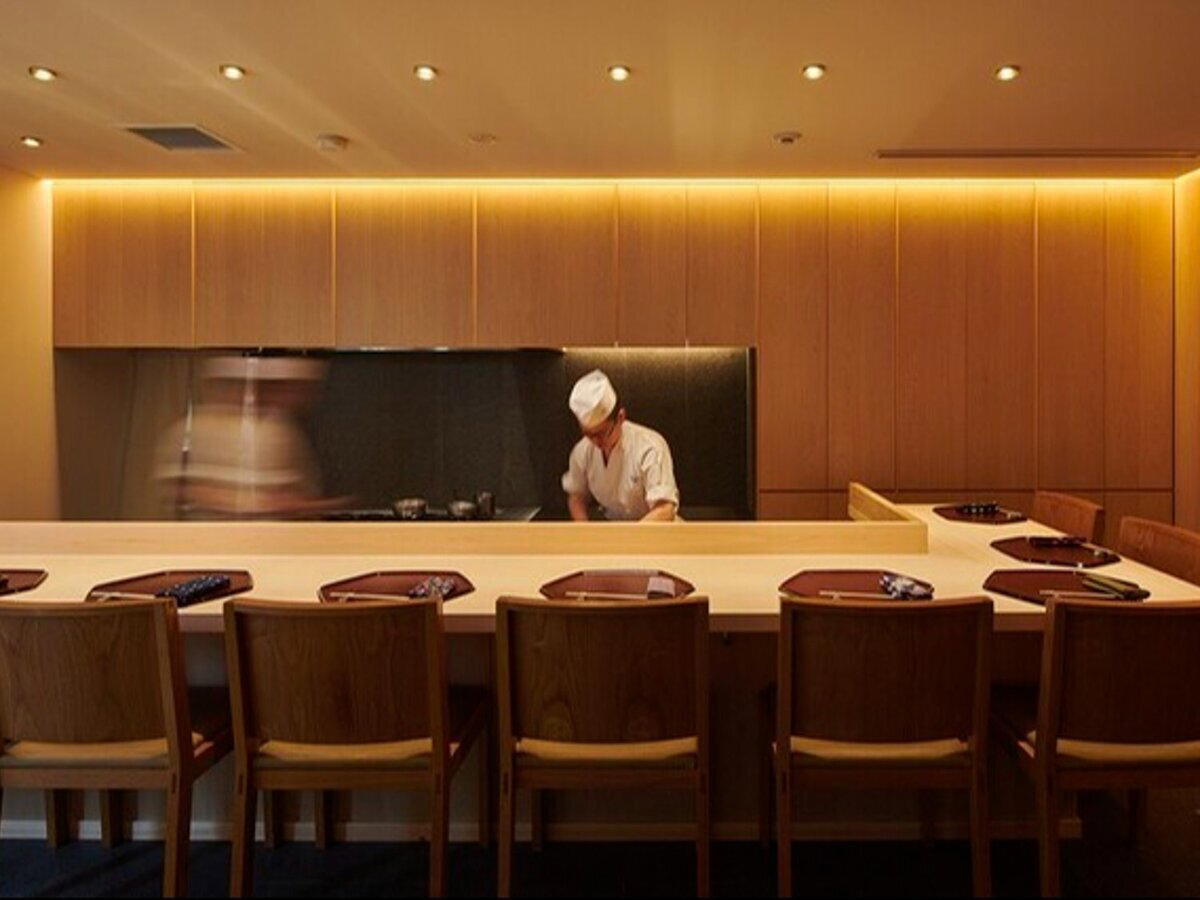
Soft, warm lighting illuminates a serene, minimalist Japanese space with a refined, relaxing atmosphere. The modern 2004 building designed by Kengo Kuma features two floors with counter seating and private rooms, creating an intimate yet spacious dining environment.