
Michelin Bib Gourmand · Star Wine List
Our verdict
UMA holds a Michelin Bib Gourmand for 2025, placing it among a small cohort of Tallinn restaurants where the quality-to-price ratio draws as much attention as the food itself. The kitchen takes a bold approach to Asian flavour combinations, and the wine list matches that energy with concise, considered curation. At the €€ price point, it is one of the more compelling arguments for Tallinn's growing dining credibility.

Pearl is the En Primeur Club membership app, where members save venues, book tables and use the concierge.
The menu
What to order
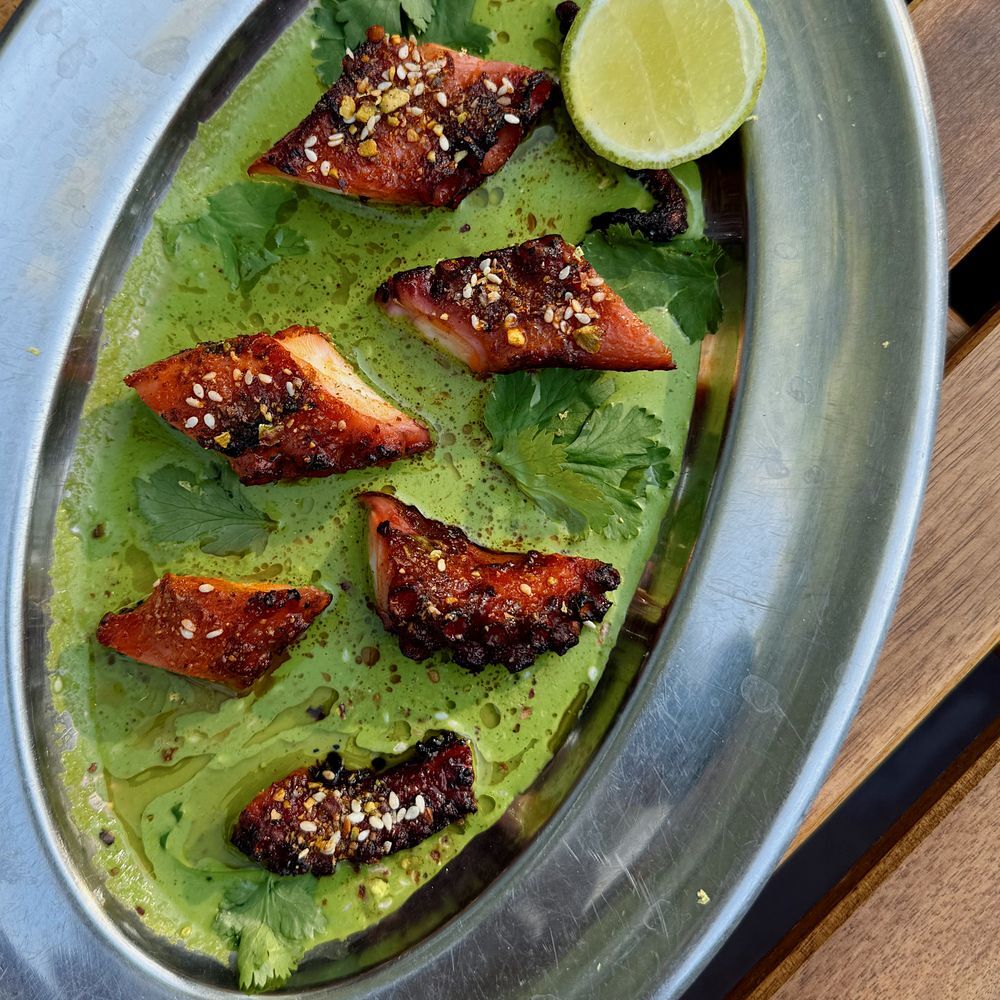
- Coconut flatbread
- Prawns in laksa sauce
- Chicken Satay
Asian Cooking in a City That Has Learned to Cook
Tallinn's restaurant scene has shifted considerably over the past decade. What was once a city of amber-lit medieval cellars serving wild boar and black bread has grown into something harder to categorise, a capital where creative kitchens now sit alongside Baltic tradition, and where Michelin's inspectors have started paying sustained attention. In 2025, the Guide awarded Bib Gourmands to a small group of Tallinn restaurants, a designation reserved for kitchens that deliver cooking of genuine quality without the price architecture of a formal tasting menu. UMA, on Peetri tänav in the city centre, is one of those restaurants, and its presence on that list says something specific about where Tallinn dining has arrived.
The Bib Gourmand is a more instructive signal than it might first appear. It does not reward ambition for its own sake, it rewards execution at a price point where corners are easy to cut. That UMA earned it with an Asian-inflected menu, a category that sits well outside Estonia's culinary default settings, suggests the kitchen has found a register that is genuinely its own rather than borrowed wholesale from a template.
What the Michelin Recognition Actually Means
Within Tallinn's Michelin-recognised tier, there is a clear split between the high-commitment, high-price end and the more accessible bracket. NOA Chef's Hall and 180° by Matthias Diether sit at the €€€€ level, with tasting menus that ask for both a significant financial and temporal commitment. Art Priori and 38 occupy the creative middle ground. UMA operates at €€, which in Tallinn's price context means a meal that does not require advance financial planning. The Bib Gourmand is precisely the recognition designed for this bracket, it signals that the cooking has been assessed against the full international Michelin standard, not merely local competition.
For the reader comparing options, that distinction matters. A Bib Gourmand from Michelin's 2025 edition is a verifiable credential, not a review platform aggregate.
Bold Flavours, Considered Pours
Asian cooking in Northern European capitals tends to occupy a spectrum from faithful regional reproduction to something more interpretive and fusion-adjacent. UMA sits toward the latter end, with a kitchen described as combining flavours and textures boldly and playfully. That language, used in the Michelin citation itself, is meaningful shorthand for a cooking style that takes liberties with expectation, acidity against fat, textural contrast as a structural device, heat deployed with intention rather than as a default register.
The wine list extends the same logic. It is concise rather than encyclopaedic, which in a restaurant of this price range and format is usually the correct decision. A shorter list, when smartly curated, signals editorial confidence, the team has made choices rather than assembled a catalogue. Pairing wine with Asian-inflected cooking is a genuine exercise in matching, not just pouring, and a list built with that challenge in mind tends to perform better at the table than one assembled on conventional European-restaurant principles. The programme at UMA appears to have been put together with that pairing logic as a starting point.
For comparison, the Asian dining category at a similar price level in other European cities worth noting includes taku in Cologne and Jun's in Dubai, both of which approach Asian cuisine with a similar emphasis on technique and creative latitude. UMA's Bib Gourmand places it in recognisable international company.
Tallinn's Wider Creative Dining Context
Understanding UMA's position requires some sense of what surrounds it. Tallinn's most formally acclaimed restaurants tend to anchor themselves in Estonian produce and Nordic cooking logic, Bocca represents the Estonian culinary tradition end of that spectrum, while the creative kitchens cluster around interpretive approaches to local ingredients. UMA takes a different route entirely, drawing its reference points from Asia rather than the Baltic or Nordic playbook. That is not unusual in other European capitals, but in Tallinn it represents a deliberate positioning away from the dominant local frame.
Beyond the capital, Estonia has developed a scattered but genuine fine dining presence. Alexander in Pädaste and Hõlm in Tartu demonstrate that serious cooking is not confined to Tallinn alone. Hiis in Manniva, Kolm Sõsarat in Lüllemäe, Fellin in Viljandi, and Lahepere Villa in Kloogaranna fill out a national picture that Michelin has increasingly taken seriously. UMA's recognition sits within that broader Estonian moment rather than as an isolated anomaly.
Planning a Visit
UMA is located at Peetri tn 12 in central Tallinn, a direct address to reach on foot from the Old Town or by short taxi from most city-centre accommodation. At the €€ price point, it operates in a range where a full meal with wine remains well below what comparable quality commands in Helsinki, Stockholm, or Copenhagen. For visitors building a multi-night Tallinn itinerary, it fits sensibly alongside a higher-commitment dinner at one of the city's tasting menu restaurants, with UMA handling an earlier evening or a second night when the preference is for something more relaxed in format and lighter on the bill. Booking ahead is advisable given the recognition the restaurant has received in 2025; the combination of accessible pricing and a Michelin citation typically compresses availability at tables of this size and format. For broader Tallinn planning, EP Club's guides cover hotels, bars, wineries, and experiences across the city.
Frequently asked questions
Where is UMA located?
UMA is located at Peetri tn 12, 10415 Tallinn, Estonia, Tallinn.
Is UMA focused on a specific cuisine style?
Does UMA have a Michelin star or similar recognition?
UMA has received recognition including: UMA is a creative, Asian-style restaurant where flavours and textures are combined boldly and playfully. The same philosophy extends to the wine list. Smartly curated, the list is concise yet offers a...; Michelin Bib Gourmand (2025).
What should I order at UMA?
UMA's kitchen works across the Asian spectrum with a stated focus on bold combinations of flavour and texture, so the menu skews towards dishes that contrast rather than comfort. The wine list is concise and deliberately matched to that approach, making it worth asking staff for a pairing suggestion. Specific dishes are not published in advance and change with the kitchen's direction.
How much does it cost to eat at UMA?
Pricing at UMA is listed as €€.
Do they take walk-ins at UMA?
Given the restaurant holds a 2025 Michelin Bib Gourmand, a designation that reliably increases demand at mid-price venues, booking ahead is the sensible approach, particularly on weekends. The address is Peetri tn 12, Tallinn, and the restaurant is reachable on foot from the Old Town.
What has UMA built its reputation on?
UMA's reputation rests on Asian cooking that treats flavour and texture as active variables rather than fixed reference points, applied at a price tier (€€) that sits well below Tallinn's high-commitment tasting-menu end. The 2025 Michelin Bib Gourmand confirms that value-to-quality ratio as the defining credential. The wine list follows the same logic: concise, curated, and calibrated to the food rather than padded for appearance.
Cuisine and Awards Snapshot
A quick peer list to put this venue’s basics in context.
| Venue | Cuisine | Price | Awards | Notes |
|---|---|---|---|---|
| UMAThis venue (the venue you are viewing) | Unorthodox Modern Asian | $50–100 | Michelin Bib Gourmand · Star Wine List | Not listed |
| NOA | Modern International | $50–100 | Michelin Bib Gourmand · White Guide Baltic Restaurants - Very Fine Level | Modern European, Modern Cuisine |
| 180° by Matthias Diether | Modern Creative Fine Dining | $300–500 | 2 Michelin Stars · La Liste Top Restaurants | Estonian Fusion |
| NOA Chef’s Hall | Modern European Fine Dining | $150–200 | 1 Michelin Star · La Liste Top Restaurants | Creative |
| Fotografiska | Progressive Sustainable Food & Drink | Not listed | Michelin Bib Gourmand · Star Wine List | Modern Cuisine |
| Härg | Modern Chargrilled Steakhouse | $50–100 | Michelin Plate · White Guide Baltic Restaurants - Very Fine Level | Meats and Grills |
Recognition history
Dated appearances from independent guides and award organizations, with the underlying list record or original source where available.
Michelin Bib Gourmand
Michelin
Star Wine List
Star Wine List
Full recognition history (3 entries)
Michelin Bib Gourmand
Michelin