Our verdict
Takaoka sits at the edge of Toyama Bay, where Japan's most celebrated seafood comes ashore, and Tsumama works within that supply chain in the Shinyokomachi district. The restaurant's address places it inside a city better known for lacquerware and bronze casting than for fine dining, which is part of the point: ingredient-led cooking here draws on a region whose produce rarely travels far enough to reach Tokyo menus.

Pearl is the En Primeur Club membership app, where members save venues, book tables and use the concierge.
The menu
What to order
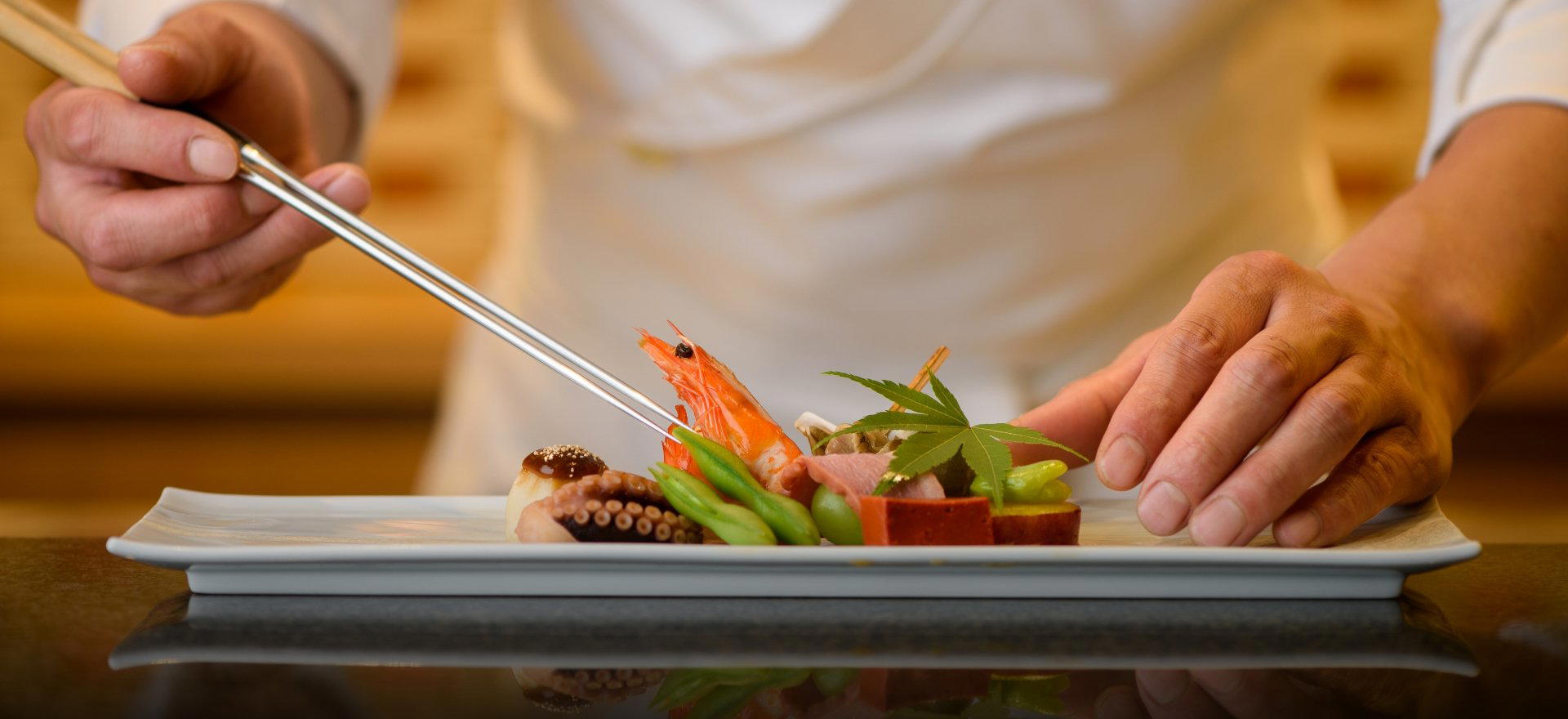
- Toyama Bay Sushi
- Firefly Squid Pickled in Soy Sauce
Where Toyama's Larder Meets the Table
Takaoka does not present itself as a dining destination. The city's reputation rests on centuries of metalwork and Takaoka lacquer, and its streets reflect that industrial heritage more than any culinary scene. Yet Toyama Prefecture sits against one of Japan's most productive bays, where cold, deep-water currents drive exceptional seafood quality, and the agricultural inland supplies rice, mountain vegetables, and wild ingredients that rarely appear outside the region. Tsumama, at 1 Shinyokomachi, operates inside this geography rather than despite it, a restaurant whose entire rationale is proximity to where the food actually comes from.
Toyama Bay is one of a small number of Japanese coastal zones where the ocean floor drops sharply close to shore, creating the temperature differential that concentrates flavor in fish and shellfish. White shrimp (shiroエビ) and firefly squid (hotaruika) are the bay's two internationally recognised specialties, both short-season catches that local restaurants access at a time and quality level that no Tokyo supplier can replicate. Ingredient-led kitchens in cities like Osaka or Kyoto, including HAJIME in Osaka and Gion Sasaki in Kyoto, can source from Toyama, but they are always one step removed from the landing. A kitchen in Takaoka itself is not.
The Case for Cooking at the Source
Japanese fine dining has increasingly divided into two models. One concentrates talent in metropolitan centers, Tokyo, Osaka, Fukuoka, where reputation, foot traffic, and media access justify the overhead. The other, smaller and less covered, is rooted in producing regions, where chefs work directly with farmers and fishermen not as a sourcing strategy but as a daily operational reality. Goh in Fukuoka represents the regional city model done at high level; places like 一本木 石川製 in Nanao sit even deeper in the producing zone. Tsumama belongs to this second category, positioned in a city where the supply chain is measurably shorter.
That proximity changes what is possible on the plate. Firefly squid season in Toyama runs from roughly March through May. During that window, squid caught the same morning can reach a kitchen twelve kilometers from the bay before the texture changes in ways that even overnight refrigeration cannot prevent. This is not a marketing premise, it is a logistical fact that shapes what a kitchen in Takaoka can do that a Tokyo counterpart cannot. The same principle applies to the region's rice, grown in Toyama's flat plains and consistently ranked among Japan's highest-quality table rice varieties, and to the mountain vegetables that descend from the Tateyama range as the season advances.
Shinyokomachi and the Character of the Neighbourhood
The Shinyokomachi address places Tsumama in a district that carries the weight of Takaoka's working history. The city's grid reflects its Edo-period origins as a castle town, with merchant districts that supplied the metalworking trades. Dining here does not exist in the orbit of a luxury hotel strip or a high-profile tourist corridor. That context matters because it shapes both the clientele and the competitive set. Restaurants in Takaoka are not competing for the visitor traffic that sustains the premium tiers in Kanazawa, forty minutes to the west. They are, by and large, cooking for locals and for the occasional traveller who has made the deliberate choice to come here. Compare the dynamic to Ahora Aquí, another Takaoka address that operates with a distinct identity within the same city context, or to 味喜寿し, which approaches the same regional supply chain through a different format.
For the reader planning a visit, the practical architecture of a trip to Takaoka is direct from the Hokuriku Shinkansen corridor. The line connects Kanazawa and Toyama, with Takaoka sitting on a local branch that adds roughly twenty minutes to either journey. Travelling from Tokyo, Kanazawa is the standard gateway; Takaoka is accessible the same day without losing significant time. That ease of access makes it a viable addition to an itinerary that might otherwise focus entirely on Kanazawa's more established food scene. For a wider read on what the city offers, our full Takaoka restaurants guide maps the options across price points and formats.
Regional Cooking in National Context
Japan's regional dining tier, serious kitchens outside the three major metros, has attracted growing critical attention, but the coverage remains uneven. Sapporo and Fukuoka have established profiles; Toyama and its smaller cities remain less documented internationally. This is partly a language barrier, partly a function of how restaurant award systems weight urban density. Michelin, for instance, operates guides in Tokyo, Osaka, Kyoto, Hokkaido, and a handful of other prefectures, but Toyama does not currently have its own guide edition.
The comparison to better-documented regional formats is instructive. Harutaka in Tokyo operates at the top of the capital's sushi tier with full award recognition. akordu in Nara has built a profile in a secondary city by applying a European framework to Japanese regional ingredients. The ingredient-sourcing argument that both make is one that Toyama-based kitchens can make with equal or stronger geographic logic, simply without the same critical infrastructure behind them. For readers who track restaurants through Atomix in New York City or Le Bernardin in New York City, where sourcing narratives are extensively documented, Toyama represents the version of that story where the restaurant is still physically at the source.
Planning a Visit
Given the scale and character of Takaoka's dining scene, direct contact with the restaurant is the appropriate first step for any visit. Japanese restaurants at this level of regional specificity frequently operate on reservation-only or limited-seating formats, and visiting without prior confirmation is unlikely to succeed. Travellers arriving from outside Japan should account for the possibility that communication will require Japanese-language assistance or a hotel concierge intermediary. The Shinyokomachi address is in central Takaoka and accessible on foot from the main station area.
Frequently asked questions
Can I bring kids to Tsumama?
No specific policy is published for Tsumama, but the Shinyokomachi address and the character of Takaoka's serious regional dining scene suggest a setting oriented toward adult meals. Contacting the restaurant directly before visiting with children is advisable. Takaoka itself has family-friendly attractions nearby if you are travelling with younger guests.
What kind of setting is Tsumama?
Tsumama sits at 1 Shinyokomachi in Takaoka, a district shaped by the city's Edo-period grid and its long association with craft industries including lacquerware and metalwork. The neighbourhood gives the restaurant a grounded, working-city context rather than a tourist-facing one. Published details on interior format are not available, but the address places it within Takaoka's historically textured core.
Is Tsumama worth visiting if you are travelling through the Hokuriku region?
Takaoka sits on the Hokuriku Shinkansen corridor between Kanazawa and Toyama, making it a plausible stop for travellers moving through the region rather than a detour from it. Tsumama's Shinyokomachi address places it in the city's historic core, within reach of Takaoka's well-documented craft and temple districts. For anyone spending time in Hokuriku's regional dining scene, Takaoka represents a less-covered node alongside the better-documented Kanazawa restaurant circuit.
What's the signature dish at Tsumama?
Specific menu details for Tsumama are not in current published records. Toyama prefecture's larder, which includes Toyama Bay seafood, locally grown rice, and mountain vegetables, forms the natural reference point for any serious kitchen in the region. What Tsumama does with those ingredients in practice requires a visit or direct inquiry to confirm.
Where do I go for Tsumama?
Tsumama is located at 1 Shinyokomachi, Takaoka, Toyama 933-0035, Japan, Takaoka.
Can I walk in to Tsumama?
At Takaoka's scale, walk-in access is sometimes possible at smaller regional restaurants, but attempting to reserve ahead through local channels or the restaurant's address at 1 Shinyokomachi is the more reliable approach. Arrival without a reservation carries real risk of unavailability.
What has Tsumama built its reputation on?
Tsumama operates in a city whose identity is defined by centuries of craft production rather than gastronomy, which means any serious kitchen there earns its standing through the quality of its cooking rather than a built-in dining audience. Takaoka's position in Toyama prefecture gives it access to one of Japan's more distinctive regional larders, including cold-water seafood from Toyama Bay.
In Context: Similar Options
Comparable venues nearby, for context on price, style, and recognition.
| Venue | Cuisine | Price | Awards | Notes |
|---|---|---|---|---|
| TsumamaThis venue (the venue you are viewing) | Traditional Toyama Bay Sushi | $50–100 | Not listed | Not listed |
| 味喜寿し | Traditional Toyama Sushi | $50–100 | Not listed | Jōtō |
| 串家物語 イオンモール高岡店 | 串揚げビュッフェ | $10–20 | Not listed | 高岡市 |
| Yakitori Saneyuki | Yakitori | $30–50 | Tabelog 100 #83 | Takaoka |
| Ahora Aquí | Modern French-Japanese Fusion | $200–300 | Not listed | Takaoka |
| ダ ゼロ | Natural Italian | Not listed | Tabelog 100 #67 | Sakawa-cho, Takaoka-gun |
Continue exploring
More in Takaoka
Restaurants in Takaoka
All restaurants in Takaoka →
Hotels in Takaoka
Browse all →

Wineries in Takaoka
Browse all →
Details
- Elegant
- Classic
- Quiet
- Family
- Business Dinner
- Special Occasion
- Hotel Restaurant
- Open Kitchen
- Sake Program
- Local Sourcing
- Sustainable Seafood
- A La Carte
- Set Menu
- Counter Dining
- Sake
- Local Beverages
- Pescatarian Friendly
- Allergy Accommodating
Current opening hours
- Monday
- 11:30 AM–2 PM, 5:30–9:30 PM
- Tuesday
- 11:30 AM–2 PM, 5:30–9:30 PM
- Wednesday
- Closed
- Thursday
- 11:30 AM–2 PM, 5:30–9:30 PM
- Friday
- 11:30 AM–2 PM, 5:30–9:30 PM
- Saturday
- 11:30 AM–2 PM, 5:30–9:30 PM
- Sunday
- 11:30 AM–2 PM, 5:30–9:30 PM
Hours can change for holidays and private events. Hours as of .
Calming and serene atmosphere with traditional Japanese aesthetics blended with contemporary design, creating an ideal setting for family gatherings.