
Tabelog 100 #32
Our verdict
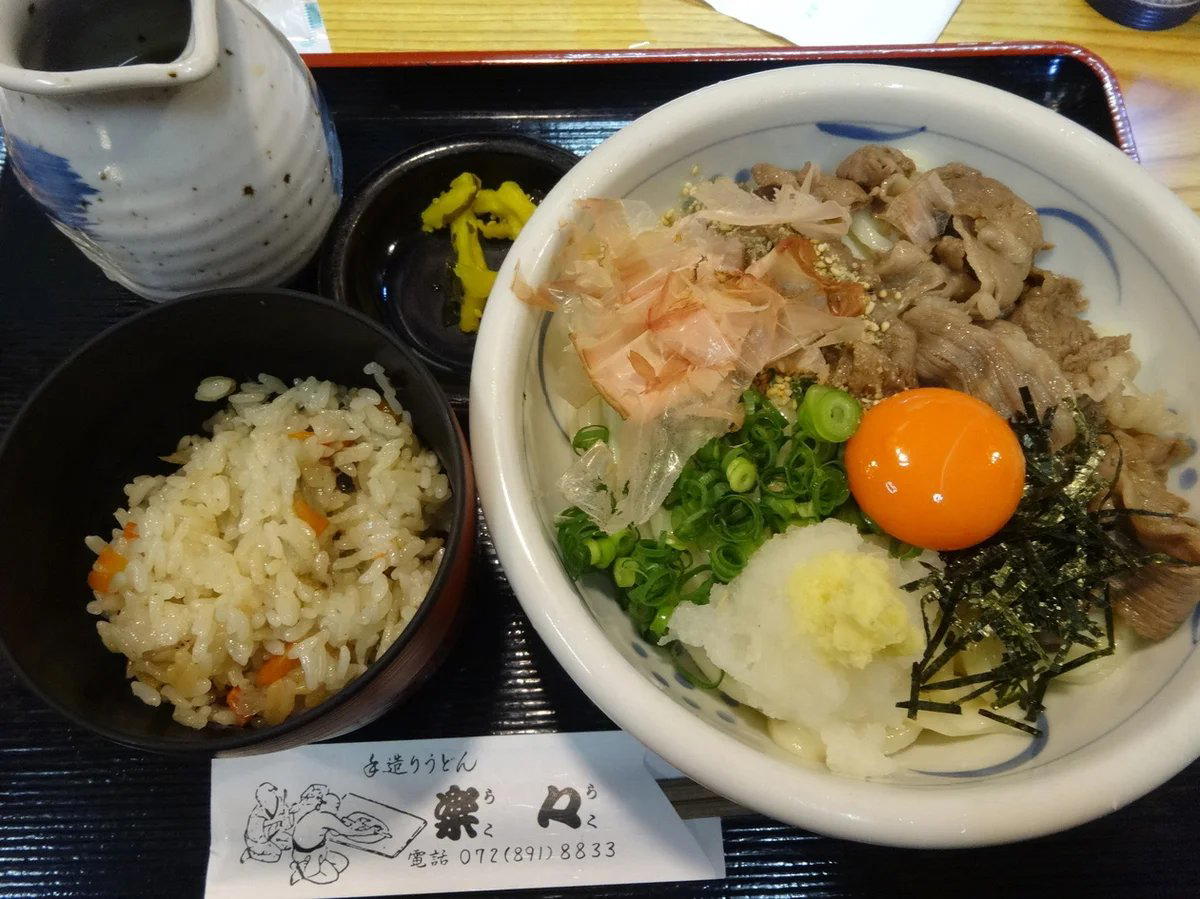
In Katano, a quiet residential city in northeastern Osaka Prefecture, Tezukuri Udon Rakuraku represents a format of handmade udon production that prioritises craft over scale. The name itself signals intent: tezukuri means handmade, and rakuraku suggests ease or comfort, pointing toward a neighbourhood-facing operation rather than a destination dining circuit. For visitors exploring the Osaka region beyond its metropolitan core, this is where everyday Japanese noodle culture lives closest to its working origins.

Pearl is the En Primeur Club membership app, where members save venues, book tables and use the concierge.
Where Everyday Noodle Culture Operates at Its Most Honest
Arrive at the address in Ikuno, Katano, and the immediate context tells you something that no press release would: this is not the kind of restaurant that courts attention. Katano sits in the northeastern reach of Osaka Prefecture, beyond the transit hubs that funnel visitors toward Namba or Shinsaibashi, and the streets around 6 Chome-6-1 Ikuno are residential in the way that matters most to understanding what the food means here. There are no design-forward facades, no reservation queues spilling onto the pavement. What you find instead is the architecture of a working neighbourhood, and a udon shop that belongs to it rather than performing for it.
That physical context is not incidental to the eating. In Japan, the most telling indicator of a noodle shop's character is often the street it occupies. The further it sits from tourist infrastructure, the more likely its menu and pricing reflect local demand rather than visitor expectations. Tezukuri Udon Rakuraku, with its tezukuri designation, places itself in a specific and meaningful tradition: handmade udon, produced on-site rather than sourced from a central commissary or a commercial noodle supplier.
The Handmade Imperative and Why Sourcing Shapes the Bowl
The category of tezukuri udon in the Osaka and greater Kansai region sits at a distinct remove from the industrial udon that dominates convenience food culture across Japan. The distinction begins with flour. Sanuki-style udon, the dominant reference point for the region's noodle tradition, traditionally depends on domestic wheat varieties selected for their gluten content and moisture absorption. In a shop where noodles are made by hand on-site, those sourcing decisions are visible in the final product in ways that machine-processed noodles cannot replicate: the slight irregularity of thickness along the strand, the chew that comes from hand-kneading rather than mechanical rolling, and the way the noodle holds heat and broth differently across the duration of a bowl.
This matters because Kansai udon and Sanuki udon represent two distinct traditions in Japanese noodle culture. Kansai-style udon tends toward a softer, more yielding texture and a lighter dashi broth, often built from kombu and a delicate bonito blend. Sanuki-style, associated with Kagawa Prefecture, is firmer and more aggressively chewy. A handmade shop in the Osaka area occupies a space between and around those traditions, and the sourcing of wheat, the ratio of salt to water, and the rest time of the dough before cutting all constitute meaningful variables. For a tezukuri operation, those decisions are made daily rather than outsourced.
Across the Kansai region, handmade udon shops represent a smaller and slower-moving category than their machine-produced counterparts. Venues like HAJIME in Osaka or Gion Sasaki in Kyoto operate at the haute end of the regional dining spectrum, while neighbourhood udon shops occupy the opposite register but with their own exacting standards. The handmade designation is not a marketing distinction in that context; it is a production commitment that imposes daily labour costs and limits output volume in ways that a commercial supplier relationship does not.
Katano as a Dining Context
Katano is not a city that appears on the standard Osaka Prefecture dining itinerary, and that omission reflects a broader pattern in how Japanese food tourism organises itself. The Keihan Electric Railway connects Katano to Osaka's main network, making it accessible from the city without requiring significant transit planning, but most visitors to the region exhaust their attention in Osaka proper or make day trips toward Nara or Kyoto. That means Katano's food culture, including its neighbourhood noodle shops, functions primarily for residents rather than for outside audiences.
That insularity, where it exists in Japanese food culture, tends to produce a particular kind of quality signal: consistency over showmanship. A shop that serves the same neighbourhood week after week cannot rely on the tolerance that first-time visitors extend to destination restaurants. Its repeat clientele is also its most demanding critic. For context on how regional Japanese dining fits into a broader Osaka Prefecture picture, our full Katano restaurants guide maps the city's options across categories.
The comparison set for a tezukuri udon shop in a city like Katano is not the high-end kaiseki counters or the Michelin-circuit venues that draw international attention. Venues like Harutaka in Tokyo or akordu in Nara and Goh in Fukuoka represent the category of Japanese dining that commands international planning and advance booking. Rakuraku sits in an entirely different register, one where the relevant comparison is other neighbourhood udon shops across the Osaka basin, and where success is measured in regulars rather than in review cycles.
Planning a Visit
Reaching Katano from central Osaka is direct via the Keihan Katano Line, which runs from Kyobashi station into the northeastern suburbs. The address at 6 Chome-6-1 Ikuno places the restaurant in a quiet residential section of the city.
Visitors exploring the wider Kansai region may also find context in the dining cultures of adjacent destinations. The contrast between a neighbourhood tezukuri operation in Katano and the formal structure of venues like Denko Sekka in Hiroshima or the international frame of reference provided by Le Bernardin in New York City and Atomix in New York City illustrates how wide the spectrum of serious food culture runs, from the handmade noodle shop that serves its postcode to the tasting-menu counter that serves a global audience. Other regional reference points include Birdland in Sakai, Bistro Ange in Toyohashi, and bodai in 那智勝浦町, each occupying distinct positions within Japan's regional dining fabric.
Frequently asked questions
Is Tezukuri Udon Rakuraku child-friendly?
The handmade udon format at a neighbourhood counter in Ikuno, Katano suits families well in practice. Udon is one of Japan's most broadly accepted dishes across age groups, and local spots of this type in the Osaka suburbs typically operate without the formality or noise restrictions that would make children unwelcome. Arrive early to avoid any wait.
What's the vibe at Tezukuri Udon Rakuraku?
The address in Ikuno, Katano places this squarely in residential Osaka suburbs, which sets the tone. Expect a working local counter rather than a destination dining room, the kind of place where regulars eat quickly and without ceremony. There is nothing here that resembles a tourist-facing operation.
How far is Tezukuri Udon Rakuraku from central Osaka, and how do I get there?
Katano sits in the northeastern suburbs of Osaka Prefecture, reachable via the Keihan Katano Line from Kyobashi station. The restaurant's address is in Ikuno, Katano, a residential area that sees very little through-traffic from visitors based in the city centre. The train journey puts it within practical range for a dedicated lunch trip without requiring an overnight stay.
What should I order at Tezukuri Udon Rakuraku?
The name tezukuri means handmade, so the udon itself is the point. In the Kansai tradition, the broth tends toward a lighter, dashi-forward style distinct from the darker Kanto preparations, and the noodle texture is the variable that separates a serious tezukuri counter from a standard shop. Follow what the table next to you orders, in a neighbourhood spot like this in Katano, the regulars have already done the fieldwork.
Where is Tezukuri Udon Rakuraku in Katano?
Tezukuri Udon Rakuraku is located at 6 Chome-6-1 Ikuno, Katano, Osaka 576-0054, Japan, Katano.
Comparable Spots, Quickly
Comparable venues nearby, for context on price, style, and recognition.
| Venue | Cuisine | Price | Awards | Notes |
|---|---|---|---|---|
| Tezukuri Udon RakurakuThis venue (the venue you are viewing) | Handmade Udon | $10–20 | Tabelog 100 #32 | Not listed |
| 楽々 | Handmade Udon | $10–20 | Tabelog 100 #32 | 幾野 |
| やまざと | Traditional Japanese Soba | Not listed | Not listed | 西祖谷山村 |
| Akaishi Shokudou | Okinawan Yaeyama Soba | $10–20 | Not listed | Ibaruma |
| Rishiri Ramen Miraku | Hokkaido Rishiri Ramen | $10–20 | Not listed | Kutsugata, Rishiri Island |
| ペッパーランチ | Japanese Pepper Steak Rice | Not listed | Not listed | 茂里町 |
Recognition history
Dated appearances from independent guides and award organizations, with the underlying list record or original source where available.
Tabelog 100 #32 · No. 32
Tabelog · Tabelog 100 - Udon - WEST - 2024
Continue exploring
More in Katano
Restaurants in Katano
All restaurants in Katano →

Bars in Katano
Browse all →

Hotels in Katano
Browse all →

Wineries in Katano
Browse all →
Details
- Rustic
- Cozy
- Casual Hangout
- Sake Program
- A La Carte
- Counter Dining
Current opening hours
- Monday
- Closed
- Tuesday
- Closed
- Wednesday
- 11 AM–3 PM
- Thursday
- 11 AM–3 PM
- Friday
- 11 AM–3 PM
- Saturday
- 11 AM–3 PM
- Sunday
- 11 AM–3 PM
Hours can change for holidays and private events. Hours as of .
Casual residential neighborhood setting with counter and table seating.