
Okegawa’s udon culture is built on everyday repetition rather than spectacle, and Teuchi Udon Matsuya belongs to that serious, low-price end of the craft. Its Tabelog Udon EAST 100 selections in 2020, 2022 and 2024 give it a credentialed place in Saitama’s noodle conversation without changing the appeal: hand-made wheat noodles, curry udon, and a compact house-restaurant format.
Pearl is the En Primeur Club membership app — saves, bookings, and concierge access live there. Same editors, same standards.
- Address
- 埼玉県桶川市寿1-11-18
- Phone
- +81487711608
- Website
- tabelog.com
- Directions
- Get directions
 Saves & bookings on Pearl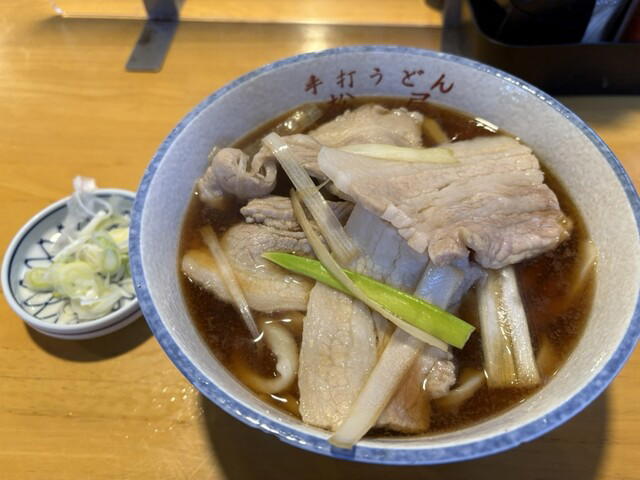
Approaching a small udon shop in a Saitama commuter city sets expectations differently from arriving at a polished Tokyo counter. The point is not theatre. It is wheat, water, kneading, and turnover: the quiet mechanics that make hand-made udon a daily food rather than a luxury performance. In Okegawa, that matters. The city is close enough to Tokyo for day-trip eating but far enough from the capital’s dining machinery that a noodle shop is judged less by décor than by consistency, price discipline, and how directly it serves its neighbourhood.
Teuchi Udon Matsuya fits that category with unusual clarity. Its recognition in Tabelog’s Udon EAST 100 in 2024 places it among a selective group of udon specialists, yet the format remains rooted in the everyday: udon and curry udon, modest pricing, and a local noodle-shop feel. That combination says a great deal about Saitama’s udon identity. This is not a rarefied tasting-menu interpretation of noodles; it is craft applied to a food that local families and regulars can return to without ceremony.
Hand-made udon as Saitama's practical luxury
Japanese udon is often discussed through regional archetypes: Sanuki’s firm, square-edged pull; Inaniwa’s thinner, silkier lines; Musashino’s rustic chew across western Tokyo and Saitama. Okegawa’s appeal belongs to the broader Kanto wheat belt, where udon has long functioned as a grain culture food rather than a restaurant affectation. In that context, hand-made noodles carry weight because the labor is visible in the product category itself. “Teuchi” signals hand work, and in udon that usually means a closer relationship between flour strength, hydration, resting time, and cut than a factory noodle can offer.
The ingredient story here is therefore not about named farms or luxury produce. It is about wheat as the central ingredient and about how a narrow menu keeps attention on texture. Curry udon adds another Kanto comfort register: a bowl where noodle structure has to hold against a thicker, seasoned broth. That is a useful test for a small udon shop because weak noodles disappear under curry; stronger ones remain legible. The presence of both udon and curry udon gives diners two readings of the same craft, one cleaner and one more enveloping.
Within Okegawa, comparison sharpens the point. Teuchi Udon Ishizuka occupies a nearby hand-made udon lane, while Teuchi Udon Matsuya stays in the sub-¥1,000 bracket. That difference is not merely accounting. It marks a democratic end of serious noodle dining, where recognition and affordability can coexist. Against out-of-metro casual peers such as Chuka Soba Yoshikawa Ageo ten or Jinenjo, the draw is not breadth of category but the narrower claim of udon craft.
A small room with award-level discipline, not award-level formality
Tabelog’s Hyakumeiten lists are useful in Japan because they often catch specialists that Michelin-style systems may overlook: shops built around a single staple, modest settings, and local demand. Selection for the Udon EAST 100 in 2024 gives this address a clear signal within its category. The current Tabelog score of 3.71 reinforces that it is being assessed inside a competitive noodle field, not as a generic neighbourhood lunch stop.
The shop’s scale matters. A modest local restaurant has limited slack, so the experience depends on timing, turnover, and a willingness to eat within the rhythm of a small udon specialist. Those details shape the meal as much as the noodles do. This is the kind of place where a late, leisurely arrival is a weaker strategy than treating the stop as a planned part of the day.
The value setup also preserves the old-school frame: both lunch and dinner are listed in the - JPY 999 range. For travellers used to Tokyo’s increasingly elaborate restaurant systems, that detail is not incidental. It is part of the difference between capital-city occasion dining and suburban craft shops that operate on lean, familiar routines. The appeal is practical as much as culinary: go for udon, keep expectations focused, and let the shop’s category discipline do the work.
How to place it in an Okegawa eating day
Okegawa does not ask to be eaten like Ginza or Kyoto. It rewards narrower itineraries: one strong noodle shop, a walk around the city, and a practical sense of timing. For readers mapping a meal rather than a full dining circuit, start with our full Okegawa restaurants guide. If the visit extends beyond lunch, the wider city rails are better handled through our full Okegawa hotels guide, our full Okegawa bars guide, our full Okegawa wineries guide, and our full Okegawa experiences guide.
For a broader Japan dining map, the contrast is instructive. Other regional specialists across Japan show how single-category focus differs by city and price band, from everyday noodle counters to more elaborate casual dining rooms. Even Japanese-format venues outside Japan underline the same point from another angle: when the category is narrow, execution carries the argument.
The editorial case for Teuchi Udon Matsuya is not that it reinvents udon. It is that Okegawa’s noodle culture does not need reinvention to be worth attention. A modest spend, 2024 Hyakumeiten recognition, and a focused udon identity make it a precise example of how serious everyday food survives outside Japan’s larger dining headlines.
Quick Comparison
Comparable venues by cuisine and price in the same metro.
| Venue | Cuisine | Price | Notes |
|---|---|---|---|
| Teuchi Udon Matsuya | Traditional handmade udon & curry udon | $ | Okegawa |
| Teuchi Udon Ishizuka | Traditional hand-made udon | $ | Okegawa |
| 三たてそば 長畑庵 | 三たて蕎麦 | $ | 長畑 |
| Mingei Chadokoro Fukatsuya | Traditional Japanese Tea House | $ | Fukuyama City |
| Teuchi Udon Matsuna | Handmade Udon | $ | Urawa |
| asakanakicchinruburu | Hiroshima okonomiyaki & fish deli kitchen-café | $ | Asaka |
Recognition history
Dated appearances from independent guides and award organizations, with the underlying list record or original source where available.
Tabelog 100 #37 · No. 37
Tabelog · Tabelog 100 - Udon - EAST - 2024
Continue exploring
More in Okegawa
Restaurants in Okegawa
Browse all →




Bars in Okegawa
Browse all →



Hotels in Okegawa
Browse all →



Wineries in Okegawa
Browse all →
At a Glance
- Classic
- Cozy
- Rustic
- Solo
- Family
- Casual Hangout
- Group Dining
- Standalone
A simple, house-like neighborhood udon shop with a nostalgic, classic feel and a cozy, casual atmosphere focused on quick daytime meals rather than lingering.
Know Before You Go
- Reservations
- Walk in friendly
- Getting there
- 埼玉県桶川市寿1-11-18