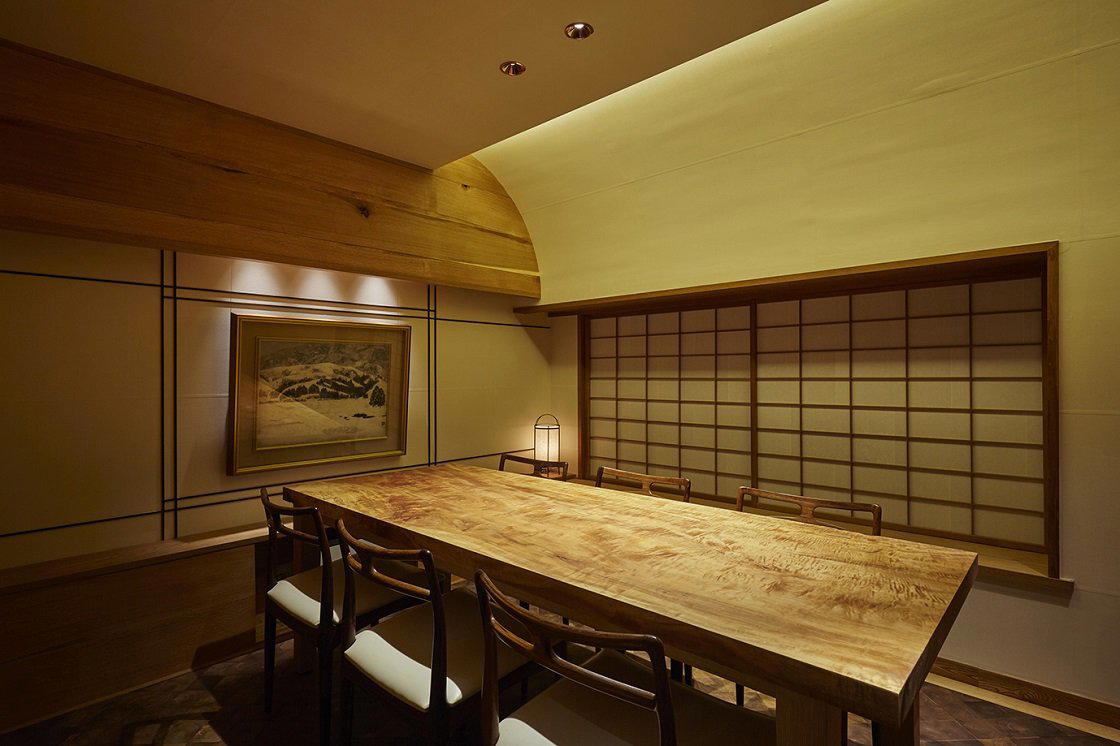
Tabelog 100 #92
Our verdict
Tenta sits in Osaka’s Sonezakishinchi/Kita-ku dining orbit as a high-price, membership-based Korean, Asian and ethnic restaurant with only 10 seats and two groups per day. Recognition on Tabelog’s Asian cuisine / Ethnic cuisine WEST 100 list in 2022, 2023 and 2024 places it in a narrower category than Osaka’s mainstream luxury counters.

Pearl is the En Primeur Club membership app, where members save venues, book tables and use the concierge.

In Osaka, the mood changes block by block: office towers thin out, late-night dining rooms sit behind discreet façades, and the city’s expense-account culture can feel more private than theatrical. That setting matters for Tenta because Osaka’s premium dining scene is often read through sushi, kappo and wagyu, while high-priced Korean and broader Asian formats occupy a smaller, harder-to-parse tier. Here, the format is part of the appeal: a premium restaurant whose public information is selective, making access and planning important before the menu ever enters the discussion.
The restaurant’s public category is Korean, Asian and Ethnic, and that combination says more about contemporary Osaka than a simple cuisine label can. The city’s upper-end Korean dining has moved beyond easy shorthand; at this price tier, Korean and broader Asian identity can sit beside Japanese hospitality expectations, longer service pacing and careful drinking. For travellers, the useful point is not to over-define the room from outside, but to understand Tenta as part of a more access-conscious side of Osaka dining.
Osaka's premium Korean dining has moved into luxury-counter territory
Tenta’s position is written less through public biography than through format and recognition. It operates in a premium Osaka context where the details available to diners are selective, and where the act of securing a table can matter as much as reading a menu in advance. That places the experience closer to Osaka’s access-led luxury dining culture than to the city’s more public Korean dining rooms. The location should simply be understood as Osaka, with advance planning forming part of the operating model.
The Tabelog signal is useful here because it classifies the restaurant inside Korean, Asian and Ethnic categories rather than the more heavily covered Japanese fine-dining categories. Its 2024 Tabelog Hyakumeiten recognition gives the venue a clear public marker, and the 2024 listing carries a Tabelog score of 3.68. In Japan, where Tabelog ratings can be conservative at the higher end, that score, combined with list placement, marks a restaurant with committed demand rather than broad walk-in visibility.
The current direction is also access-led. A carefully managed premium restaurant produces a different kind of meal from the high-turnover dining that defines much of Osaka. Planned meals are part of the service language, and the room is best read as a hosted setting rather than a casual drop-in stop. This is not simply about cuisine type; it is about pacing and the expectations that come with a premium restaurant whose public profile is relatively narrow.
The meal sits between Korean identity, broader Asian framing and Osaka hospitality
Osaka rewards restaurants that understand generosity, but at Tenta the more interesting signal is restraint: the public category spans Korean, Asian and Ethnic rather than locking the restaurant into a single, easy frame. That matters because Korean cooking in Japan is often publicly associated with grill smoke, heat and convivial volume. At this level, the category can become quieter and more formal, with a format designed for longer, planned meals.
The appeal also complicates the usual luxury-restaurant assumptions. Rather than treating the restaurant as a simple status booking, it is better understood as a premium Osaka room where access, mood and context shape the experience. In a city where many high-end restaurants are defined as much by booking culture as by cuisine, Tenta creates a specific overlap: high-spend dining, selective public detail and a category that remains less common than sushi, kappo or wagyu at the top end.
There are practical limits. The restaurant sits in a dinner price band of JPY 30,000 to JPY 39,999, which puts it firmly in Osaka’s premium tier. The result is not casual Osaka hospitality with luxury pricing attached; it is a managed restaurant with high cost, selective access and a relatively narrow public footprint.
Where it fits in an Osaka dining itinerary
For travellers, Tenta belongs in the part of an Osaka itinerary reserved for access-dependent dining, not spontaneous eating. The city’s pleasure is that both modes can coexist: a planned dinner in Osaka one night, then bakeries, casual counters, bars and neighbourhood restaurants the next. For wider planning, start with Our full Osaka restaurants guide, then build the rest of the trip through Our full Osaka hotels guide, Our full Osaka bars guide, Our full Osaka wineries guide and Our full Osaka experiences guide.
Osaka’s range is better understood through contrast than hierarchy. Casual and specialist references across the city might include cafés, bakeries, local snack counters, pizza specialists, Italian rooms and other unnamed dining rooms that sit far from Tenta’s premium, access-led style.
The editorial case for Tenta is not that it represents Osaka as a whole. It represents a narrower development: Korean and Asian fine dining adopting the pacing and access codes long associated with Japan’s small luxury counters, while retaining enough category flexibility to sit outside the usual sushi, kappo and wagyu map. That is a specific slice of the city, and a telling one.
Frequently asked questions
Can I bring kids to Tenta?
Confirm current guest policies directly when booking. Tenta is in Osaka.
What's the overall feel of Tenta?
Expect a premium, access-conscious Osaka restaurant rather than casual walk-in dining. Tabelog selected Tenta for its 2024 Korean, Asian and Ethnic recognition, and the public listing carries a score of 3.68.
What price level is Tenta?
Pricing at Tenta is listed as JPY 30,000 - JPY 39,999.
What is Tenta known for?
Tenta is known as a Korean, Asian and Ethnic restaurant in Osaka with 2024 Tabelog Hyakumeiten recognition.
In Context
Comparable venues nearby, for context on price, style, and recognition.
| Venue | Cuisine | Price | Awards | Notes |
|---|---|---|---|---|
| TentaThis venue (the venue you are viewing) | Members-only Modern Korean Fine Dining | $150–200 | Tabelog 100 #92 | Not listed |
| Tenpa | Korean Royal Cuisine (Members-Only) | Not listed | Tabelog 100 #35 | Kita-ku (Kitashinchi), Korean Royal Cuisine (Members-Only) |
| Rakuraku Udon | Handmade Udon | $10–20 | Not listed | Katano, Handmade Udon |
| KOBEキッチン MUGUNI | Omurice-focused Yoshoku (Japanese Western-style) | $20–30 | Tabelog 100 #14 | Amerikamura, Modern Omurice with Kobe Beef |
| Ult Coffee Roasters | Kyomachibori, Specialty Coffee Roasters | $10–20 | The World's 100 Best Coffee Shops #24 | Not listed |
| Chitose (千とせ) | Osaka-style Okonomiyaki | $10–20 | Not listed | Minami Horie, Osaka-style Okonomiyaki |
Recognition history
Dated appearances from independent guides and award organizations, with the underlying list record or original source where available.
Tabelog 100 #92 · No. 92
Tabelog · Tabelog 100 - Asian cuisine / Ethnic cuisine - WEST - 2024