
Tabelog 100 #14
Our verdict
MUGUNI belongs to Osaka’s yoshoku tradition: Japanese Western cooking measured through omurice, curry, and lunch-counter discipline rather than luxury theatre. Its selection for Tabelog 100 - Yoshoku - WEST - 2025, alongside earlier Yoshoku Tabelog 100 selections in 2022 and 2020, makes it a serious reference point for this category in Nishishinsaibashi.

Pearl is the En Primeur Club membership app, where members save venues, book tables and use the concierge.
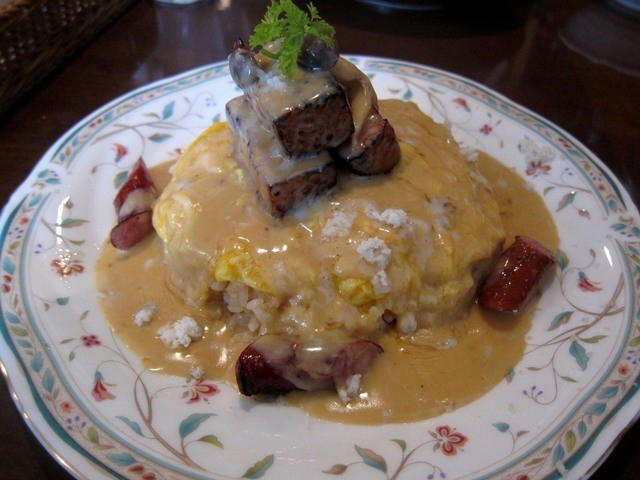
The menu
What to order
- Kobe beef omurice
- Omurice with Hayashi sauce
- Omurice with cream cheese and Hayashi sauce
Approaching Osaka, the dining rhythm changes from department-store polish to compact rooms built for repeat eating. Yoshoku fits that geography well. It is Western food translated through Japanese kitchens: familiar rice plates, sauces, and everyday combinations that rely less on imported nostalgia than on the city’s appetite for lunch that feels complete without ceremony. MUGUNI sits inside that tradition, with omurice, yoshoku, and curry defining the frame rather than a tasting-menu narrative.
Osaka is often flattened into street-food shorthand, but its serious everyday cooking has another register: small shops where technique shows through ordinary ingredients. Rice, eggs, sauce, and curry carry more weight here than luxury produce. That is the point of yoshoku when it works. The food reads as familiar, but the margin for error is narrow because there are few distractions. A soft omelette over rice, a curry with depth, or a Western-style sauce adjusted to Japanese restraint can expose kitchen discipline faster than a longer menu.
Yoshoku in Osaka is judged by restraint, not spectacle
Yoshoku began as adaptation, but in Kansai it has become its own category of craft. The cooking is not French, not diner food, and not home cooking, though it borrows from all three. Osaka’s version tends to reward concentration: rice prepared to work with sauce, eggs handled for texture, curry calibrated for balance, and portions shaped around lunch rather than display. MUGUNI’s category placement in omurice, yoshoku, and curry puts it in the part of the scene where ingredients are modest but technique is exposed.
The Tabelog Hyakumeiten Yoshoku 2025 recognition matters because yoshoku is a crowded, highly local category. The list does not function like a luxury ranking; it signals sustained attention within a genre where regular customers and specialist diners both know what the format should deliver. MUGUNI’s listed Tabelog score of 3.60 adds a useful public-facing signal. This is not framed as a luxury destination, but as a place clearly placed inside the regional conversation for Japanese-style Western cooking.
Within Osaka, that puts the restaurant in a different decision bracket from higher-spend beef or counter formats. Karen Oosaka shinsaibashi ten operates in a different dining register, while SUGALABO V and Teppan Toyoshimake belong to a more occasion-led conversation. MUGUNI is closer to the city’s lunch craft: a focused room, familiar categories, and a price band that keeps attention on execution rather than ceremony. For travellers, that distinction matters. Osaka dining should not be read only through premium sushi, beef, or kaiseki; yoshoku is one of the clearest ways to taste how the city treats imported forms as local food.
Omurice and curry make sourcing visible through everyday ingredients
The ingredient story here is not about named farms or rare seafood. It is about how ordinary components behave under pressure. Omurice depends on egg handling, rice texture, and sauce balance; curry depends on aromatics, spice, and time. In yoshoku, sourcing usually becomes visible through consistency rather than announcement. A kitchen can hide less behind garnish when the plate is built around eggs, rice, curry, and sauce.
That is why MUGUNI’s compact genre focus has editorial weight. Omurice and curry are not minor comfort foods in Japan; they are benchmark dishes. A strong version must manage contrast: softness against structure, sweetness against acidity or spice, richness without fatigue. Osaka diners are unforgiving about this kind of cooking because the reference points are everywhere, from casual counters to long-running local restaurants. Recognition in the 2025 Tabelog Hyakumeiten Yoshoku selection places the restaurant among the names being measured by those expectations.
The surrounding city gives useful context. A traveller can build an Osaka food day around different forms of everyday precision: casual snacks, bakery craft, coffee-shop pacing, Italian cooking, or other focused dining rooms. The thread is not cuisine type; it is how Osaka rewards formats that do a narrow thing with confidence.
How to place it in an Osaka itinerary
MUGUNI works as a midday anchor rather than a grand evening production. The format is casual, and the appeal is strongest for diners who care about Japanese Western cooking as a serious genre. It is also a useful corrective to the idea that Osaka’s food identity is only about high-energy street eating. Osaka is dense, commercial, and easy to over-schedule; a yoshoku stop gives the city a slower, plate-focused centre of gravity.
For a broader reading of the city, pair this kind of lunch with other Osaka categories rather than another similar meal. Use Our full Osaka restaurants guide for dining context, then separate the rest of the trip through Our full Osaka hotels guide, Our full Osaka bars guide, Our full Osaka wineries guide, and Our full Osaka experiences guide. The comparison should be national as well as local: curry specialists, sake-led dining, and rice-focused casual formats all show how simple staples become serious when the format is disciplined.
Travellers extending beyond Osaka can map the same idea across Japan: beef-led dining, charcoal cooking, regional cooking, Vietnamese cooking through a Japanese urban lens, and Kyoto’s more restrained dining culture all offer different ways to read everyday technique. MUGUNI’s role is narrower and more revealing: it shows how Osaka treats yoshoku not as retro novelty, but as a living lunch craft with standards of its own.
Frequently asked questions
Is MUGUNI more mid-range or high-end?
Pricing at MUGUNI is listed as JPY 2,000 - JPY 2,999.
What part of town is MUGUNI in?
Osaka.
What are MUGUNI's hours?
Hours for MUGUNI are not specified in the provided venue information.
What's MUGUNI best at?
MUGUNI is strongest for yoshoku built around omurice and curry in Osaka. Its 2025 Tabelog Hyakumeiten Yoshoku recognition is the clearest trust signal here, and the listed lunch price sits at JPY 2,000 - JPY 2,999.
Comparable Spots, Quickly
Comparable venues at a similar level for quick context.
| Venue | Cuisine | Price | Awards | Notes |
|---|---|---|---|---|
| MUGUNIThis venue (the venue you are viewing) | Omurice-focused Yoshoku (Japanese Western-style) | $20–30 | Tabelog 100 #14 | Not listed |
| Seoul | Yakiniku (Japanese BBQ) with black wagyu beef | $30–50 | Tabelog 100 #48 | Naniwa |
| Miyabi Tei | Japanese Teppanyaki | $30–50 | Tabelog 100 #70 | Kita |
| curry restaurant BRUNO HEP NAVIO ten | Japanese Curry House | $10–20 | Tabelog 100 #8 | Kita |
| Restaurant Genchan | Japanese-Style Western (Yoshoku) Restaurant | $20–30 | Tabelog 100 #9 | Chūō |
| Shuhari Tanimachi yonchome ten | Traditional handmade soba & tempura | $10–20 | Tabelog 100 #73 | Chūō |
Recognition history
Dated appearances from independent guides and award organizations, with the underlying list record or original source where available.
Tabelog 100 #14 · No. 14
Tabelog · Tabelog 100 - Yoshoku - WEST - 2025
Continue exploring
More in Osaka
Restaurants in Osaka
All restaurants in Osaka →



Bars in Osaka
All bars in Osaka →

Hotels in Osaka
All hotels in Osaka →



Wineries in Osaka
Browse all →
Details
- Cozy
- Lively
- Intimate
- Solo
- Casual Hangout
- After Work
- Chefs Counter
- Standalone
- A La Carte
- Counter Dining
- Beer
- Wine
Current opening hours
- Monday
- 11 AM–3 PM
- Tuesday
- 11 AM–3 PM
- Wednesday
- 11 AM–3 PM
- Thursday
- 11 AM–3 PM
- Friday
- 11 AM–3 PM
- Saturday
- 11 AM–3 PM
- Sunday
- 11 AM–3 PM
Hours can change for holidays and private events. Hours as of .