Tabelog 100 #36
Our verdict
Tenfuku is an Omori tempura address with a fish-led Edomae focus, selected for Tabelog 100 Tempura 2025. The draw is the split personality of the format: rice-bowl lunches on one side, evening course dining on the other, with counter seating and private-room flexibility giving it a broader Tokyo use case than many specialist tempura rooms.

Pearl is the En Primeur Club membership app, where members save venues, book tables and use the concierge.
The menu
What to order
- Edomae tempura course
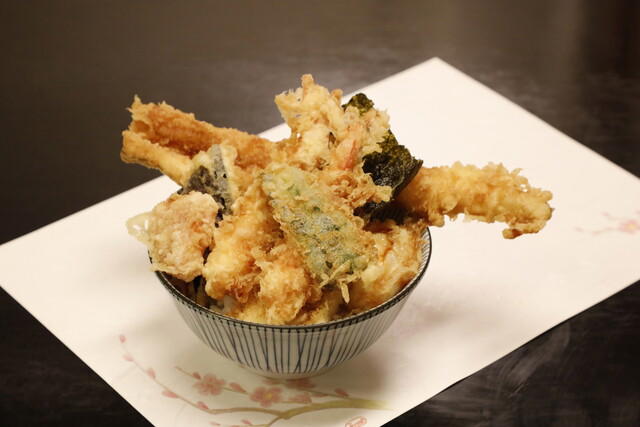
- Tendon (tempura rice bowl)
- Seasonal sashimi platter
- Sakura Shiokara Ten Don
- Ikasumi Curry Ten Don
- Mentaiko Mayo Ten Don
Approaching Tenfuku in Tokyo, the city feels less theatrical than it can in its most internationally familiar dining districts: a restaurant culture shaped as much by regular meals as by special occasions. That setting matters for tempura. The cuisine can be presented as ceremony, but it also has an urban, immediate, oil-driven side, with seafood and rice-bowl formats remaining central to how many diners understand it. Tenfuku belongs to that practical Tokyo lineage rather than to a purely luxury-dining version of the genre.
Tokyo tempura is often misunderstood by visitors who treat it as a side dish. In its serious form, it is a test of sourcing, batter control, oil management, and timing. Ingredients are not supporting actors; they are the reason the format exists. The restaurant’s public category signals tell the story clearly: tempura, ten-don, and seafood, with seafood given particular emphasis. That places the cooking inside a sourcing-led tradition where the kitchen is judged by how cleanly it frames ingredients rather than how loudly it decorates them.
Tokyo tempura, with seafood doing the heavy lifting
The stronger Tokyo tempura rooms tend to make a choice: either they chase luxury through course structure, or they preserve the rice-bowl culture that made the cuisine democratic. Tenfuku is interesting because its public profile keeps both ideas in view. Its Tabelog Tempura 100 recognition for 2025 gives it a public benchmark inside Japan’s tempura category, while the restaurant’s listed categories also acknowledge the everyday pull of ten-don. That combination says more about Tokyo than a purely formal tasting room could. This is a city where a specialist kitchen can serve different appetites without diluting its identity.
Ingredient sourcing is the useful lens here. Tempura depends on ingredients that can survive direct exposure to hot oil without losing character. Seafood-led tempura asks for precision because there is nowhere to hide: batter thickness, oil temperature, portion sequence, and seasoning all show themselves quickly. A kitchen that lists seafood so prominently is making a claim about freshness and handling, but the more important editorial point is restraint. Tempura’s sophistication lies in subtraction.
Compared with the sushi-heavy end of Tokyo dining, where venues such as Sushidokoro Shishi and Matsunozushi speak to another exacting Japanese discipline, tempura occupies a narrower lane for many travellers. It is less globally decoded, and that makes it more revealing. Sushi has taught diners to read rice temperature, knife work, and aging; tempura asks them to read oil, coating, and the moisture inside an ingredient. For readers mapping a broader Tokyo itinerary, Our full Tokyo restaurants guide is the useful companion, while cross-category planning sits better in Our full Tokyo hotels guide, Our full Tokyo bars guide, Our full Tokyo wineries guide, and Our full Tokyo experiences guide.
A format that separates everyday appetite from occasion dining
Tokyo restaurants often draw a hard line between casual meals and more deliberate evenings. Tenfuku’s public price data suggests that distinction without needing to overstate the format: lunch is listed at JPY 1,000 - JPY 1,999, while dinner is listed at JPY 10,000 - JPY 14,999. The gap matters. Ten-don rewards immediacy and appetite, with rice anchoring the bowl; a more expensive dinner context asks diners to slow down and pay closer attention. The same technique behaves differently depending on structure, which is why this kind of price spread can teach a diner more about tempura than a single-mode counter.
The appeal is not only in cost, but in use case. Tenfuku’s categories place it at the intersection of tempura, ten-don, and seafood, which makes it legible to both focused tempura diners and those looking for a more direct rice-bowl experience. That breadth is useful in Tokyo, where specialist restaurants can sometimes feel difficult to decode from the outside. Here, the public signals are straightforward: oil, batter, seafood, and rice are the framework.
There is also a pacing signal worth reading. Tempura can be difficult to pair and to sequence because oil, salt, and delicate seafood require restraint rather than power. Whether a diner approaches Tenfuku for a simpler bowl or a more substantial meal, the same central question applies: how cleanly does the cooking carry heat, texture, and ingredient character? That makes the restaurant less about spectacle than about concentration.
Where it fits in a Tokyo dining map
Tokyo gives this restaurant a different rhythm from dining rooms that compete through spectacle. Tenfuku’s public case rests on category confidence and use case. Tabelog’s 2025 Tempura 100 recognition places it inside a serious conversation for the genre, while its listed categories preserve tempura’s two familiar faces: quick rice-bowl satisfaction and more measured seafood-focused eating. That is a useful distinction for travellers who already understand sushi and want another Japanese vocabulary.
Tokyo’s dining range can be disorienting, from casual cafés and morning rooms such as Coffee Tei Ruan and Kerala no Kaze no Morning to sushi specialists such as Matsunozushi and Sushidokoro Shishi. Other Tokyo dining rooms move through different formats, price points, and levels of formality, but Tenfuku’s appeal is more focused: tempura, ten-don, and seafood, with Tabelog recognition giving the listing a clear external marker. For readers connecting several meals in the city, it works best as part of a Tokyo plan rather than as a generic luxury stop.
The editorial case for Tenfuku is not that it performs luxury in an obvious way. It is that the restaurant sits in a category where technique, sourcing, and structure are inseparable. Seafood-led tempura rewards attention, and Tokyo gives it a grounded setting: less ceremonial than the city’s most formal counters, more serious than a casual fry shop, and credible enough to be named in Tabelog’s 2025 tempura selection.
Frequently asked questions
What's Tenfuku's location?
Tokyo.
What are Tenfuku's hours?
Current opening hours are not provided in the available verified data. Check directly with Tenfuku before planning a visit.
What should I budget for a meal at Tenfuku?
Pricing at Tenfuku is listed as Dinner: JPY 10,000 - JPY 14,999; Lunch: JPY 1,000 - JPY 1,999.
What has Tenfuku built its reputation on?
Tenfuku is selected for Tabelog Tempura 100 in 2025, with public categories listed as tempura, ten-don, and seafood. Its Tabelog score is listed as 3.63.
Is Tenfuku allergy-friendly?
Formal allergy protocols are not provided in the available verified data. For ingredient-specific concerns, contact the restaurant directly at +81-3-3766-1029.
Is Tenfuku a family-friendly restaurant?
Family-specific policies are not provided in the available verified data. Contact Tenfuku directly at +81-3-3766-1029 to confirm suitability for children or group meals.
Cost Snapshot
Comparable venues in the metro at similar price points.
| Venue | Cuisine | Price | Awards | Notes |
|---|---|---|---|---|
| TenfukuThis venue (the venue you are viewing) | Edomae Tempura & Tendon | $20–30 | Tabelog 100 #36 | Not listed |
| Shio Ramen Shinka | Traditional Shio Ramen | $10–20 | Not listed | Machida, Traditional Shio Ramen |
| Kinozen | Traditional Japanese Sweets | $10–20 | Not listed | Kagurazaka, Traditional Japanese Sweets |
| Kooriya Peace | Japanese Kakigori Shaved Ice | $10–20 | Not listed | Kichijoji, Japanese Kakigori Shaved Ice |
| Kajitsuen Riberu | Fruit Parlor | $10–20 | Not listed | Meguro, Fruit Parlor |
| Tonkatsu Aoki Kamata honten | Tonkatsu (Japanese pork cutlet) | $20–30 | Tabelog 100 #84 | Ōta, Tonkatsu (Japanese pork cutlet) |
Recognition history
Dated appearances from independent guides and award organizations, with the underlying list record or original source where available.
Tabelog 100 #36 · No. 36
Tabelog · Tabelog 100 - Tempura - 2025