
Our verdict
A kaiseki counter in Minamiaoyama that has climbed steadily through Opinionated About Dining's Japan rankings, from Recommended in 2023 to #418 by 2025, Tadenoha operates Tuesday through Saturday from 6 pm, positioning itself firmly in Tokyo's evening-only kaiseki tier. Chef Kiyofumi Kozuru leads the kitchen at this Riviera Minamiaoyama address, where the format and timing signal a focused, counter-led experience rather than a large-format dining room.

Pearl is the En Primeur Club membership app, where members save venues, book tables and use the concierge.
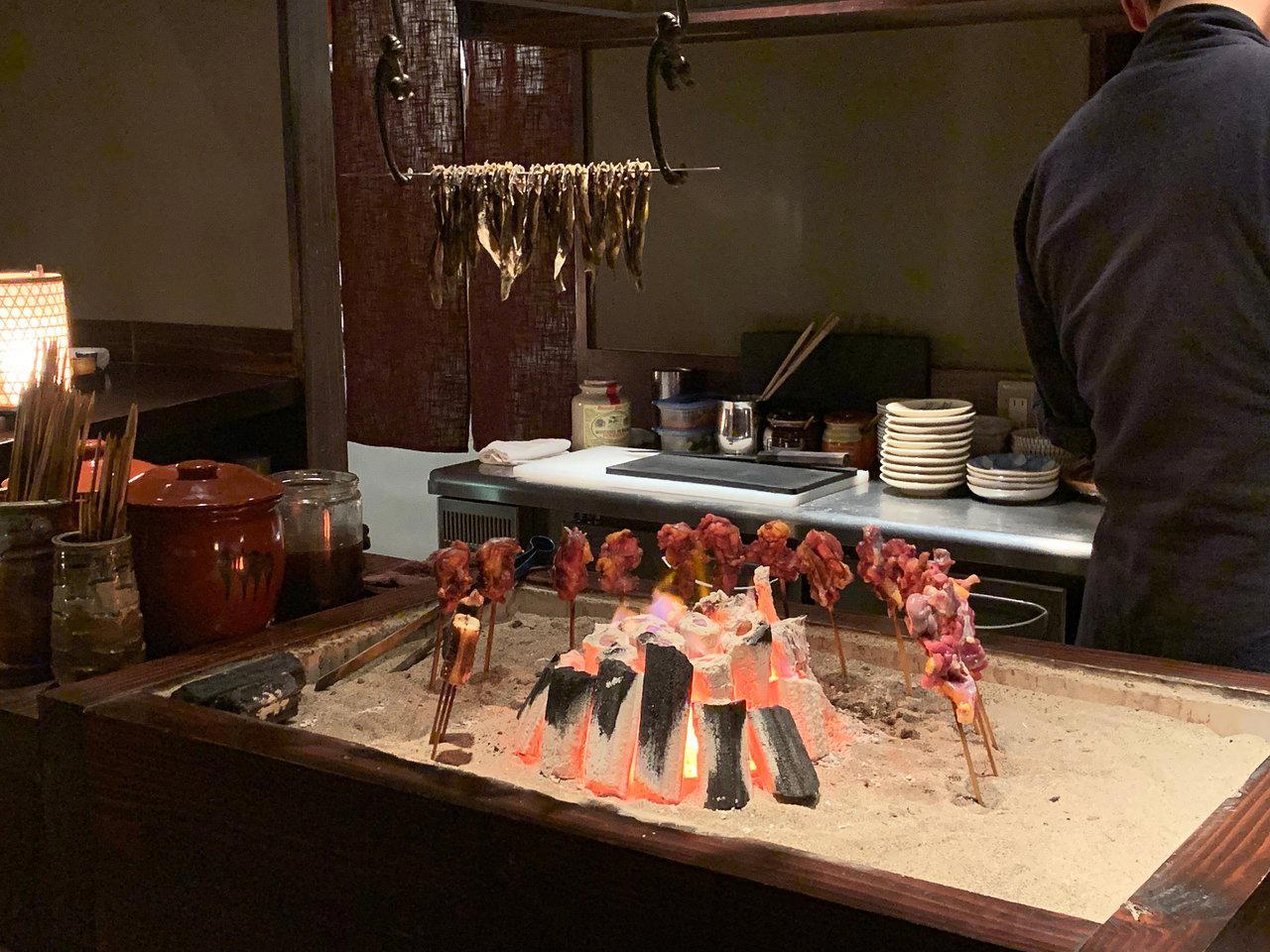
The menu
What to order
- Bear meat shabu-shabu
- Grilled duck
- Wild boar
- River ayu
- Grilled tachiuo
Kaiseki in Minami-Aoyama: The Neighbourhood and the Form
Tokyo's kaiseki scene does not concentrate in a single district the way Kyoto's does along the Kamogawa. Instead, it disperses across the city's premium residential and commercial pockets, with Minami-Aoyama occupying a particular tier: close enough to Omotesando money to support high covers, quiet enough on weekday evenings to allow the stillness that multi-course kaiseki actually requires. Tadenoha sits on the second floor of the Riviera Minamiaoyama building on 3 Chome, which places it among a cluster of destination dining addresses that draw from the neighbourhood's design-literate, internationally travelled resident base rather than from tourist flows.
That positioning matters for how kaiseki functions here versus how it functions in, say, Ginza or Roppongi. The format at this tier is almost always counter-led and evening-only, built around a fixed progression tied to the season, and priced to reflect the labour intensity that kaiseki demands. Tadenoha's Tuesday-through-Saturday operation, running 6 pm to midnight, fits that model precisely. Closed Mondays and Sundays, the schedule avoids the weekend tourist crush and signals a kitchen pacing itself over a smaller weekly window, a pattern common among smaller kaiseki operations that prioritise consistency over volume.
For readers building a Tokyo itinerary around Japanese seasonal cuisine, the Minami-Aoyama option occupies different territory than the Akasaka and Ginza alternatives. Akasaka Ogino and the Tokyo outpost of Kikunoi both operate in areas with higher foot traffic and more established kaiseki infrastructure; Tadenoha's address asks slightly more of the guest in terms of navigation, and in return tends to attract a more deliberate reservation.
The OAD Trajectory and What It Signals
Opinionated About Dining's annual Japan list is the most granular peer-reviewed ranking system covering the country's non-Michelin-tracked tier. Unlike the Guide Michelin, OAD rankings are driven by frequent-diner input rather than anonymous inspector visits, which means they tend to surface smaller, harder-to-reach operations that reward return visits. Tadenoha's progression through those rankings is a useful data point: Recommended in 2023, #462 in 2024, #418 in 2025. Three consecutive years of upward movement in a list covering thousands of Japanese restaurants represents a meaningful signal rather than a one-year anomaly.
The #418 rank in 2025 places Tadenoha in the solid mid-tier of OAD's Japan coverage, well below the 50 Best-adjacent names at the top of the list but clearly within the bracket of restaurants that regular fine-dining visitors to Japan seek out. In the context of Tokyo kaiseki, where the category runs from approachable neighbourhood kappo restaurants up through RyuGin-level kaiseki with full Michelin recognition, Tadenoha occupies the credentialed-but-intimate segment.
Chef Kiyofumi Kozuru leads the kitchen. In the OAD model, the kitchen team's reputation is built through repeat diner feedback over time rather than through a single critical visit, which means the ranking trajectory reflects accumulated assessment rather than a single moment of recognition. That's a different kind of trust signal than a Michelin star, and arguably more useful for predicting consistency on a specific visit.
Sake, Wine, and the Kaiseki Pairing Question
The editorial angle for Tadenoha that matters most to a certain kind of visitor is the drinks program. Kaiseki is one of the formats where the pairing question is genuinely complex: the dish progression moves through delicate dashi-based soups, raw preparations, grilled proteins, vinegared courses, and rice finales, each presenting different pairing challenges. Sake, the traditional match, handles most of the range, but the Tokyo kaiseki scene has increasingly incorporated wine pairings, particularly among restaurants drawing an international clientele or chefs with exposure to European training.
The Minami-Aoyama address is relevant here. The neighbourhood sits alongside Omotesando, which hosts a higher concentration of internationally minded dining than most Tokyo districts, and that context tends to produce drinks programs with more wine depth than the traditional Kyoto kaiseki model. Kyoto institutions like Ifuki and Ankyu tend to anchor their programs in sake, shochu, and the occasional whisky service; the Tokyo equivalents, particularly those in premium residential districts, are more likely to carry Burgundy alongside premium junmai daiginjo. Whether Tadenoha's cellar leans one way or the other is something to clarify at booking, but the location and positioning suggest a program designed to support both traditions rather than one alone.
For context on what premium kaiseki pairing looks like in the broader Japan market: restaurants in the OAD 300-500 range at this price point typically maintain a sake list selected by region and rice polishing ratio, sometimes with direct brewery relationships. Wine lists, where they exist, tend toward French whites for the lighter courses and aged Burgundy or northern Rhône for the grilled and simmered sections. The format encourages this specificity because the fixed menu structure makes pairing by course feasible in a way it isn't at à la carte restaurants.
Booking, Timing, and Practical Context
Tadenoha's Tuesday-through-Saturday schedule means availability windows are narrower than for seven-day operations. The late closing time of midnight leaves room for a longer sitting, a practical advantage for the kaiseki format, which can run three hours or more at the upper tier. Reservations should be treated as essential rather than optional; the OAD ranking trajectory and limited weekly operation both point toward a restaurant where same-week availability is uncommon.
The Riviera Minamiaoyama building is on 3 Chome-2-3 Minamiaoyama, Minato City. The second-floor location is standard for this category in Tokyo, where street-level retail rents make upper-floor dining rooms the norm for specialist counters. Omotesando Station is the most convenient access point via the Tokyo Metro Ginza, Chiyoda, and Hanzomon lines, placing Tadenoha within walking distance of a major interchange without being in the station's immediate tourist orbit.
For readers building a wider Tokyo dining itinerary around Japanese cuisine, the neighbourhood also hosts Aoyama Jin. Those looking to extend across categories can reference Hirosaku and Ajihiro for different points on the Japanese cuisine spectrum. For readers planning beyond Tokyo, the kaiseki tradition extends across Japan's culinary cities: Gion Sasaki in Kyoto represents the Kyoto lineage, while HAJIME in Osaka and Goh in Fukuoka show how kaiseki techniques have migrated into contemporary Japanese fine dining formats. Broader Japan coverage also includes akordu in Nara, 1000 in Yokohama, and 6 in Okinawa for readers mapping a wider itinerary.
The full EP Club city guides cover everything beyond the dining room: Tokyo restaurants, Tokyo hotels, Tokyo bars, Tokyo wineries, and Tokyo experiences.
Quick reference: Tadenoha, Riviera Minamiaoyama 2F, 3 Chome-2-3 Minamiaoyama, Minato City, Tokyo. Tuesday–Saturday, 6 pm–midnight. Closed Monday and Sunday. Reservations required. OAD Japan #418 (2025).
What Should I Eat at Tadenoha?
Tadenoha operates as a kaiseki counter under Chef Kiyofumi Kozuru, which means the menu is set and seasonal rather than à la carte. The kaiseki format follows a fixed sequence, typically moving through raw and lightly prepared courses in the early stages before building toward grilled, simmered, and rice-based finales. Guests do not choose individual dishes; the kitchen determines the progression based on what is at seasonal peak. This is standard practice across Tokyo kaiseki at this tier, and Tadenoha's OAD recognition across three consecutive years from 2023 to 2025 reflects a kitchen whose seasonal execution has earned repeat endorsement from frequent diners. The most practical pre-visit question is not what to order but whether dietary restrictions can be accommodated, worth confirming directly at the time of booking.
Price Lens
Comparable options at a glance, pulled from our tracked venues.
| Venue | Cuisine | Price | Awards | Notes |
|---|---|---|---|---|
| TadenohaThis venue (the venue you are viewing) | Wild Game Robatayaki | $100–150 | Not listed | Not listed |
| Harutaka | Edo-Style Omakase Sushi | $200–300 | 3 Michelin Stars · World's 50 Best #76 | Sushi |
| RyuGin | Modern Kaiseki | $500+ | 3 Michelin Stars · World's 50 Best #41 | Kaiseki, Japanese |
| L'Effervescence | Modern French with Japanese Influences | $200–300 | 3 Michelin Stars · World's 50 Best #69 | French |
| HOMMAGE | Modern French with Japanese Influences | $150–200 | 2 Michelin Stars · World's 50 Best #78 | Innovtive French, French |
| MAZ | Innovative Peruvian-Japanese Fusion | $150–200 | 2 Michelin Stars · World's 50 Best #28 | Innovative |
Recognition history
Dated appearances from independent guides and award organizations, with the underlying list record or original source where available.
Opinionated About Dining Top Restaurants in Japan Recommended
Opinionated About Dining
Full recognition history (4 entries)
Opinionated About Dining Top Restaurants in Japan Ranked #418
Opinionated About Dining
Opinionated About Dining Top Restaurants in Japan Ranked #462
Opinionated About Dining
Opinionated About Dining Top Restaurants in Japan Recommended
Opinionated About Dining
Continue exploring
More in Tokyo
Restaurants in Tokyo
All restaurants in Tokyo →



Bars in Tokyo
All bars in Tokyo →







Details
- Intimate
- Rustic
- Sophisticated
- Special Occasion
- Date Night
- Solo
- Chefs Counter
- Open Kitchen
- Sake Program
- Extensive Wine List
- Local Sourcing
- Farm To Table
- Counter Dining
- Omakase
- Sake
- Wine
- Allergy Accommodating
Current opening hours
- Monday
- Closed
- Tuesday
- 6 PM–12 AM
- Wednesday
- 6 PM–12 AM
- Thursday
- 6 PM–12 AM
- Friday
- 6 PM–12 AM
- Saturday
- 6 PM–12 AM
- Sunday
- Closed
Hours can change for holidays and private events. Hours as of .
Warm wood-based interior with U-shaped counter seating around a central charcoal hearth; intimate and quiet atmosphere befitting a chef-driven experience.