Our verdict
Sushimushi brings Japanese-style dining to Paide's central square at Keskväljak 8, making it one of the few Asian-leaning kitchens operating in Estonia's inland towns. The address alone signals something worth investigating: sushi in a small county capital points to a broader shift in how provincial Estonian dining has diversified over the past decade. For travellers moving between Tallinn and Tartu, Paide offers a quieter, less-toured stop.

Pearl is the En Primeur Club membership app, where members save venues, book tables and use the concierge.
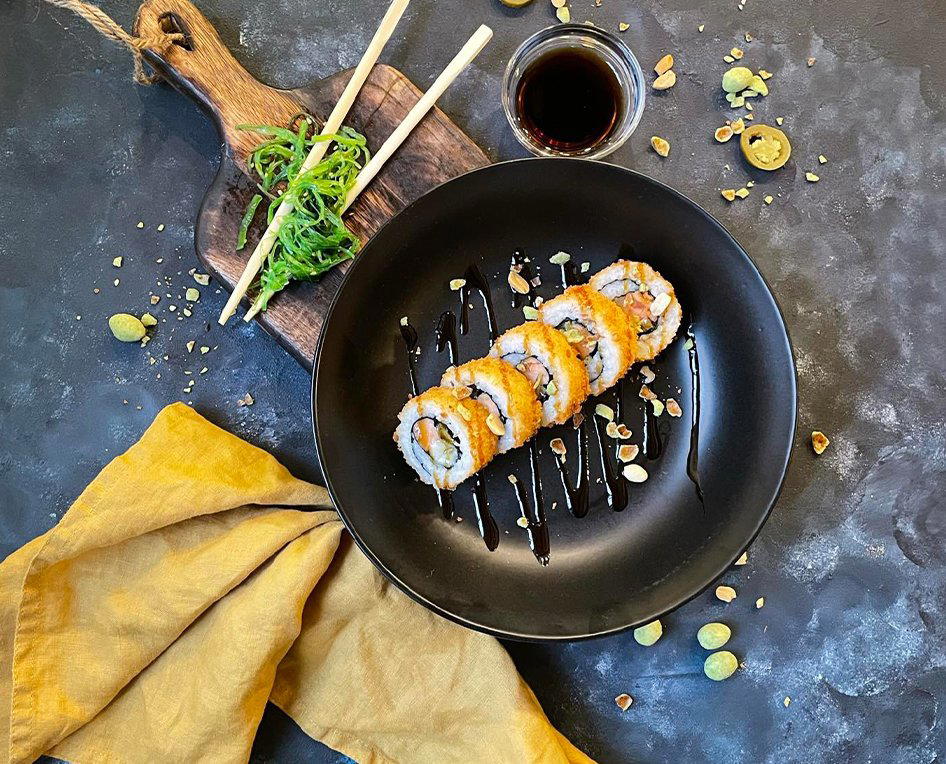
The menu
What to order
- Chef's special rolls
- Tempura rolls
- Tofu poke
Sushi in Järva County: What It Means That This Exists
Small-city dining in Estonia has followed a pattern familiar across the Baltic states: a wave of international formats, sushi among the most common, arrived in regional towns well after Tallinn's restaurant scene had already absorbed and refined them. In Paide, the county seat of Järva maakond with a population of roughly 8,000, that pattern is visible at Sushimushi on the central market square. The address, Keskväljak 8, places it at the geographic and social core of the town, not tucked into a side street but facing the square that functions as Paide's public living room. That positioning is a choice, and it says something about the confidence with which Japanese-influenced formats have settled into Estonian provincial life.
For context on the wider Estonian dining picture, the gap between Tallinn's top tier, where venues like 180° by Matthias Diether operate at a premium Estonian Fusion price point, and the regional towns has narrowed considerably since the mid-2010s. That narrowing is not uniform: it runs faster in formats with low equipment barriers, and sushi, with its reliance on sourcing discipline rather than elaborate kitchen infrastructure, has travelled particularly well into smaller Estonian cities.
Ingredient Sourcing and What It Demands in This Geography
The editorial question worth asking about any sushi operation in a landlocked Estonian county town is a sourcing one. Estonia has Baltic coastline, and the country's fishing industry supplies fresh catch to Tallinn markets and coastal kitchens with relative efficiency. The supply chain reaching Paide, situated roughly equidistant between the capital and Tartu, is a longer and more logistically complex one. Operations like Eva Sushi in Tartu, a larger city with better distribution infrastructure, face fewer sourcing headaches than an inland town of Paide's scale.
This matters for how you read a sushi menu in a place like Järva maakond. The premises of traditional Japanese omakase sourcing, daily market fish, direct supplier relationships, temperature-controlled transit from ports, are harder to replicate the further inland you go. Estonian sushi restaurants outside the coastal belt have largely adapted by leaning into cooked formats, rolls with cured or smoked fish, and locally available proteins rather than competing on live-market freshness with coastal peers. Whether Sushimushi follows this pattern or works against it is a question the menu itself answers, and one worth putting directly to the kitchen on arrival.
For comparison, Kohvik in Viljandi and Kolm. Restoran in Voru show how Estonian regional kitchens have generally handled the tension between international format ambitions and local supply realities: by grounding menus in what the region reliably provides rather than importing everything at a cost and quality penalty.
Paide as a Dining Destination: The Honest Assessment
Paide is not a town you visit for its restaurant scene. It functions as a stopping point, for travellers on the Tallinn-Tartu corridor, for those attending summer events around the town's medieval tower, or for visitors with business in Järva County. That context shapes what Sushimushi is likely doing in the market: serving a regular local population that wants variety beyond Estonian-standard café fare, and catching passing travellers who need a meal in a town with limited options.
The town's dining footprint is small. Our full Paide restaurants guide maps what exists, and the picture is one of a compact market where a Japanese-format restaurant occupies a distinct niche simply by existing. Elsewhere in Estonia's smaller towns, format diversity has arrived through similar logic: Everest Thai/Nepalese Restaurant in Parnu operates on comparable reasoning, filling a gap in a city where international dining has grown but remains thinly spread. The novelty premium is real: in a small city, being the only representative of a format carries commercial weight that the same restaurant would not have in Tallinn or even Tartu.
Where Sushimushi Sits in the Regional Picture
Estonian regional dining has split broadly into two camps over the past decade. One camp stays close to traditional Baltic and Nordic ingredients, rye, foraged herbs, dairy, smoked fish, and positions that localism as a quality signal. The other imports format templates from international cuisine traditions and adapts them to available supply and local price tolerance. Sushimushi belongs to the second camp, and its peers are not the Tallinn fine-dining tier but rather the sushi and Asian-format restaurants that have opened across Estonian provincial centres from Narva to Haapsalu.
At the higher end of Estonian dining, venues like 180° by Matthias Diether and internationally referenced restaurants such as Atomix in New York City or Le Bernardin set the technical and sourcing benchmarks for Japanese and seafood-forward cooking globally. That context is worth holding in mind not to diminish what a regional Estonian sushi restaurant does, but to clarify what it is: a practical dining option serving a genuine local need, not a destination in the culinary-travel sense.
Other regional operators worth knowing about if you are travelling the Estonian interior include Franzia in Narva Joesuu, Kohvik Kaar in Narva, Kuur in Vihtra, and Burger Bros in Rakvere. For coastal options, KABE Beach in Kaberneeme, Wana Kala Kõrts in Neeme, Kalana ÄÄR in Kalana, Kärme Küülik in Haapsalu, Valgeranna Veinitall in Audru, and Ilmaveere in Obinitsa round out the picture of what regional Estonian dining looks like across formats and geographies.
Planning a Visit
Frequently asked questions
Does Sushimushi work for a family meal?
Sushimushi's location on Paide's central square at Keskväljak 8 makes it logistically straightforward for families passing through the town. Sushi formats generally suit mixed groups, with rolls and nigiri offering enough variety across different appetites.
Is Sushimushi formal or casual?
Paide is a small Estonian county town rather than a metropolitan dining destination, and restaurants operating on its central square tend toward relaxed, everyday formats. No dress code or formal dining structure is documented for Sushimushi. Treat it as a casual stop rather than a special-occasion venue.
Is Sushimushi the only sushi restaurant in Paide or Järva County?
Paide is a small city serving as the administrative centre of Järva County, and the arrival of a sushi restaurant here reflects the broader spread of international dining formats across Estonia's regional towns. Travellers moving through the Järva region who want sushi outside Tallinn or Tartu have limited alternatives, which gives this address practical relevance on that corridor.
What should I eat at Sushimushi?
The editorial question worth asking about any sushi operation in landlocked Järva County is how it handles sourcing, Estonia has Baltic coastline, and what reaches the interior varies. Ask the staff what's fresh on the day.
Where do I go for Sushimushi?
Sushimushi is located at Keskväljak 8, Paide, 72713 Järva maakond, Estonia, Paide.
How far ahead should I plan for Sushimushi?
Sushimushi sits at Keskväljak 8 on Paide's central square, a town that functions largely as a corridor stop rather than a dining destination in its own right. No booking data or advance reservation requirements are documented. For travellers on the Tallinn-Tartu route, a same-day check on availability is likely sufficient.
At-a-Glance Comparison
Comparable venues nearby, for context on price, style, and recognition.
| Venue | Cuisine | Price | Awards | Notes |
|---|---|---|---|---|
| SushimushiThis venue (the venue you are viewing) | Authentic Japanese Sushi | $10–20 | Not listed | Not listed |
| Mack Bar-B-Que Beachclub | American BBQ Beach Club | $20–30 | Not listed | Beach Area |
| Supelsaksad | European Café | Not listed | White Guide Baltic Restaurants - Fine Level | Old Town |
| Eva Sushi | Japanese Sushi & Poke | $10–20 | Not listed | Tartu linn |
| Habaja Viinavabriku | Pizza and Local Fruit Wines | $20–30 | Not listed | Habaja |
| Kebabi Wabrik | Estonian-Style Turkish Kebab | $10–20 | Not listed | Männiku |
Continue exploring
More in Paide
Details
- Cozy
- Modern
- Casual Hangout
- Sake Program
- A La Carte
- Vegan Options
- Vegetarian Friendly
Current opening hours
- Monday
- 11 AM–8 PM
- Tuesday
- 11 AM–8 PM
- Wednesday
- 11 AM–8 PM
- Thursday
- 11 AM–8 PM
- Friday
- 11 AM–8 PM
- Saturday
- 11 AM–8 PM
- Sunday
- 12–5 PM
Hours can change for holidays and private events. Hours as of .
Welcoming and cozy atmosphere with attentive service.