

Michelin Plate · Tabelog 100 #17
Our verdict
On the third floor of a Chuo Ward office building, Sushi Takumi operates at the quieter, more deliberate end of Osaka's omakase spectrum. The chef sources tuna through a single trusted wholesaler and completes each piece with a renowned mustard from Fukui prefecture, his home region. The result is a counter built on provenance, precision, and longstanding personal relationships rather than volume or visibility.

Pearl is the En Primeur Club membership app, where members save venues, book tables and use the concierge.
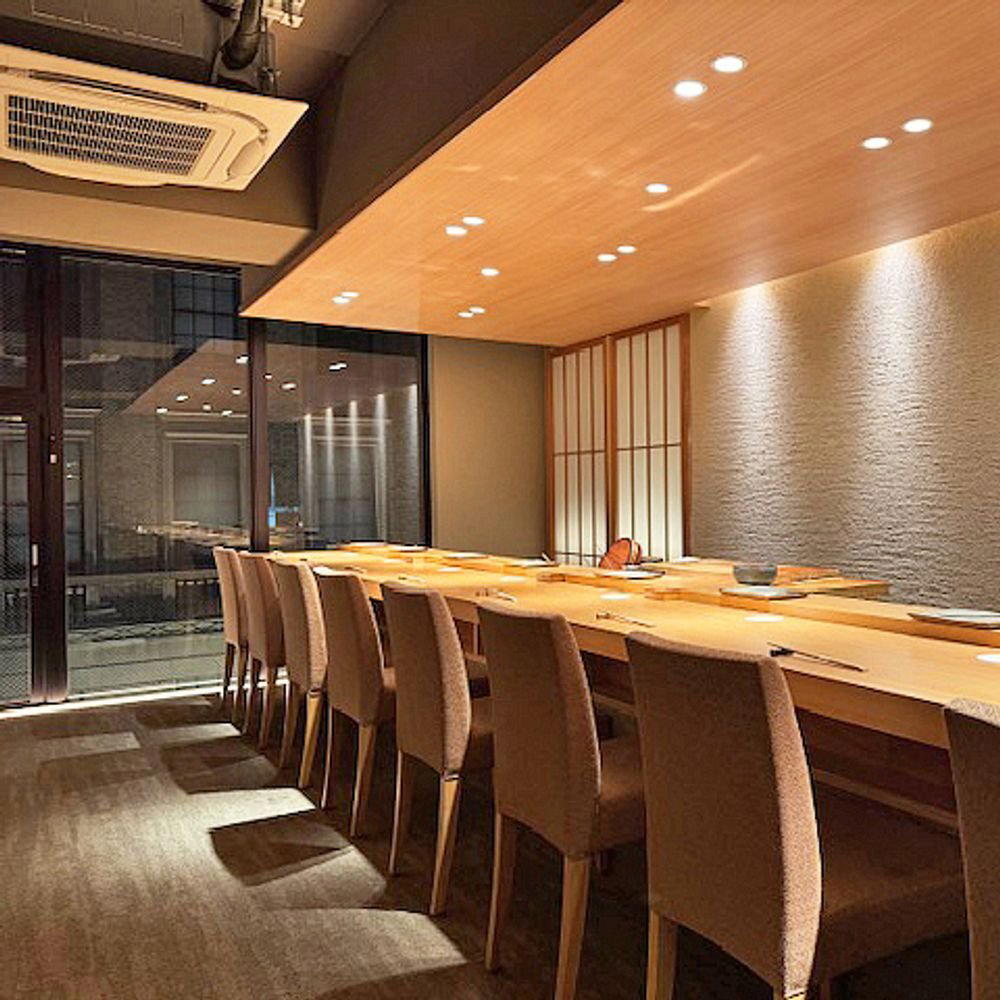
A Third-Floor Counter in Chuo Ward
Most of Osaka's serious sushi is not on the ground floor. The city's omakase counters tend to occupy the upper levels of unremarkable commercial buildings in Chuo Ward, accessible by small elevator or narrow staircase, with no signage visible from the street below. This deliberate remove from foot traffic is not accidental: it filters the clientele before a single piece of nigiri is cut, and it signals that the experience begins with intention, not impulse. Sushi Takumi occupies the third floor of a building on Bingomachi, a short walk from the business and retail density of Honmachi. The physical container here, a compact space reached by elevator, set apart from the commercial noise of the neighbourhood below, fits a pattern common to Osaka's most concentrated counter dining.
Bingomachi sits within the broader Chuo Ward grid that has quietly become one of the most dense concentrations of serious Japanese dining in any city. Taian and Kashiwaya Osaka Senriyama anchor the kaiseki end of this neighbourhood's offer, while French-influenced houses like HAJIME, La Cime, and Fujiya 1935 have extended the city's fine-dining conversation well beyond Japanese tradition. A sushi counter like Takumi operates in parallel to all of this, quieter in profile, narrower in format, and defined less by the breadth of its menu than by the depth of its supply relationships.
The Logic of the Counter Format
Omakase sushi at the upper tier operates through a structural logic that distinguishes it from the broader restaurant category. The chef controls every variable: sourcing, sequence, tempo, temperature, and portion. There are no à la carte decisions. The counter format, typically a narrow bar of檜 (hinoki) cypress or similar timber, with the chef working within arm's reach of each guest, concentrates attention and eliminates the ambient noise of a larger dining room. In Osaka, where the dominant high-end format has historically been kaiseki, the sushi counter represents a distinct discipline: less ceremony around service, more precision around the nigiri itself.
At Sushi Takumi, the space amplifies this dynamic. Being on an upper floor of an office-district building means the room is quiet by default. Street noise does not reach the third floor. The counter, by nature of the format, places the chef's movements at the centre of the experience, the prep, the slicing, the pressing of rice, and the surroundings support that focus rather than compete with it. This is a common deliberate choice among Osaka's serious counters, and Takumi's Bingomachi address fits the pattern precisely.
Provenance as the Kitchen's Foundation
Across Japan's leading omakase counters, the provenance of key ingredients, particularly tuna, has become one of the primary markers of a kitchen's seriousness. The most referenced counters in Tokyo, such as Harutaka, have built reputations partly on sustained relationships with specific wholesalers and fish markets. In Kyoto, a comparable rigour around ingredient origin defines houses like Gion Sasaki. The principle is consistent: at this tier, sourcing is not a marketing point but a structural constraint that shapes what can be served and when.
At Sushi Takumi, the tuna comes from a single wholesaler, the one with whom the chef had a direct personal relationship when he first opened independently. That constraint is meaningful. It means the supply line is narrow and relationship-dependent, not transactional. The kitchen does not pivot between suppliers based on price or availability; it works within the parameters of a single trusted source. For a guest, the implication is that what arrives on the counter reflects what that relationship yields on a given day, not what a broad market survey might optimise for.
Equally specific is the mustard sourced from Fukui, the chef's home prefecture. Fukui is not a region that appears often in Osaka dining conversation, it is renowned for its seafood (particularly crab in winter) and for producing a high concentration of Japan's quality knife-makers. The mustard from that region is described as renowned within its category, and at Takumi it is used in pairings that complement specific sushi toppings rather than as a universal condiment. This regional specificity, using an ingredient because it is genuinely from a place the chef knows, not because it fits a vague terroir narrative, is part of what separates this kind of counter from the many omakase operations that have adopted provenance language without the underlying relationships.
The Knife as Context
The knife set at Sushi Takumi was specially ordered from a maker in Fukui, and this detail carries more weight than it might initially appear. Fukui prefecture is one of Japan's principal knife-producing regions, with Takefu (now Echizen) holding particular status in the craft. A knife ordered from a specific maker in that region is not a generic professional purchase; it is a commission from a tradition the chef has a direct personal and geographical connection to. In a counter format where every cut is visible and the quality of the slice directly affects texture and temperature, the tool is part of the technique. The provenance of the equipment and the provenance of the ingredients operate by the same logic here.
Where Sushi Takumi Sits in Osaka's Dining Picture
Osaka's serious dining at the upper end divides, broadly, between the kaiseki tradition (long, seasonal, ceremonial) and the counter formats (sushi, tempura, yakitori) that apply equivalent rigour to a narrower discipline. The kaiseki houses like Taian and Kashiwaya carry strong institutional recognition. The French-influenced rooms like HAJIME and La Cime operate in a different register entirely, bringing European technique to a Japanese ingredient context. Sushi Takumi occupies neither of those zones. It is a sushi counter defined by its supply relationships, its regional ingredient identity, and the quiet concentration of its third-floor setting.
For readers who want to extend the regional comparison, akordu in Nara and Goh in Fukuoka represent different expressions of precision-driven dining in the Kansai and Kyushu contexts. Further afield, 1000 in Yokohama and 6 in Okinawa show how Japan's serious counter and tasting-menu format has distributed itself beyond Tokyo. Outside Japan, the commitment to ingredient provenance and counter discipline finds partial parallels at houses like Le Bernardin and Atomix in New York, though the format and tradition differ substantially.
For a full picture of where Sushi Takumi sits within the city's offer, see our full Osaka restaurants guide. Broader planning across dining, lodging, and leisure in the city is covered in our Osaka hotels guide, Osaka bars guide, Osaka wineries guide, and Osaka experiences guide.
Planning Your Visit
Sushi Takumi is located on the third floor of the Rare Building at 3 Chome-1-2 Bingomachi, Chuo Ward, Osaka. The Bingomachi address places it within a short walk of Honmachi Station, accessible via the Midosuji and Chuo subway lines. Counter sushi at this tier in Osaka typically requires reservations made several weeks to a few months in advance, and first-time bookings are often facilitated through a Japanese-speaking intermediary or hotel concierge for guests without an existing relationship with the venue. Phone, website, and booking details are not publicly listed; contact through a concierge channel is the most reliable route for international visitors.
Quick reference: 3F, Rare Building, 3-1-2 Bingomachi, Chuo Ward, Osaka, nearest station Honmachi, advance reservation required.
Frequently asked questions
What do regulars order at Sushi Takumi?
The counter operates on an omakase format, meaning the chef determines the sequence rather than guests selecting from a menu. The tuna, sourced through a single trusted wholesaler, is the cornerstone of the nigiri programme, and pieces incorporating the Fukui mustard are central to how the kitchen expresses its regional identity. At counters like this one, regular guests tend to develop a rapport with the chef over multiple visits, which can influence the pace and composition of a sitting, but the selection itself remains in the chef's hands. For context on how Osaka's leading sushi and kaiseki houses approach ingredient-led menus, the full Osaka restaurants guide covers the broader field, and venues like Taian and Kashiwaya Osaka Senriyama offer points of comparison for how Osaka's serious kitchens think about seasonal and sourced menus.
How far ahead should I plan for Sushi Takumi?
Counter sushi at Sushi Takumi's level in Osaka typically books between four and twelve weeks in advance for domestic diners with an existing connection to the house. For international visitors without that prior relationship, the timeline extends further: a hotel concierge or specialist reservation service in Osaka is the practical route, and they will generally advise beginning the process two to three months before travel. Osaka's leading sushi counters do not operate open online booking in the way that some European fine-dining restaurants do, and Takumi is no exception. If the Osaka visit involves multiple serious meals, at houses like HAJIME, La Cime, or Fujiya 1935, it is worth sequencing all bookings simultaneously rather than addressing them one at a time.
Standing Among Peers
Comparable venues nearby, for context on price, style, and recognition.
| Venue | Cuisine | Price | Awards | Notes |
|---|---|---|---|---|
| Sushi TakumiThis venue (the venue you are viewing) | Modern Japanese Omakase | $150–200 | Michelin Plate · Tabelog 100 #17 | Not listed |
| Rokkakutei | Michelin-Starred Japanese Kushikatsu Omakase | $50–100 | Not listed | Chūō |
| Kizuna | Edo-style Omakase Sushi | $150–200 | Tabelog Bronze #188 | Chūō |
| Gyuho | Female Wagyu Omakase Yakiniku | $100–150 | Not listed | Kita |
| Sui Okazaki | Modern Japanese Omakase | $150–200 | Michelin Plate | Chūō |
| Sushisho Nehachi | Modern Omakase Sushi | $50–100 | Michelin Plate | Fukushima |
Recognition history
Dated appearances from independent guides and award organizations, with the underlying list record or original source where available.
Michelin Plate
Michelin
Tabelog 100 #17 · No. 17
Tabelog · Tabelog 100 - Sushi - WEST - 2025
Continue exploring
More in Osaka
Restaurants in Osaka
All restaurants in Osaka →


Bars in Osaka
All bars in Osaka →
Hotels in Osaka
All hotels in Osaka →


Wineries in Osaka
Browse all →
Details
- Elegant
- Intimate
- Sophisticated
- Minimalist
- Date Night
- Special Occasion
- Chefs Counter
- Sake Program
- Sustainable Seafood
- Omakase
- Counter Dining
- Sake Program
Current opening hours
- Monday
- 6–11 p.m.
- Tuesday
- 6–11 p.m.
- Wednesday
- 6–11 p.m.
- Thursday
- 6–11 p.m.
- Friday
- 6–11 p.m.
- Saturday
- 6–11 p.m.
- Sunday
- 6–11 p.m.
Hours can change for holidays and private events. Hours as of .
Stylish, minimalist space with counter seating and a refined, relaxing atmosphere.