
Tabelog Bronze #188
Our verdict
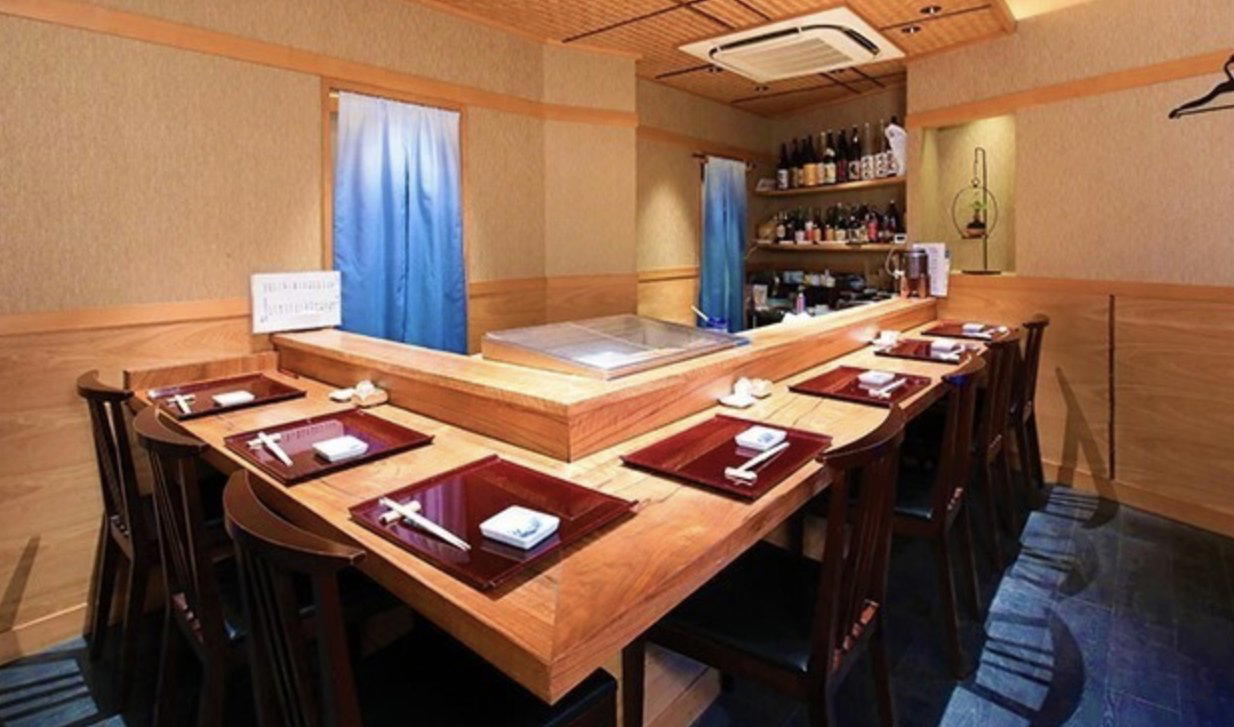
Sushi Kizuna in Osaka's Miyakojima district has held Tabelog Silver or Bronze recognition every year since 2018 and appears in the Tabelog Sushi WEST 100 for 2021, 2022, and 2025. The 12-seat counter runs a single 19,800-yen course, with two seatings per evening and a drinks program built around carefully selected sake and shochu. New reservations are not currently being accepted.

Pearl is the En Primeur Club membership app, where members save venues, book tables and use the concierge.
The menu
What to order
- Oyster sushi
- Seto Inland Sea fish sushi
- Toro
- Senpouji oysters
A Counter That Has Earned Its Place in Osaka's Sushi West Tier
Osaka's sushi scene occupies a different register from Tokyo's. Where the capital's omakase counters cluster around Ginza and Azabu lineage networks, Osaka's most respected sushi rooms tend to sit in quieter residential wards, drawing a predominantly local clientele and operating without the international booking infrastructure that has come to define the Tokyo market. Kyobashi, roughly eight minutes on foot from the JR Osaka Loop Line station of the same name, is exactly the kind of neighbourhood where that pattern holds. Low-rise, unhurried, not a dining destination in the tourist-guide sense, it is the sort of area where a serious sushi counter can build a reputation over years without any particular fanfare.
Sushi Kizuna has been doing precisely that. The 12-seat counter, counter seating only, no private rooms, has collected Tabelog Silver or Bronze Awards in every consecutive year from 2018 through 2026, with Silver in 2018, 2019, 2020, and 2025, and Bronze in the remaining years. It has also been named to the Tabelog Sushi WEST 100 in 2021, 2022, and 2025, a designation that maps the most consistently rated sushi rooms across western Japan. A Tabelog score of 4.35 in 2026 and 4.31 for the Silver year of 2025 places it in a tier where the gap between counters is measured in fractions and competition is sustained rather than occasional.
Eight Years of Consistent Recognition and What That Signals
The evolution story at Kizuna is less about reinvention than about consolidation. The return to Silver in 2025 and inclusion in the Sushi WEST 100 that same year signals that Kizuna has held its position in a shifting field rather than coasting on early momentum.
That kind of sustained record matters in the context of how Tabelog awards work. The platform's annual awards are based on aggregated user scores across hundreds of thousands of reviews, and Silver at the 4.31–4.35 range is a threshold that filters out most counters in any given city. To sit there across multiple years, through changes in the competitive landscape and the general upward drift of Osaka's dining reputation post-pandemic, requires consistency that is structural rather than circumstantial.
For context on where Kizuna sits within the broader Osaka fine dining tier: the city's most-decorated Western-influenced rooms, including HAJIME and La Cime, operate at the ¥¥¥¥ price point with Michelin three- and two-star recognition respectively. Japanese format rooms like Taian and Kashiwaya Osaka Senriyama hold three Michelin stars each and anchor the kaiseki end of the market. Kizuna operates in a parallel sushi-specialist tier, with Tabelog as its primary recognition framework rather than Michelin, and with pricing, a single course at 19,800 yen, that positions it as a serious but not stratospherically priced counter. It is not competing for the same occasion as a 50,000-yen Tokyo omakase; it is competing within western Japan's sushi specialist tier, and within that frame it has been consistently ranked among the leading for nearly a decade.
The Format: One Course, No Variation
The operating structure at Kizuna is fixed and deliberate. A single course at 19,800 yen is the only option. There are two seatings on Tuesday through Saturday (18:00 and 20:40) and two seatings on Sunday and public holidays (17:00 and 19:40). The counter seats 12. This is the format of a room that has decided exactly what it is and is not interested in accommodating requests for something different.
That rigidity has parallels across Japan's most respected counter restaurants. At this level, fixed-price, counter-only, reservation-required, the format itself communicates intent. The kitchen controls the sequence, the pacing, and the supply relationships. The single course means the kitchen can source for one menu and execute it at full attention rather than managing parallel paths. The 19,800-yen price point sits in the mid-upper tier for Osaka sushi, below the top-end counters in central Tokyo but above the casual omakase that has proliferated across Japan's cities in recent years.
The drinks program focuses on sake and shochu, with the listing specifically noting a particular emphasis on both. This is consistent with the regional drinking culture of western Japan, where shochu has a stronger presence than in Tokyo's sushi rooms, and where the sake selection at a serious counter often reflects local and regional brewery relationships rather than a national list.
Within Japan's sushi geography, a room like Kizuna occupies a position worth comparing to counters elsewhere. Harutaka in Tokyo represents the capital's lineage-driven end of the spectrum. Gion Sasaki in Kyoto operates at the intersection of kaiseki and sushi traditions that defines Kyoto's counter format. Kizuna, by contrast, is a straightforwardly Osaka sushi room, ingredient-focused, counter-driven, and oriented toward the city's own rhythms rather than toward a national or international audience.
Booking: The Hard Part
Kizuna's reservation status is currently closed to new bookings. This is the single most practically significant piece of information for any prospective visitor. The Tabelog listing states explicitly that new reservations are not being accepted, which is a common position for counters of this recognition level in Japan, where existing guest relationships and waitlists tend to fill the schedule before any vacancy becomes publicly available.
For those planning an Osaka trip around serious dining, the broader picture of the city's options is worth knowing. Our full Osaka restaurants guide maps the city's current dining tier from multi-starred kaiseki to neighbourhood specialists. Complement the table with context from our full Osaka bars guide, full Osaka hotels guide, full Osaka wineries guide, and full Osaka experiences guide.
For those building a broader Japan itinerary, the sushi-specialist tier extends across the country. Goh in Fukuoka anchors the Kyushu end of serious Japanese dining. akordu in Nara offers a different register entirely. Further afield, 1000 in Yokohama and 6 in Okinawa represent the geographic spread of Japan's counter-dining culture. For a global comparison, Le Bernardin in New York City and Atomix in New York City sit at a different end of the fine dining spectrum but share the counter format's commitment to fixed-menu, high-attention service. Innovative Osaka dining is also represented by Fujiya 1935, for those who want to explore the city's range beyond the sushi tier.
Know Before You Go
- Address: Miyakojima Ward, Osaka (Miyakojimaminamidori 2-4-9, Fujimi Heights 1F)
- Nearest station: 8-minute walk from JR Osaka Loop Line Kyobashi Station; 9-minute walk from Keihan Electric Railway Kyobashi Station
- Hours: Tue–Sat 18:00–23:00 (seatings at 18:00 and 20:40); Sun and public holidays 17:00–23:00 (seatings at 17:00 and 19:40); closed Monday and the third Tuesday of each month
- Price: 19,800 yen course only (dinner); no lunch service
- Seats: 12 (counter only); private use available for up to 20 people
- Reservations: Required; new reservations not currently being accepted
- Payment: VISA and Mastercard accepted; electronic money and QR code payments not accepted
- Smoking: Completely non-smoking since July 1, 2010
- Parking: Not available at venue; coin parking nearby
- Phone: 06-6922-5533
Frequently asked questions
What do regulars order at Kizuna?
Kizuna operates on a single fixed course at 19,800 yen with no à la carte options, so the question of what to order does not apply in the conventional sense. The course is the meal. The Tabelog listing notes a particular emphasis on fish sourcing, and the drinks program is built around sake and shochu rather than wine, consistent with a traditional Japanese counter format. Regulars are returning for the course as a whole, and the consistency across eight consecutive years of Tabelog Silver or Bronze recognition reflects that the kitchen has maintained the quality of that offering over time.
What is the signature at Kizuna?
What the record does confirm is that Kizuna has held Tabelog Silver Award status in 2018, 2019, 2020, and 2025, and Bronze in 2021, 2022, 2023, 2024, and 2026, with scores in the 4.31–4.35 range. It has also been named to the Tabelog Sushi WEST 100 in 2021, 2022, and 2025. At a counter with that recognition history, the course itself, sourced, sequenced, and served at a 12-seat counter in Kyobashi, is effectively the signature.
| Venue | Cuisine | Price | Awards | Notes |
|---|---|---|---|---|
| KizunaThis venue (the venue you are viewing) | Edo-style Omakase Sushi | $150–200 | Tabelog Bronze #188 | Not listed |
| HAJIME | Avant-Garde Japanese Fine Dining | $300–500 | 3 Michelin Stars · World's 50 Best #83 | French, Innovative |
| La Cime | Modern French with Japanese Ingredients | $150–200 | 2 Michelin Stars · World's 50 Best #13 | French |
| Kashiwaya Osaka Senriyama | Seasonal Kaiseki Omakase | $200–300 | 3 Michelin Stars · La Liste Top Restaurants | Japanese |
| Taian | Traditional Japanese Kaiseki Omakase | $150–200 | 3 Michelin Stars · La Liste Top Restaurants | Kaiseki, Japanese |
| Fujiya 1935 | Modern Japanese with European influences | $100–150 | 2 Michelin Stars · La Liste Top Restaurants | Innovative |
Recognition history
Dated appearances from independent guides and award organizations, with the underlying list record or original source where available.
Tabelog Bronze #188
Tabelog
Full recognition history (3 entries)
Tabelog 100 #79 · No. 79
Tabelog · Tabelog 100 - Sushi - WEST - 2025
Tabelog Silver
Tabelog
Continue exploring
More in Osaka
Restaurants in Osaka
All restaurants in Osaka →


Bars in Osaka
All bars in Osaka →

Hotels in Osaka
All hotels in Osaka →


Wineries in Osaka
Browse all →
Details
- Intimate
- Elegant
- Sophisticated
- Special Occasion
- Celebration
- Business Dinner
- Chefs Counter
- Open Kitchen
- Local Sourcing
- Sustainable Seafood
- Omakase
- Counter Dining
- Pescatarian Friendly
Current opening hours
- Monday
- 11 AM–3 PM, 6 PM–5 AM
- Tuesday
- 11 AM–3 PM, 6 PM–12 AM
- Wednesday
- 11 AM–3 PM, 6 PM–5 AM
- Thursday
- 11 AM–3 PM, 6 PM–5 AM
- Friday
- 11 AM–3 PM, 6 PM–5 AM
- Saturday
- 11 AM–3 PM, 6 PM–5 AM
- Sunday
- 11 AM–3 PM, 6 PM–5 AM
Hours can change for holidays and private events. Hours as of .
Serene and intimate L-shaped 12-seat counter with warm, engaging service from the owner; simple and elegant interior with a lively yet focused dining atmosphere.