
Ramen Sugita Ya Honten is a compact Shin-Sugita counter that puts Yokohama’s Ie-kei ramen tradition into a tightly run, everyday format. Its 15-seat counter, sub-¥1,000 listed budget, and repeated Tabelog Ramen Hyakumeiten selections place it in the city’s serious ramen tier without moving it into luxury pricing.
Pearl is the En Primeur Club membership app — saves, bookings, and concierge access live there. Same editors, same standards.
- Address
- 神奈川県横浜市磯子区新杉田町3-5
- Phone
- +81457762155
- Website
- sugitaya.com
 Saves & bookings on Pearl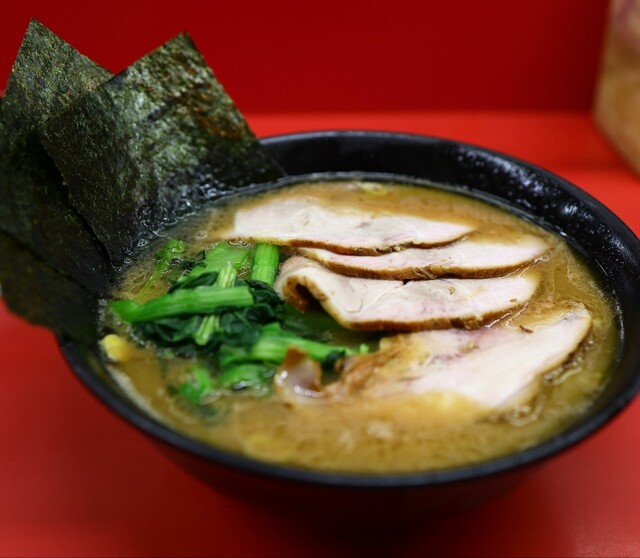
Approaching the Shin-Sugita side of Yokohama, the ramen scene feels less like a polished dining district than a working grid of rail lines, shopfronts, and quick meals built around regulars. That setting matters. Yokohama’s Ie-kei ramen culture was never designed for long tasting-menu pacing; it is a counter tradition, a bowl-and-go format where the room, the ticket machine, and the queue discipline are part of the grammar.
Ramen Sugita Ya Honten belongs to that grammar with unusual clarity. The room is a 15-seat counter, a physical arrangement that leaves little space for theatre and even less for indecision. In a city where ramen can range from station-adjacent convenience to obsessive destination eating, this is the compact end of the spectrum: narrow, functional, and built around turnover rather than lingering. The design is not decoration-led. It is operational design, and that is exactly the point.
A counter built for Yokohama's Ie-kei rhythm
Ie-kei ramen is one of Yokohama’s major contributions to Japan’s ramen map, known broadly for its pork-and-soy lineage, thick noodles, and customizable intensity. The category rewards directness. A successful Ie-kei shop does not need a dining room that softens the edges; it needs a counter where the sequence is legible and the bowl remains the focus.
Here, the format signals seriousness before any award badge does. Counter-only seating compresses the experience into a few decisions and a short meal, closer to a craft workshop than a restaurant built for ceremony. That puts it in a different lane from Yokohama restaurants where the room carries more of the value proposition, from grilled skewers at 1000 (Yakitori (Grilled chicken skewers)) to the more meal-structured pacing of Aichun, Ajowan, and Alpenjiro Honten. Ramen at this level is judged less by upholstery and more by whether the shop can repeat the same tight sequence hundreds of times without losing its edge.
The listed price band, under JPY 999, also matters editorially. Yokohama still has a category of serious ramen that has not detached from everyday eating. Among comparison venues in the city, G Men 7 and Susurimase nka occupy a similar sub-¥1,000 ramen band, while Izutsu and Ganesh sit in higher dining brackets. That spread explains why ramen remains such a useful lens on the city: technical reputation and low-ticket accessibility can occupy the same address.
Recognition without luxury signals
The trust signal here is not a Michelin-style fine-dining apparatus, but sustained Tabelog recognition. Ramen Sugita Ya Honten was selected for Tabelog Ramen KANAGAWA Hyakumeiten 2025, with prior Hyakumeiten selections listed across Kanagawa and East Japan categories. Its Tabelog score is 3.77, a meaningful figure in a platform where ramen shops compete against dense local reviewing cultures rather than destination-dining spectacle.
That recognition should be read correctly. It does not turn the shop into a luxury restaurant; it confirms that a small counter can command attention inside a crowded regional ramen field. The first direct branch connection to Yoshimura-ya, the foundational name in Ie-kei ramen, also gives the address a lineage signal that ramen specialists will understand immediately. In editorial terms, this is heritage expressed through format rather than biography.
The physical container reinforces that reading. A 15-seat room with counter seating creates a narrow social contract: arrive prepared, follow the sequence, eat with pace, and make room for the next diner. That style is common in serious ramen shops, but it feels especially appropriate in Yokohama, where Ie-kei’s identity is tied to directness and density rather than elaboration. The room is small because the cuisine does not need a larger stage.
How it fits into a Yokohama food day
For visitors mapping Yokohama through food, this is a specialist stop rather than an all-evening anchor. The surrounding Shin-Sugita area is better understood as part of the city’s rail-fed everyday dining network than as a polished hospitality quarter. That makes the shop useful for travelers who want ramen with local weight and minimal ceremony, then plan the rest of the day around other neighborhoods, hotels, bars, or cultural stops.
Its practical appeal is also its constraint. The counter format rewards small groups and solo diners more than large parties, and the meal structure is short by design. Children are welcomed, but the room’s rhythm is still that of a ramen counter. Payment is cash-oriented, with cards, electronic money, and QR payments not accepted, so the friction is less about cost than readiness.
For broader planning, compare it with the city’s wider dining spread in Our full Yokohama restaurants guide, then build the stay through Our full Yokohama hotels guide, Our full Yokohama bars guide, Our full Yokohama wineries guide, and Our full Yokohama experiences guide. Nearby-city comparisons are useful only if the trip is broader than Yokohama: -Grilled beef Sukiyaki- KAMAKURA TANUKIAN 鎌倉 たぬき庵 in Kamakura, (Shoku) Vietnam in Kawasaki. 鮪と炭火焼き うお炭 秋葉原店 in Tokyo.cafe in Osaka.know in Kumamoto, [Curry Senmon Ten] Maruyama Kyoju. in Sapporo, Jōdo Saké Bar in Los Angeles, and Onigiri Time in Pasadena show how differently casual Japanese formats travel across cities.
The editorial verdict is simple: this is Yokohama ramen as infrastructure, not performance. The address makes sense for diners who value lineage, counter discipline, and price restraint over comfort padding. In a city where Ie-kei is part of the local food identity, Ramen Sugita Ya Honten gives that tradition a compact, high-credibility frame.
Same-City Peers
Comparable venues by cuisine and category.
| Venue | Cuisine | Price | Notes |
|---|---|---|---|
| Ramen Sugita Ya HontenThis venue — the venue you are viewing | Traditional Yokohama Iekei ramen | $ | Not listed |
| Ramen Moriya. | Ramen shop in Yokohama | $ | Sakae |
| Raamen Mu | Traditional Ramen & Tsukemen Counter | $ | Kanagawa |
| Hi, How Are You | Pakistani-style Japanese curry house | $ | Kōhoku |
| Ryusei Ken | Japanese Ramen | $ | Minami |
| Izutsu | Traditional Tempura & Seafood | $$ | Isogo |
Recognition history
Dated appearances from independent guides and award organizations, with the underlying list record or original source where available.
Tabelog 100 #17 · No. 17
Tabelog · Tabelog 100 - Ramen - KANAGAWA - 2025











At a Glance
- Well Known
- Lively
- Solo
- Casual Hangout
- Late Night
- After Work
- Standalone
A compact, counter-only ramen-ya with the no-frills, functional feel typical of classic Iekei shops, focused on efficiency and hot bowls of rich shoyu-tonkotsu rather than decor, with a busy, energetic atmosphere especially at peak hours.