
RAINBOW SPICE is a compact Tachikawa curry counter with 11 seats and a repeat selection in Tabelog’s Curry TOKYO 100, including 2024, 2023 and 2022. The value proposition is unusually clear for Tokyo: Indian curry and curry in a counter format, with published spending in the low JPY bracket and practical payment options across cards, transit IC and QR services.
Pearl is the En Primeur Club membership app — saves, bookings, and concierge access live there. Same editors, same standards.
- Address
- 東京都立川市柴崎町3-3-4 英ビル 1F
- Phone
- +81425243117
- Website
- rbspice.exblog.jp
 Saves & bookings on Pearl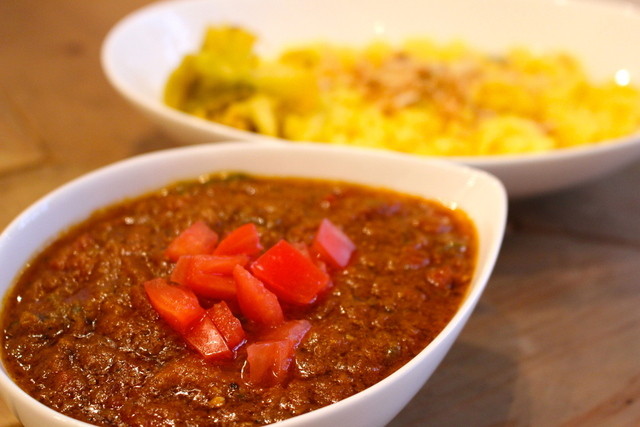
South of Tachikawa Station, Tokyo’s curry culture shifts register. Central wards often cast curry as lunch-counter staple or chef specialty; in Tachikawa, it moves at neighborhood speed. RAINBOW SPICE is compact: an 11-seat counter, Indian curry and curry as the stated category, and a turnover-minded format. That matters because Tokyo curry is now a serious micro-category, with recognition systems distinguishing long-running specialists from everyday plates.
Read this address not as a Ginza-style destination restaurant, but as a value test. As Tokyo dining headlines tilt toward tasting menus, private counters and exportable luxury, curry remains one of the city’s sharpest measures of craft per yen. A Tabelog score of 3.76 and selection for Tabelog Curry TOKYO 100 in 2024, after selections in 2023 and 2022, put it in a narrower band than casual convenience suggests. The room is small, the category democratic, and the critical signal stronger than the spend implies.
Tokyo curry, judged by concentration rather than ceremony
Japanese curry is comfort food, but Tokyo’s specialist shops now follow the sorting logic of ramen or soba: clear format, repeatability, queue tolerance and a house style regulars recognize without theatrical plating. The scene spans Indian-influenced spice shops, Japanese-style roux counters, soup curry, European-leaning curry rice and hybrid cafés. RAINBOW SPICE sits in the Indian curry and curry lane, where spice architecture matters more than garnish and the rhythm is direct, plate to counter.
That distinction calibrates expectations. This is not a slow-course evening meal. The counter points to focused lunch or early dinner: come for a specific genre, eat with pace, and judge it against Tokyo curry specialists, not full-service restaurants. Compared with a café such as Ichiroku Coffee Ten or a broader casual American room such as OLD NEW DINER, the bargain differs. Spend is low, but the margin for error is not. A curry counter succeeds only if the core plate justifies repetition.
Tabelog’s Hyakumeiten lists help because they identify category depth rather than luxury hierarchy. A curry selection does not mean what a Michelin star means, and should not be read that way. It does say the shop has cleared a visible threshold within Tokyo’s curry conversation across multiple years. For diners tracking city specialists, that signal matters more than décor language or chef mythology.
The counter format keeps the value equation honest
Small counters remove padding: little room for long beverage programs, lounge pacing or performative service. What remains is plate, seat, rhythm and any queue outside or behind the door. RAINBOW SPICE uses that model, with 11 counter seats and take-out noted. The diner’s equation is simple: low-spend curry, recognized specialist category, and minimal commitment beyond timing.
Tokyo handles this dining style with unusual efficiency. Serious low-cost food culture is not a consolation prize below fine dining; it is a parallel system with its own hierarchies. Ramen shops, standing soba counters, tonkatsu specialists and curry rooms earn loyalty because the premise is narrow and measurable. RAINBOW SPICE fits. Its 2012 opening gives it more than a decade of continuity, crucial in a genre where consistency separates local habit from casual novelty.
The value proposition sharpens by contrast. Soba Kaiseki Muan uses a different structure, where kaiseki pacing and higher published spending change the meal’s meaning. Senju, from the comparison field, sits elsewhere again, with less pricing context attached. A Tachikawa curry counter should be judged by how directly it converts a short meal into satisfaction, not by destination-dining markers. In that frame, repeated curry-list recognition and narrow category focus are the evidence.
How to place it in a Tokyo eating day
Tachikawa is not an afterthought on Tokyo’s western edge; it is a major station zone with department stores, commuters, families and dining culture not dependent on international hotel traffic. Curry specialists therefore serve locals first, then travelers willing to ride beyond the usual map. For visitors already using the Chuo Line, the stop works as a compact food detour rather than a full-day plan.
The practical reading is lean. Seating is counter-only, private rooms are absent, and the room is non-smoking. Children are welcome, though no special children’s menu is noted. Payment is broader than at many small counters, with credit cards, transport IC cards and QR payment options listed. Parking is not attached, with coin parking nearby. The details reinforce the category: efficient, accessible, and more serious about the core dish than hospitality extras.
For a Tokyo itinerary, RAINBOW SPICE pairs better with other focused food stops than with a grand dining arc. Readers mapping the city’s range can cross-check central seafood at . 鮪と炭火焼き うお炭 秋葉原店, Shinjuku casual dining at 12/10 Shinjuku ten, skewers at 124. KAGURAZAKA (Yakitori), visual café culture at 2D Cafe, and another curry reference point at 3 Chome no Curry Ya San. For broader planning, use Our full Tokyo restaurants guide, alongside Our full Tokyo hotels guide, Our full Tokyo bars guide, Our full Tokyo wineries guide and Our full Tokyo experiences guide.
The wider Japanese food map explains why a small curry counter can matter. Beef-focused trips might point to -Grilled beef Sukiyaki- KAMAKURA TANUKIAN 鎌倉 たぬき庵 in Kamakura; café tracking to.cafe in Osaka; regional contemporary dining to.know in Kumamoto; Vietnamese cooking near Tokyo to (Shoku) Vietnam in Kawasaki; curry comparisons north to [Curry Senmon Ten] Maruyama Kyoju. in Sapporo; and Kyoto minimalism to [ki:] in Kyoto. Across the Pacific, Japanese-adjacent drinking and rice culture take different forms at Jōdo Saké Bar in Los Angeles and Onigiri Time in Pasadena.
The verdict is compact: RAINBOW SPICE is for diners who value category precision over ceremony. Its appeal sits between low-cost Tokyo eating and specialist recognition, a gap the city handles better than almost anywhere. Go expecting a small counter, a curry-focused meal and a fast read on why Tokyo’s everyday genres deserve serious attention.
Cost Snapshot
Comparable venues by cuisine and category.
| Venue | Cuisine | Price | Awards | Notes |
|---|---|---|---|---|
| RAINBOW SPICEThis venue — the venue you are viewing | $ | , | ||
| Anjuna | Hino, Traditional Indian curry house | $ | , | |
| Minami Indian Nandori | Arakawa, South Indian Meals & Tiffin | $$ | , | |
| Spicy Curry House Ginza Hangetsu | Chūō, Indian Curry House | $$ | , | |
| Andhra Dhaba Katana | Chiyoda, Authentic Andhra Indian | $$ | , | |
| West India Spice Gayabaji | $ | , | Taitō, West Indian Curry & Marathi Cuisine |
Continue exploring
More in Tokyo
Restaurants in Tokyo
Browse all →



Bars in Tokyo
Browse all →



Hotels in Tokyo
Browse all →


Wineries in Tokyo
Browse all →
At a Glance
- Cozy
- Hidden Gem
- Solo
- Casual Hangout
- After Work
- Standalone
Casual, compact curry house with counter-style seating and simple decor, focused on quick, satisfying masala curries rather than a long sit-down experience.