On Simon Stevinplein, one of Brugge's most-visited squares, Poules Moules anchors itself in the Belgian bivalve tradition that has defined coastal Flemish dining for generations. The name says it plainly: chicken and mussels, the two pillars of a menu built around produce that has fed this corner of Belgium since the medieval trade era. For visitors and locals who want honest regional cooking in a setting the city does well, this is a reliable address.
Pearl is the En Primeur Club membership app — saves, bookings, and concierge access live there. Same editors, same standards.
- Address
- Simon Stevinplein 9, 8000 Brugge, Belgium
- Phone
- +32 50 34 61 19
- Website
- poulesmoules.be
- Directions
- Get directions
 Saves & bookings on Pearl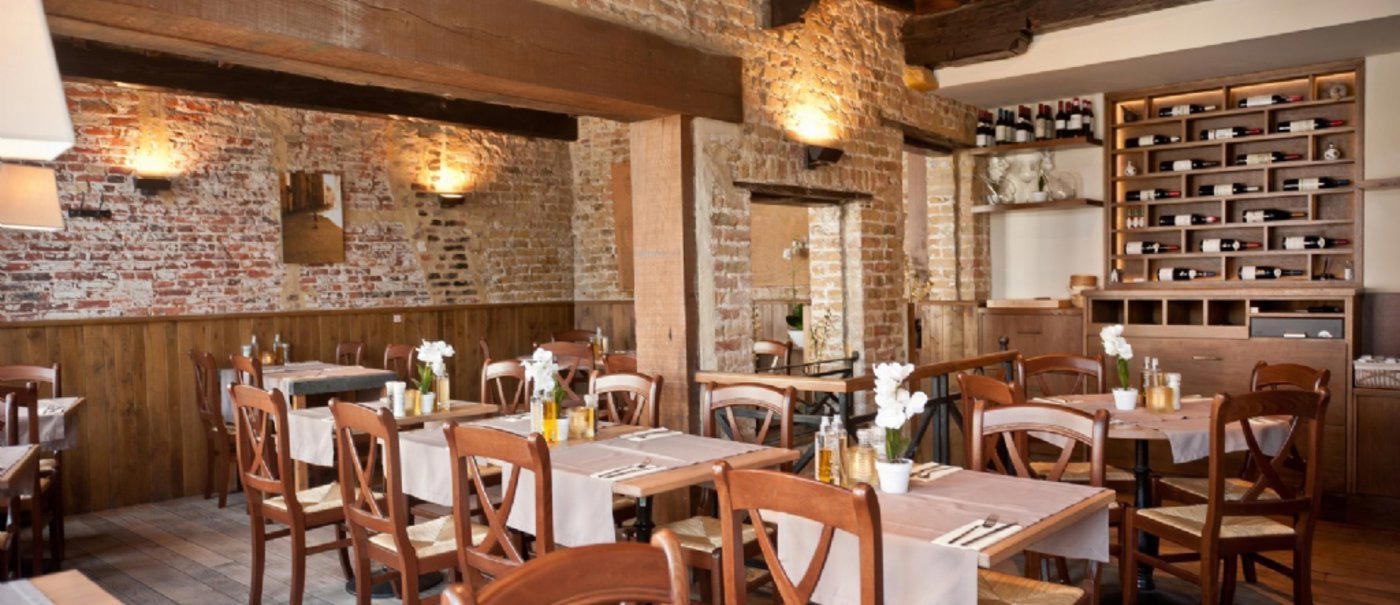
A Square Built for Sitting, a Menu Built for the Season
Simon Stevinplein sits a short walk from the Markt, far enough from the main tourist corridor to feel like a place where Brugge actually lives rather than performs. The square is named for the sixteenth-century mathematician whose statue anchors its centre, and the buildings that ring it carry the stepped-gable silhouette that makes this city immediately legible to any visitor. Poules Moules occupies a ground-floor position on the square at number nine, with the kind of frontage that signals a kitchen serious about its two lead ingredients rather than a kitchen trying to look serious about everything at once.
Brugge's restaurant scene divides, broadly, into two categories: the destination tables that draw visitors on named-chef recognition, and the neighbourhood addresses that sustain themselves on regional cooking done consistently well. Poules Moules belongs to the latter category, which in a city this old and this visited is not a soft position. Competition on the squares and along the canal streets is constant, and venues that last here do so because they have a clear identity. The name Poules Moules is that identity made explicit.
The Ingredient Argument: Mussels, Chicken, and the Flemish Coastal Larder
The pairing of poultry and shellfish is not an accident of branding. Both ingredients reflect the historical larder of the Low Countries, where the North Sea coast and the agricultural polders behind it produced the protein that defined Flemish cooking long before restaurant culture formalised it. Mussels from the Zeeland beds just across the Dutch border have supplied Belgian kitchens for centuries, arriving seasonally, graded by size and salinity, and cooked in formats that range from the classic white-wine and parsley pot to preparations involving cream, beer, or celery root.
The mussel season in Belgium runs roughly from July through April, with the Zeeland harvest typically peaking in late summer and autumn. This is the period when the shellfish carry greater weight and flavour, and Belgian kitchens that take mussels seriously time their menus around that window. A restaurant named for the ingredient signals, at minimum, an awareness of that calendar. Whether the restaurant sources from named Zeeland producers or operates through regional wholesalers is not information in the public record, but the premise of the restaurant connects it to one of Belgium's most traceable supply chains. Zeeland mussels carry a geographic identity as clear as any appellation, grown on rope culture in tidal waters, and their provenance is a point of regional pride on both sides of the Belgian-Dutch border.
Poultry side of the menu draws from a similarly legible tradition. Belgian chicken farming, particularly the free-range production centred in the Flemish countryside, produces birds with a flavour density that industrial rearing does not. The Flemish kitchen has long treated chicken as a serious ingredient rather than a default option, and a restaurant that pairs it with mussels as co-equal headliners is making a statement about sourcing rather than hiding behind a catch-all menu. For visitors used to seafood restaurants that treat chicken as an afterthought for non-fish eaters, the dual billing here inverts that hierarchy.
Where Poules Moules Sits in the Brugge Dining Picture
To understand the restaurant clearly, it helps to map it against the wider range of serious Flemish and Belgian cooking available within reach of Brugge. At the summit of the regional hierarchy sit destination restaurants with Michelin recognition: Patrick Devos in Brugge itself offers creative Flemish cooking at a different price and formality tier, while De Jonkman in Sint-Kruis and Boury in Roeselare represent the region's commitment to modern Flemish technique at the €€€€ level. Further afield, Hof van Cleve in Kruishoutem and Zilte in Antwerp anchor the upper end of the Belgian fine-dining conversation.
The restaurant operates in a different register from all of those. It is the kind of address that answers a different question: not where to eat one ambitious meal in the region, but where to eat something specifically Belgian, on a square that has been functioning as a gathering point since the city's merchant era, without the formality of a tasting menu or the wait time of a starred kitchen. That positioning is legitimate and, in Brugge's tourism-heavy environment, genuinely useful.
For travellers who want to extend their West Flanders itinerary into coastal territory, Willem Hiele in Oudenburg and Bartholomeus in Heist both work the North Sea ingredient set at a higher technical level. Across Belgium, the seafood-forward tradition also surfaces in different contexts at Le Bernardin in New York City, which traces its lineage directly to the French-Belgian seafood canon. Bozar Restaurant in Brussels and Castor in Beveren offer additional points of comparison for those mapping the modern European tradition across the country. For a broader picture of where the restaurant fits within the city's dining options, our full Brugge restaurants guide maps the scene across price tiers and cooking styles.
Other Belgian addresses worth cross-referencing for context include L'air du temps in Liernu, La Durée in Izegem, Maison Colette in Tongerlo, Le Chalet de la Forêt in Uccle, d'Eugénie à Emilie in Baudour, La Table de Maxime in Our, and Atomix in New York City for a view of how ingredient-led sourcing arguments play out across different culinary traditions.
Planning Your Visit
The restaurant is located at Simon Stevinplein 9, a square that is walkable from the central Markt in a few minutes and reachable from most of Brugge's canal-side accommodation without needing transport. The restaurant is open Tuesday to Saturday from 12 to 4 PM and 5:30 to 9 PM, and Sunday from 12 to 4 PM and 5:30 to 8:30 PM; it is closed on Monday. Reservations are recommended, and the price level is moderate, around $35 per person.
Side-by-Side Snapshot
Comparable venues nearby, for context on price, style, and recognition.
| Venue | Cuisine | Price | Notes |
|---|---|---|---|
| Poules MoulesThis venue — the venue you are viewing | Belgian Mussels & Chicken | $$ | Not listed |
| Patrick Devos | Modern French-Belgian Fine Dining | $$$$ | Bruges centrum |
| Bistro De Boeie | Classic Belgian Bistro | $$ | Centrum |
| De Smaak | Belgian Bistro | $$ | Izegem |
| Faim | Modern Belgian Bistro | $$ | Kontich |
| Ensemble | Modern Belgian Bistro | $$$ | Snellegem |
Continue exploring
More in Bruges
Restaurants in Bruges
Browse all →
Bars in Bruges
Browse all →
Hotels in Bruges
Browse all →
Wineries in Bruges
Browse all →
At a Glance
- Cozy
- Rustic
- Classic
- Casual Hangout
- Family
- Group Dining
- Historic Building
- Terrace
- Street Scene
Current opening hours
- Monday
- Closed
- Tuesday
- 12–4 PM, 5:30–9 PM
- Wednesday
- 12–4 PM, 5:30–9 PM
- Thursday
- 12–4 PM, 5:30–9 PM
- Friday
- 12–4 PM, 5:30–9 PM
- Saturday
- 12–4 PM, 5:30–9 PM
- Sunday
- 12–4 PM, 5:30–8:30 PM
Hours can change for holidays and private events. Last verified .
Cozy rustic atmosphere with original wooden beams and niches in a narrow multi-story historic building, pleasant both indoors and on the terrace.