Our verdict
Among Rome's most recognised addresses for pizza al taglio, Panificio Bonci on Via della Meloria has ranked on Opinionated About Dining's European Cheap Eats list in both 2023 and 2024, reaching #86 in the latter year. The format is counter-service and cut-to-order, positioning it firmly within the capital's bread-and-bakery tradition rather than the sit-down trattoria circuit.

Pearl is the En Primeur Club membership app, where members save venues, book tables and use the concierge.
The menu
What to order
- Pizza bianca with mortadella
- Pizza con porchetta
- Organic chicken with artichoke potatoes
A Prati Bakery and What It Says About Roman Pizza Culture
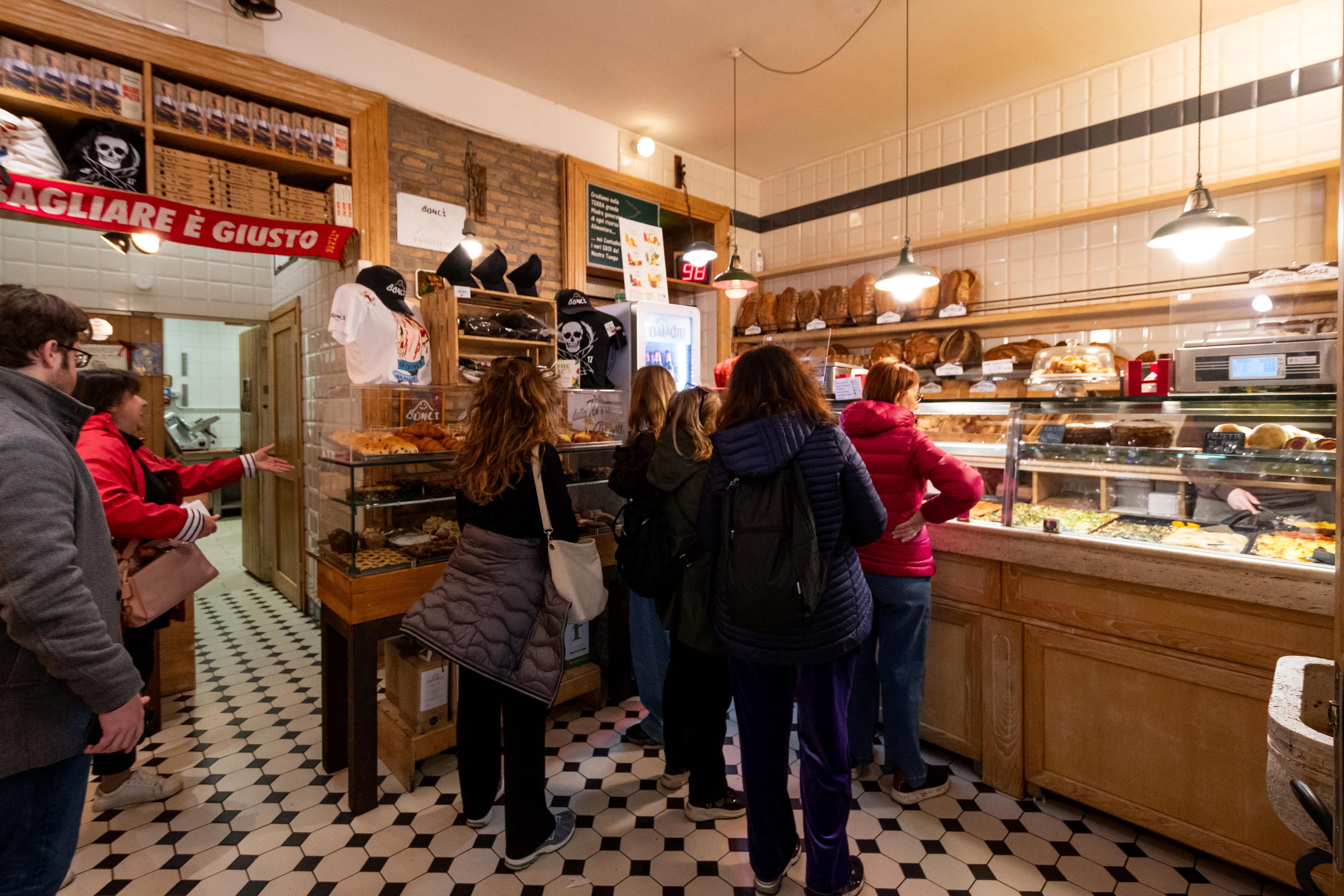
Via della Meloria is a residential street in Prati, the grid-planned neighbourhood west of the Vatican that Romans have claimed as their own well-insulated from tourist pressure. Arriving at Panificio Bonci, you encounter something that looks less like a destination restaurant and more like a serious neighbourhood bakery: a glass-fronted counter, long trays of pizza al taglio laid out in alternating arrangements, and a line that forms before the door opens. That line is not accidental. Pizza al taglio, sold by weight and cut to order, is a format that rewards bakers who treat dough seriously, and Rome has long been its primary proving ground.
The city's al taglio tradition differs in almost every structural way from Neapolitan pizza. Where Naples works from a single canonical dough, Rome's bakers have historically treated the rectangular sheet as a canvas for grain experimentation. Long fermentation, often 48 to 72 hours, and high hydration doughs produce a base that is simultaneously open-crumbed and crisp on the underside. When this approach is executed at scale and with consistency, the result is a style that has attracted international food press attention and earned serious recognition from the kind of critics who usually reserve column space for tasting-menu restaurants.
What the Rankings Actually Mean
Panificio Bonci has appeared on Opinionated About Dining's European Cheap Eats list in consecutive years: ranked #88 in 2023 and #86 in 2024. OAD's cheap eats rankings are built from critic-weighted surveys rather than anonymous mass voting, which means placement reflects the judgements of people eating broadly and deliberately across the continent. Reaching the top 90 in that cohort, across a category that spans every price-accessible format from Paris bistros to Istanbul köfteci, is a different kind of credential than a star or a trophy.
Maintaining that average at that volume is statistically more meaningful than a higher score from a few hundred reviews.
For context on where this sits within Rome's broader restaurant range, the capital's fine-dining tier runs through rooms like La Pergola, Il Pagliaccio, Enoteca La Torre, and Acquolina, with tasting menus and wine lists priced accordingly. Bonci operates at the opposite end of the spectrum in format and price point, but the critical apparatus that tracks both tiers is the same. That compression of attention across price categories reflects something real about how serious food culture now works: the same critics who write about Osteria Francescana in Modena and Enoteca Pinchiorri in Florence are also tracking what comes out of a counter in Prati on a Tuesday afternoon.
The Sustainability Argument Built Into the Format
Pizza al taglio is, structurally, a low-waste format. Dough is prepared in calculated batches and baked in sheets; customers specify weight rather than portion, so cut-to-order service reduces the plate waste inherent in fixed portions. Toppings are applied across broad trays rather than assembled to individual order, which favours seasonal and bulk sourcing over highly perishable single-use components. That is not a marketing claim specific to this address, it is a feature of the format itself, and one reason why serious bakers working in the al taglio tradition have found it compatible with a more considered approach to ingredients and throughput.
Chef Gabriele Bonci has been publicly associated with a philosophy of grain diversity and slow fermentation that aligns with the broader movement toward heritage wheat varieties and reduced additive baking. Using older wheat strains with lower gluten intensity typically requires longer fermentation to develop structure, which also means less reliance on commercial yeast and improvers. The practical outcome for the customer is a dough that digests differently and tastes of more than flour and salt. The practical outcome for the supply chain is a dependence on smaller, more specialised mills rather than commodity grain distributors.
This kind of approach has parallels in Italian fine dining. Restaurants like Atelier Moessmer Norbert Niederkofler in Brunico and Dal Pescatore in Runate have both built reputations partly on sourcing discipline. The difference is that those restaurants operate at price points where the cost of principled sourcing can be absorbed into a tasting menu. A bakery working at accessible prices and high volume faces a harder constraint: the commitment to better grain has to survive the economics of selling pizza by the 100 grams.
Prati as Context
The neighbourhood matters. Prati was developed in the late nineteenth century as an orderly bourgeois district, and it has maintained a character distinct from the centro storico: fewer tourist-facing businesses, more working shops, a customer base with strong local habits. A bakery on Via della Meloria serves people who walk from nearby apartments, not people who GPS their way from a hotel near the Colosseum. That local anchoring creates a different kind of operational pressure than a restaurant positioned as a destination. Consistency matters more when the same customers return weekly. The queue at Panificio Bonci includes a meaningful proportion of regulars, and regulars are harder to impress than first-time visitors.
That local accountability, combined with the international recognition conferred by OAD and covered in publications tracking European food culture seriously, places the address in an interesting position: it is recognised internationally because it is trusted locally, not the reverse. Compare this to addresses in Rome's historic centre, where footfall can sustain a business even when quality has drifted, and the Prati location functions almost as a quality signal in itself.
For more on eating and drinking across the capital at all price points, see our full Rome restaurants guide, our full Rome bars guide, our full Rome hotels guide, our full Rome wineries guide, and our full Rome experiences guide. For reference points at the other end of Rome's dining range, Achilli al Parlamento covers the wine-bar and cellar format in the parliamentary district.
Further afield in Italy, the full register of serious cooking runs from Enrico Bartolini in Milan to Quattro Passi in Marina del Cantone, while international reference points for the kind of critical infrastructure that also tracks Bonci include Le Bernardin in New York City and Atomix in New York City.
Know Before You Go
- Address: Via della Meloria, 43, 00136 Roma
- Hours: Tuesday to Friday 11am–10pm; Saturday 11am–10pm; Sunday 11am–3pm and 5–10pm; Monday closed
- Format: Counter service, pizza sold by weight and cut to order
- Recognition: Opinionated About Dining European Cheap Eats #86 (2024), #88 (2023)
- Booking: Walk-in only; peak hours mid-lunch and early evening draw the longest queues
- Neighbourhood: Prati, approximately 15 minutes on foot from the Vatican
Frequently asked questions
Who runs the kitchen at Panificio Bonci?
The chef associated with Panificio Bonci is Gabriele Bonci.
Is Panificio Bonci focused on a specific cuisine style?
What should I eat at Panificio Bonci?
The counter runs a rotating selection of pizza al taglio toppings that shifts by day and season, so the offering you see is the offering available, no fixed menu to pre-select from. Bonci's format is weight-based: you point, they cut, and the slice is priced by the gram. Two consecutive appearances on Opinionated About Dining's European Cheap Eats list (ranked #88 in 2023, #86 in 2024) reflect the consistency of the base dough rather than any single topping. Arrive early in a session for the widest selection; the trays thin out as service progresses.
What are the operating hours at Panificio Bonci?
Hours at Panificio Bonci: Hours: Monday Closed Tuesday 11 am–10 pm Wednesday 11 am–10 pm Thursday 11 am–10 pm Friday 11 am–10 pm Saturday 11 am–10 pm Sunday 11 am–3 pm, 5–10 pm.
Where do I go for Panificio Bonci?
Panificio Bonci is located at Via della Meloria, 43, 00136 Roma RM, Italy, Rome.
Does Panificio Bonci have a Michelin star or similar recognition?
Panificio Bonci has received recognition including: Opinionated About Dining Cheap Eats in North America Ranked #578 (2025); Opinionated About Dining Cheap Eats in Europe Ranked #86 (2024); Opinionated About Dining Cheap Eats in Europe Ranked #88 (2023).
Just the Basics
A short peer table to compare basics side-by-side.
| Venue | Cuisine | Price | Awards | Notes |
|---|---|---|---|---|
| Panificio BonciThis venue (the venue you are viewing) | Roman Bakery & Pizza al Taglio | $20–30 | Not listed | Not listed |
| La Pergola | Modern Italian Fine Dining | $500+ | 3 Michelin Stars · La Liste Top Restaurants | Italian, Mediterranean Cuisine |
| Enoteca La Torre | Modern Italian Fine Dining | $200–300 | 2 Michelin Stars · La Liste Top Restaurants | Creative |
| Il Pagliaccio | Modern Italian-Japanese Fusion Fine Dining | $150–200 | 2 Michelin Stars · La Liste Top Restaurants | Contemporary Italian, Creative |
| Aroma | Modern Roman Fine Dining | $200–300 | 1 Michelin Star · Falstaff Restaurant - 93 Falstaff Points | Modern Cuisine |
| Idylio by Apreda | Modern Mediterranean-Asian Fusion | $150–200 | 1 Michelin Star · La Liste Top Restaurants | Modern Italian, Italian Contemporary |
Recognition history
Dated appearances from independent guides and award organizations, with the underlying list record or original source where available.
Opinionated About Dining Cheap Eats in North America Ranked #578
Opinionated About Dining
Full recognition history (3 entries)
Opinionated About Dining Cheap Eats in Europe Ranked #86
Opinionated About Dining
Opinionated About Dining Cheap Eats in Europe Ranked #88
Opinionated About Dining