


Two-Michelin-starred Enoteca La Torre occupies the magnificent Villa Laetitia in Rome, where Chef Domenico Stile's innovative Italian cuisine unfolds within Renaissance-era dining rooms adorned with frescoes and Art Nouveau details, creating the city's most architecturally stunning fine dining experience.
 Discover on Pearl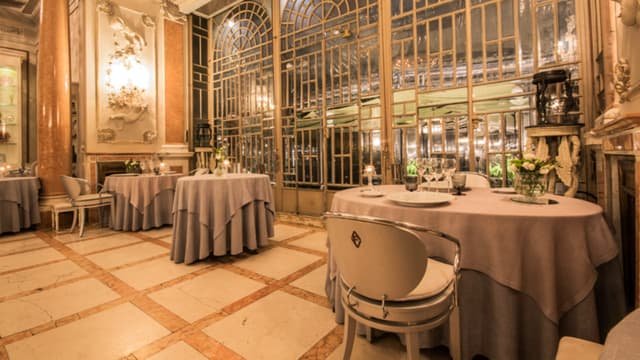
A Dining Room That Earns Its Setting
The approach along Lungotevere delle Armi already signals something different. Villa Laetitia's facade carries the layered ornamental vocabulary of early twentieth-century Art Nouveau, a style that arrived in Rome with particular force in the years before the First World War and left a handful of buildings that sit at an odd, elegant distance from the city's dominant Baroque and Renaissance registers. Behind the villa's street presence, La Torre's dining room extends into a space of stucco ceilings, columns, and windows that open onto a private garden — a visual grammar that the Michelin inspectors, in their La Liste citation, compared to a Parisian interior dropped beside the Tiber. That comparison is not idle flattery: it points to a genuine tension in the room between Roman grandeur and a more restrained northern European formality, a tension the kitchen seems to inhabit as much as resolve.
Where Enoteca La Torre Sits in Rome's Creative Tier
Rome's two-star restaurants operate in a smaller, more contested bracket than the city's broader fine-dining pool. La Pergola holds three stars at the leading; a clutch of two-star houses — including Il Pagliaccio and Enoteca La Torre , occupy the tier below, each making a different argument for what contemporary Italian cooking should look like in a city that spent decades resisting the creative idiom that Milan, Modena, and the northern regions embraced earlier. Enoteca La Torre's two Michelin stars (confirmed for both 2024 and 2025) and its La Liste score of 89 points in 2025 and 87 points in 2026 place it in a peer group that competes on precision and concept rather than on tradition alone. Its OAD Classical in Europe ranking , 208th in 2024, 256th in 2025 , situates it within the European classical canon, a designation that signals commitment to technique and consistency over novelty for its own sake. For context, other Italian addresses in that conversation include Osteria Francescana in Modena, Le Calandre in Rubano, Dal Pescatore in Runate, and Enoteca Pinchiorri in Florence. In Rome specifically, All'Oro and Glass Hostaria occupy adjacent creative positions at a lower award tier, while Marco Martini Chef and Acquolina represent the city's appetite for technique-forward cooking across different specialisations.
The shortlist, unlocked.
Hard-to-book tables, cellar releases, and concierge-planned trips.
Get Exclusive Access →Mediterranean Roots, Complex Architecture
The creative restaurant tradition in Italy has long navigated the tension between regional identity and technical ambition. In the north, that tension resolved early, producing the kind of abstracted regionalism seen at addresses like Enrico Bartolini in Milan or Atelier Moessmer Norbert Niederkofler in Brunico. In Rome, that resolution has been slower, more contested, and arguably more interesting for it. Enoteca La Torre's position in this argument is defined by Chef Domenico Stile's commitment to Mediterranean flavour , rooted in Campanian tradition , expressed through preparations of considerable structural complexity. The La Liste citation notes dishes that are imaginative and technically layered but arrive with clean, precise flavours: a description that places the kitchen in the modernist idiom without abandoning the warmth and directness associated with southern Italian cooking. This is a meaningful editorial distinction. Many creative restaurants in Europe pursue complexity that reads as complexity , where the technique is visible and declarative. The La Torre approach, if the Michelin and La Liste assessments are taken together, aims instead for complexity that dissolves into clarity at the moment of eating. Comparable ambitions in the French creative context can be found at Alléno Paris au Pavillon Ledoyen and Arpège, where Mediterranean and terroir-led references are similarly filtered through high technical frameworks.
The Wine Program and Its Italian Focus
An enoteca designation carries weight in Italian restaurant culture. It signals that the wine list is not an afterthought appended to the menu but a program with its own editorial logic. At La Torre, the list is presented in two sections and focuses predominantly on Italian labels , a deliberate positioning that aligns with the kitchen's regional anchoring and resists the default of using French references as the prestige tier. Italy's breadth as a wine-producing country makes an Italy-focused list at this level a genuine curatorial task: the range from Barolo and Barbaresco in Piedmont through Brunello in Tuscany, Aglianico in Campania, and the volcanic wines of Sicily represents as much stylistic diversity as any cross-European selection. The two-section presentation suggests a structural distinction between categories or price tiers within the Italian focus, though the specific organisation is not disclosed in the public record. For readers building a wine-forward itinerary in Rome, Achilli al Parlamento represents the city's most established wine-centric address at a different format and price point.
Campanian Roots and the Southern Italian Creative Tradition
Campania's role in Italian gastronomy is often reduced to its popular exports , pizza, mozzarella di bufala, the tomato-anchored cooking of the Amalfi coast , but its fine-dining tradition runs considerably deeper. The region has produced a strand of technically serious cooking that treats its ingredient wealth (seafood from the Tyrrhenian, vegetables from the volcanic plains around Caserta, the cheesemaking traditions of the interior) as a starting point for complex preparation rather than a reason to keep things simple. Chef Stile's Campanian background at La Torre is not biographical decoration; it is the cultural and flavour logic that gives the creative framework a specific character rather than the generic internationalism that two-star cooking can sometimes produce. The Mediterranean orientation that the Michelin citation emphasises extends the southern Italian reference outward to the broader basin, connecting the kitchen's flavour instincts to a tradition that runs from the Greek-influenced coast of Calabria through Sicilian and North African culinary intersections , a lineage that offers more structural complexity than the northern Italian creative tradition when handled with precision.
Planning a Visit
La Torre operates Wednesday through Sunday for both lunch (12:30 to 2:30 pm) and dinner (7:30 to 10:00 pm), with Monday and Tuesday closed. The format , two services a day across five days , is standard for restaurants at this award tier in Rome, where the closed midweek days allow kitchen teams to source and prepare without the operational compression that seven-day service creates. At the €€€€ price point, La Torre sits at the ceiling of Rome's restaurant market, alongside La Pergola, Il Pagliaccio, and the other two-star addresses. Reservations should be secured well in advance; the combination of limited service days, a room that is architecturally constrained in capacity by the villa format, and sustained Michelin recognition creates predictable forward demand. The address at Lungotevere delle Armi 23 places the restaurant on the west bank of the Tiber in the Prati district, within walking distance of Castel Sant'Angelo and reasonably accessible from the centre. Google reviewer scores of 4.6 across 318 ratings provide a public-record confirmation of consistent execution that is harder to fake at low volume over time. For wider planning, our full Rome restaurants guide covers the city's full range of dining options, and our Rome hotels guide, bars guide, wineries guide, and experiences guide provide the surrounding context for a complete visit.
Lungotevere delle Armi, 23, 00195 Roma RM, Italy
+39 06 4566 8304
At-a-Glance Comparison
A compact peer set to orient you in the local landscape.
| Venue | Cuisine | Price | Awards | Notes |
|---|---|---|---|---|
| Enoteca La Torre | Creative | €€€€ | Michelin 2 Stars | This venue |
| La Pergola | Italian, Mediterranean Cuisine | €€€€ | Michelin 3 Star | Italian, Mediterranean Cuisine, €€€€ |
| Il Pagliaccio | Contemporary Italian, Creative | €€€€ | Michelin 2 Star | Contemporary Italian, Creative, €€€€ |
| Aroma | Modern Cuisine | €€€€ | Michelin 1 Star | Modern Cuisine, €€€€ |
| Glass Hostaria | Creative | €€€€ | Michelin 1 Star | Creative, €€€€ |
| Idylio by Apreda | Modern Italian, Italian Contemporary | €€€€ | Michelin 1 Star | Modern Italian, Italian Contemporary, €€€€ |
Need a table?
Our members enjoy priority alerts and concierge-led booking support for the world's most difficult tables.
Get Exclusive AccessThe shortlist, unlocked.
Hard-to-book tables, cellar releases, and concierge-planned trips.
Get Exclusive Access →