






On Via dei Banchi Vecchi, Il Pagliaccio holds two Michelin stars and a place in the La Liste global top tier, where Anthony Genovese's tasting menus move fluidly between Italian regional technique and Japanese reference points. The wine list runs to approximately 1,750 selections with a cellar of around 10,000 bottles. Dinner runs Tuesday through Friday, with Saturday lunch and dinner service available.
 Discover on Pearl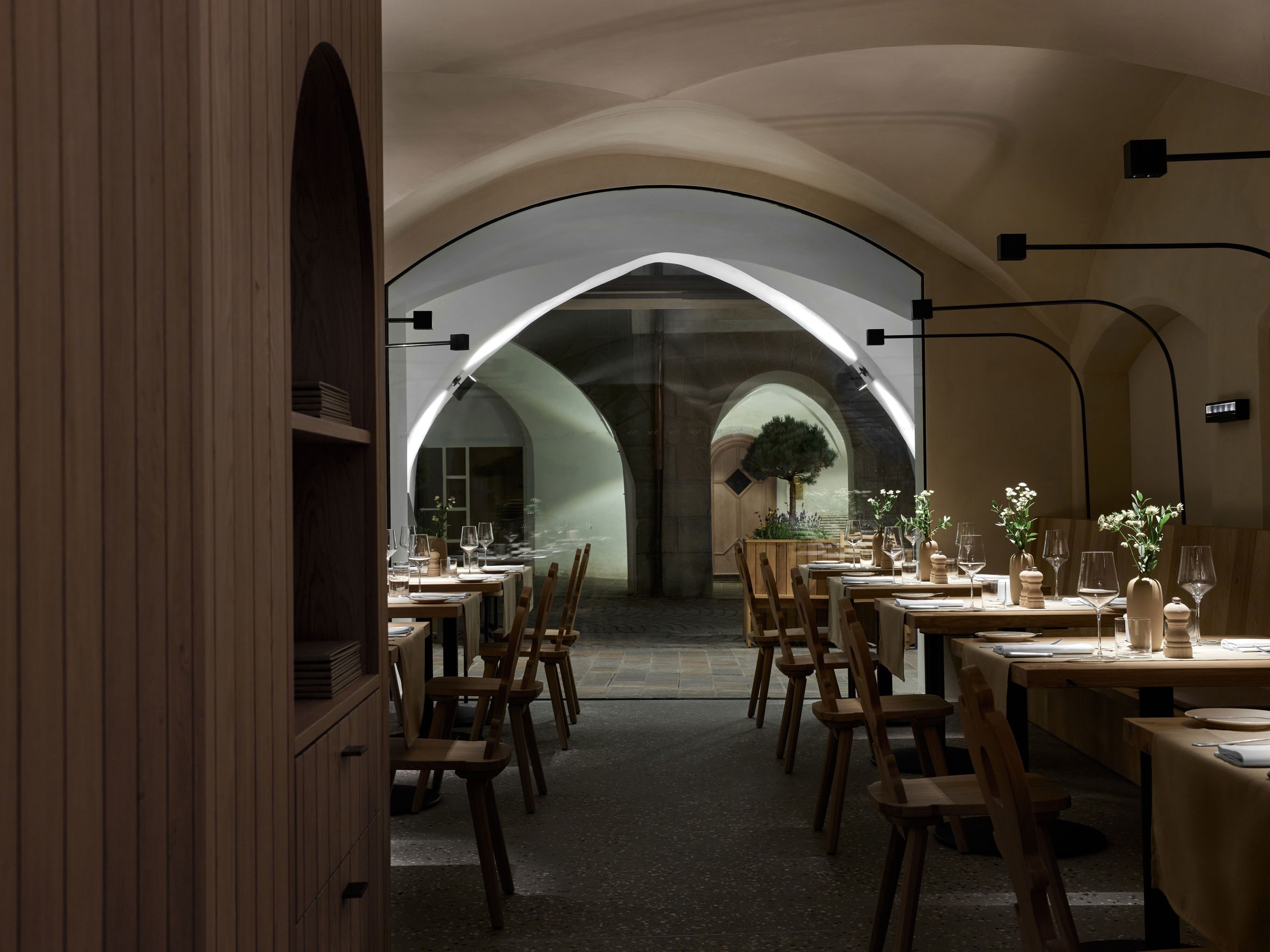
Via dei Banchi Vecchi runs through one of Rome's older residential corridors, past palazzo facades and the kind of street-level quiet that the city's more trafficked dining zones have lost. The restaurant sits at number 129a, its entrance understated against the historic stonework outside. Inside, the room is intimate and formally arranged, the kind of space where the service team has room to work precisely rather than efficiently. This is the physical register of Rome's upper-tier contemporary dining: not theatrical, not minimalist in the Scandinavian sense, but structured and considered in a way that signals intent before a plate arrives.
Where Il Pagliaccio Sits in Rome's Fine Dining Hierarchy
Rome's two-Michelin-star category is a short list. La Pergola operates at three stars with Mediterranean scope; Enoteca La Torre and Il Pagliaccio share the two-star tier with distinct orientations. Where La Torre leans into seasonal Italian classicism, Il Pagliaccio operates in a more explicitly cross-cultural register, positioning itself closer to the internationalist strand of Italian fine dining than to the Roman regionalist tradition. The Opinionated About Dining Classical in Europe ranking places it at number 116 for 2025, and La Liste's 2026 edition scores it at 94 points, consistent with its 94.5 in 2025. Membership in Les Grandes Tables du Monde further places it in a peer set of European restaurants defined by service formality and front-of-house discipline as much as kitchen output.
The shortlist, unlocked.
Hard-to-book tables, cellar releases, and concierge-planned trips.
Get Exclusive Access →For context on how this category maps across Italy more broadly, two-star addresses elsewhere in the country include Le Calandre in Rubano and Magnolia in Longiano, while the three-star tier reaches Osteria Francescana in Modena and Enoteca Pinchiorri in Florence. Il Pagliaccio's position within that national field is defined less by terroir-driven locality than by its reach across culinary traditions, which sets it apart from the strictly regional addresses in the tier above and below it.
The Menu Architecture and Its Culinary Logic
Il Pagliaccio operates on a blind tasting format of varying lengths, which removes the conventional a la carte decision and places the kitchen's sequencing at the centre of the experience. This format is now common across European fine dining's upper bracket, but the specific content here diverges from what that format usually produces in Italy. Anthony Genovese's training and travel history across multiple continents feed a menu that moves between Italian regional material and Japanese technique without treating either as subordinate. The gyoza stuffed with Piedmontese finanziera, finished with a broth and powder drawing on Roman-style oxtail preparation, is the kind of construction that illustrates this logic directly: a Japanese wrapper form, a northern Italian offal tradition, and a central Italian flavour reference converging in a single course. This is not fusion in the loose sense of the term but a structured argument about how technique and ingredient traditions can be remapped without losing specificity.
The editorial angle that matters here, from the perspective of Italian pasta tradition, is how the kitchen treats dough-based forms. The finanziera gyoza is the clearest public example in the documented record, and it demonstrates something important about the restaurant's approach to pasta's structural role. Across Italian fine dining, filled pasta tends to anchor menus in regional identity: tortellini in Bologna, agnolotti in Piedmont, cacio e pepe pasta in Rome. At Il Pagliaccio, the filled form is preserved but the regional container is renegotiated. The gyoza casing borrows from a tradition where thin, hand-worked dough encloses complex fillings; the finanziera filling belongs to Piedmontese cucina povera; the broth reference reaches south. The result sits within Italian pasta logic while refusing its geographical boundaries, which is a coherent position for a chef who has cooked on multiple continents.
In April 2025, the restaurant introduced a tasting menu marking Genovese's first 40 years in professional kitchens. The format adds a retrospective layer to the existing menu structure, drawing on the full span of his career rather than a single season or concept. For a restaurant already working in cross-cultural mode, a retrospective menu is a natural extension rather than a departure.
The Room and the Service Team
The front-of-house operation at Il Pagliaccio is the strongest argument for the Les Grandes Tables du Monde classification. Matteo Zappile serves as both maître and general manager, a dual role that concentrates front-of-house authority and consistency in a single figure, which matters in rooms where the service is as choreographed as the cooking. Sommelier Luca Belleggia oversees a wine list of approximately 1,750 selections backed by a cellar of around 10,000 bottles. The geographic weight of the list falls on Italy (with particular depth in Piedmont and Tuscany) and France (Burgundy and Champagne most prominently), which aligns with the menu's European base even as the cooking moves into broader territory. Cecilia d'Amato is listed as a second sommelier, and Veronica Loachamin completes the documented room team.
A wine list at this scale, priced in the upper bracket indicated by the available data, functions as a destination in itself for serious collectors. Burgundy depth at a Roman address is not automatic; the city's fine dining wine programs vary considerably in how far they extend beyond Italian regional coverage. Il Pagliaccio's program appears to have been built over time with a collecting logic rather than assembled for breadth alone, which changes how the cellar interacts with a tasting menu that already operates across culinary traditions.
Rome's Creative Fine Dining Field
Il Pagliaccio does not operate in isolation within the city's contemporary creative tier. Acquolina works a seafood-forward creative register; All'Oro applies seasonal Italian technique in a different key; Achilli al Parlamento occupies a more classical enoteca-anchored position. The one-star addresses including Aroma, Idylio by Apreda, and Imàgo complete a tier below where technical ambition is present but the sustained recognition of repeated Michelin stars and international ranking is not yet accumulated.
Outside Rome, the creative Italian addresses worth cross-referencing include Enrico Bartolini in Milan, Atelier Moessmer Norbert Niederkofler in Brunico, Terra The Magic Place in Sarentino, and Dal Pescatore in Runate, each working within Italian fine dining's contemporary tier with different regional anchors and stylistic orientations. Il Pagliaccio's position within that field is distinguished by its Roman address combined with a kitchen orientation that is explicitly not defined by Roman or even central Italian cooking alone.
Planning a Visit
The restaurant opens for dinner Tuesday through Friday, with service from 7:30 to 10pm. Saturday runs both lunch (12:30 to 2pm) and dinner (7:30 to 10pm). The kitchen is closed Sunday and Monday. The address is Via dei Banchi Vecchi, 129a, in the 00186 postal zone of Rome, placing it in the historic centre between the Campo de' Fiori area and the Tiber bend. The price range is at the upper end of Rome's fine dining market, consistent with a multi-course blind tasting format and a wine program at this scale. Google reviewers rate it at 4.3 across 539 responses, a score that holds up given the format's inherent subjectivity; blind tasting menus generate more variance in lay reviews than a la carte addresses, and 539 data points at 4.3 is a credible signal for a room of this size and price point.
For broader planning across the city, our full Rome restaurants guide covers the complete field. Related guides for the city include hotels, bars, wineries, and experiences.
Via dei Banchi Vecchi, 129/a, 00186 Roma RM, Italy
+39 06 6880 9595
Awards and Standing
A quick peer check to anchor this venue’s price and recognition.
| Venue | Awards | Cuisine | Notes |
|---|---|---|---|
| Il Pagliaccio | Michelin 2 Stars, Les Grandes Tables Du Monde Award (2025) | Contemporary Italian, Creative | This venue |
| La Pergola | Michelin 3 Star | Italian, Mediterranean Cuisine | Italian, Mediterranean Cuisine, €€€€ |
| Enoteca La Torre | Michelin 2 Star | Creative | Creative, €€€€ |
| Aroma | Michelin 1 Star | Modern Cuisine | Modern Cuisine, €€€€ |
| Idylio by Apreda | Michelin 1 Star | Modern Italian, Italian Contemporary | Modern Italian, Italian Contemporary, €€€€ |
| Imàgo | Michelin 1 Star | Contemporary Italian, Italian Contemporary | Contemporary Italian, Italian Contemporary, €€€€ |
Need a table?
Our members enjoy priority alerts and concierge-led booking support for the world's most difficult tables.
Get Exclusive AccessThe shortlist, unlocked.
Hard-to-book tables, cellar releases, and concierge-planned trips.
Get Exclusive Access →