On Via Candia near the Vatican Prati neighbourhood, Antico Caffè Candia occupies the kind of position Romans rely on: a neighbourhood caffè where the rituals of morning coffee, afternoon aperitivo, and casual conversation layer into something more considered than the sum of its parts. It sits close enough to the tourist corridors to be findable, but is sustained by the regulars who have made it their own.

Pearl is the En Primeur Club membership app, where members save venues, book tables and use the concierge.
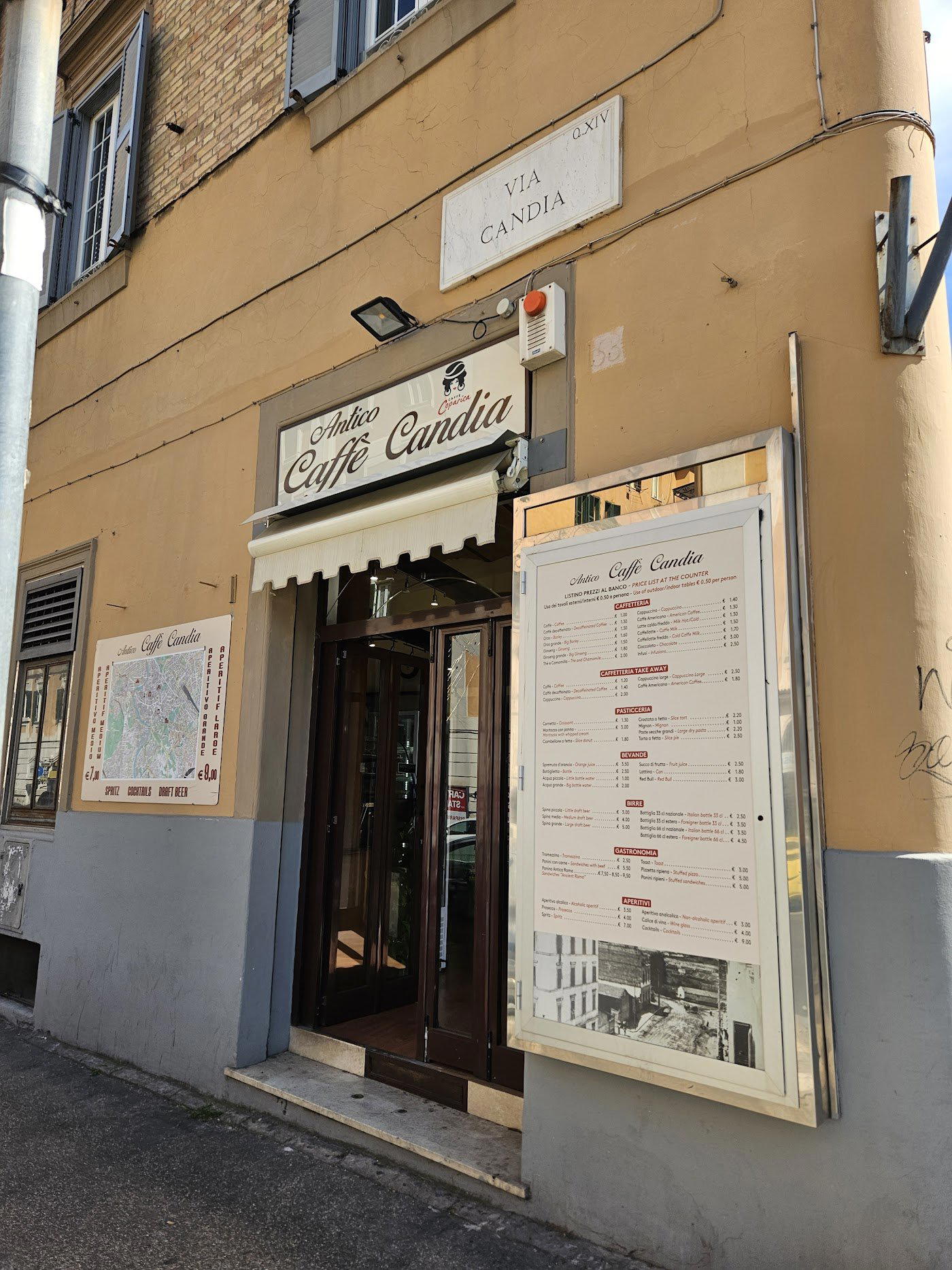
Where Prati's Daily Rhythm Plays Out
The Prati neighbourhood, running northwest from Castel Sant'Angelo toward the Vatican walls, has always been one of Rome's more residential quarters in spirit despite its central coordinates. Its wide Piemontese-grid streets and ground-floor caffès function as a kind of social infrastructure: places where the same faces appear at the same hours, where the barista reads the order before it's spoken, and where the marble counter is understood as a communal space rather than a transaction point. Antico Caffè Candia on Via Candia sits precisely within that tradition.
This is the context that matters most when approaching the address. Rome's caffè culture separates quite sharply between places that operate on tourist throughput and those sustained by neighbourhood loyalty. The former rely on position near monuments; the latter earn their place through consistency, familiarity, and the unwritten contract between a regular and a room. Antico Caffè Candia belongs to the second category, and that distinction shapes everything about how the space feels and functions.
What Brings People Back
The appeal of a place like this to its regulars is rarely about a single offering. It accumulates. A morning espresso at the counter, taken standing as Romans do, sets a tempo. The pastry case, the quality of the coffee pull, the pace at which the room moves, these are assessed and reassessed over dozens of visits until they either pass into habit or drop from rotation. The fact that Antico Caffè Candia holds its local clientele points to all of these elements working at a level worth returning to.
Prati's caffè circuit includes addresses that lean into the aperitivo hour more deliberately, with Freni e Frizioni representing one end of that spectrum across the river in Trastevere, and bars like Boeme offering a more cocktail-forward proposition. What a neighbourhood caffè of this type offers is different: continuity over occasion, the coffee bar as anchor rather than destination event. For a visitor trying to understand how Roman daily life is structured, that distinction is as informative as any single drink or dish.
The address on Via Candia places it within easy reach of the outdoor market at Piazza dell'Unità and the residential density that gives Prati its character. Locals moving between the market, the tabacchi, and a coffee stop form the natural patronage. That foot traffic is not the Vatican tourist wave; it is the neighbourhood functioning as itself.
The Caffè Format and What It Signals
Italy's caffè format is one of the most codified in European food culture. The rules are largely unspoken: stand at the counter for espresso, pay before or after depending on local convention, do not linger over a cappuccino after ten in the morning if you want to blend in. These norms are more actively observed in neighbourhood establishments than in tourist-facing bars, where staff have long since adapted to visitors unfamiliar with the script.
At an address like Antico Caffè Candia, the codes remain in place because the clientele expects them. This is part of what regulars are actually buying: a room that behaves according to Roman convention, where the rituals feel intact rather than performed for an audience. Across Italy, this distinction between the authentic-format caffè and the tourist-adapted approximation has become sharper in the years since mass tourism intensified in historic centres. Rome's Prati, less photographed than Trastevere or the centro storico, has retained more of the former.
For comparison, the more theatrically produced bar experiences in Rome Jerry Thomas Speakeasy with its cocktail-program depth, or Drink Kong with its technically driven menu, operate on entirely different registers. Those venues are destinations in themselves, drawing visitors for a specific experience. The neighbourhood caffè does not compete in that space; it serves a function those places are not designed to serve.
Italy's Caffè Tradition in Broader Context
The caffè as a social institution has counterparts across Italian cities, each shaped by local character. 1930 in Milan operates in a different mode entirely, as does Gucci Giardino in Florence or L'Antiquario in Naples. These are each products of their cities' particular relationship to the bar format. In Naples, the espresso culture is arguably the most demanding in Italy; in Milan, the aperitivo ritual shapes the afternoon; in Rome, the neighbourhood caffè operates as a kind of civic glue, the place where a district's residents acknowledge each other and the day. Further afield, venues like Al Covino in Venice or Enoteca Storica Faccioli in Bologna show how Italian drinking culture adapts format to local tradition without losing its essential character.
Even internationally, the concept of a bar sustained by loyal local custom rather than visitor throughput has analogues worth noting. Bar Leather Apron in Honolulu and Lost and Found in Nicosia both sustain dedicated return clientele through consistency and format discipline rather than novelty, a pattern that crosses geography.
Planning Your Visit
Via Candia runs between Piazza Risorgimento and the market area around Piazza dell'Unità, making it convenient to combine with a morning at the market or a walk through Prati's residential streets. The neighbourhood is accessible by metro at Ottaviano, the closest station on Line A. Morning visits, when the counter culture is at its most active, reflect the caffè at its most characteristic. Those visiting Rome and looking for a fuller map of where the city's bar culture sits should consult our full Rome restaurants and bars guide.
Cuisine Lens
Comparable venues nearby, for context on price, style, and recognition.
| Venue | Cuisine | Price | Notes |
|---|---|---|---|
| Antico Caffè CandiaThis venue (the venue you are viewing) | Bar | $10–20 | Not listed |
| Cohouse Pigneto | cocktail_bar | $30–50 | Tuscolano |
| Birra + | beer_bar | $20–30 | Prenestino-Labicano |
| Litro | wine_bar | Not listed | Gianicolo |
| Ciampini Roma | Bar | $20–30 | Campo Marzio |
| Bar Caffetteria | pub | Not listed | Ponte Mammolo |
Continue exploring
More in Rome
Bars in Rome
All bars in Rome →
Restaurants in Rome
All restaurants in Rome →

Details
- Classic
- Cozy
- Casual Hangout
- Historic Building
- Outdoor Terrace
- Conventional Wine
- Street Scene
Current opening hours
- Monday
- 6:15 AM–1:30 PM
- Tuesday
- 6:15 AM–1:30 PM
- Wednesday
- 6:15 AM–1:30 PM
- Thursday
- 6:15 AM–1:30 PM
- Friday
- 6:15 AM–1:30 PM
- Saturday
- 6:15 AM–1:30 PM
- Sunday
- Closed
Hours can change for holidays and private events. Hours as of .
Cozy and relaxed with timeless Italian café charm and a modern vibe.