Onze Kerk
Onze Kerk occupies a converted church in the small Noord-Brabant village of Hooge Zwaluwe, placing it among the Netherlands' more architecturally distinctive dining addresses. The setting alone draws visitors from outside the region, but what keeps them returning sits on the plate: cooking rooted in the agricultural produce and waterway harvests of the surrounding Biesbosch delta. See our full guide to the area for broader context.
Pearl is the En Primeur Club membership app — saves, bookings, and concierge access live there. Same editors, same standards.
- Address
- Kerkdijk 1A, 4927 BG Hooge Zwaluwe, Netherlands
- Phone
- +31168756381
- Website
- simoniscollection.nl
- Directions
- Get directions
 Saves & bookings on Pearl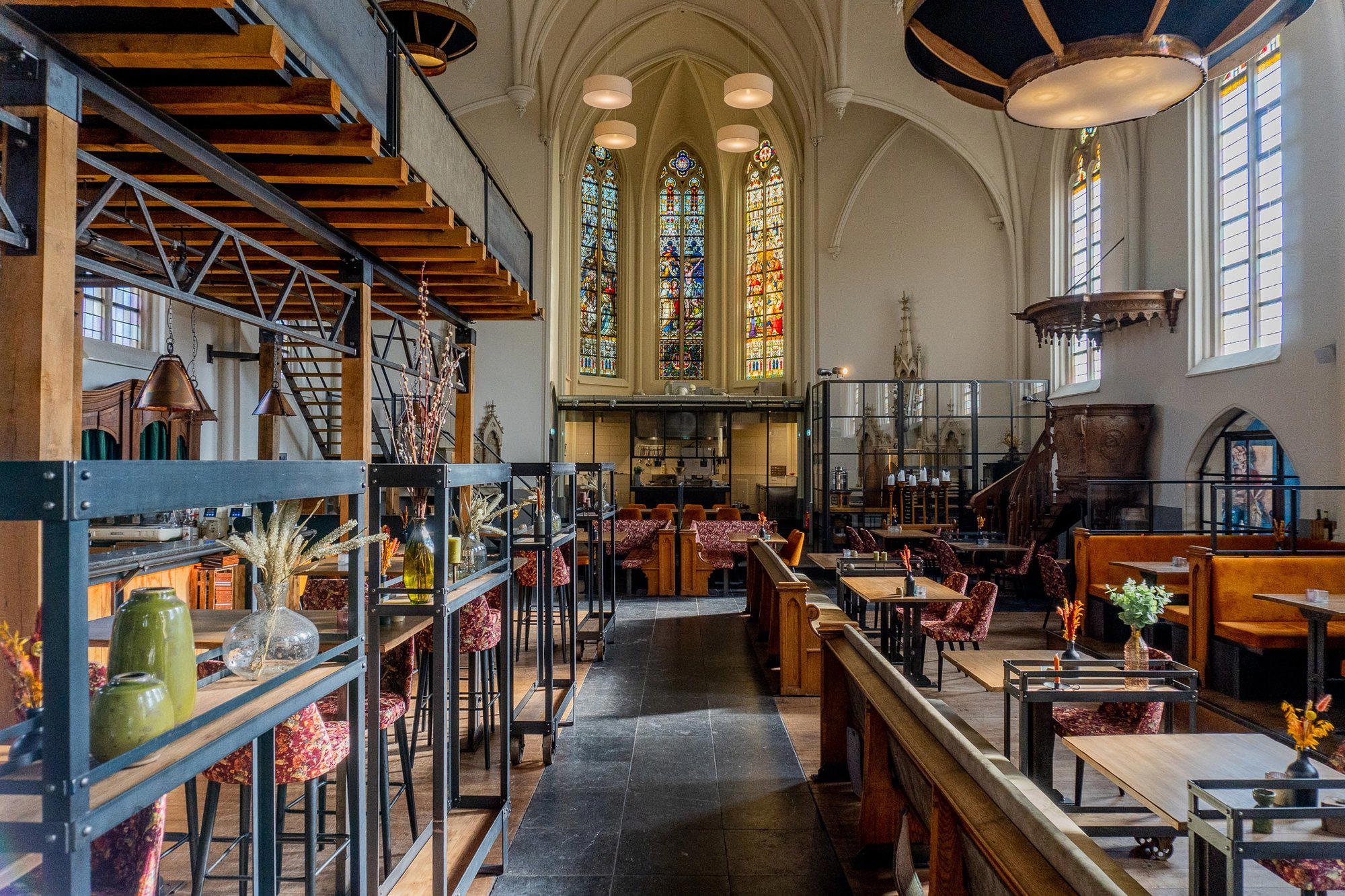
A Church, a Delta, and the Logic of Eating Close to the Source
The Netherlands has a well-documented tradition of fine dining in improbable locations. Converted mills, farmhouses, and estate outbuildings have long housed serious kitchens, partly because Dutch culinary culture places genuine weight on setting as context rather than decoration. A converted church in a village as small as Hooge Zwaluwe fits that pattern precisely. Onze Kerk, at Kerkdijk 1A, occupies a former place of worship in a community most visitors pass through rather than stop in, sitting at the edge of the Biesbosch National Park, one of the largest freshwater tidal areas in Western Europe. That geography is not incidental to what arrives on the plate.
The Biesbosch delta shapes the ingredient logic of serious kitchens in this part of Noord-Brabant and the adjacent Zeeland border zone. Eel, pike-perch, and freshwater crayfish move through its channels. Wetland herbs and wild greens grow at its margins. The reed-bordered polders beyond the park boundary yield lamb and cattle with a salinity to their pasture that coastal-grazed meat from better-known Dutch regions cannot replicate. Restaurants that take this geography seriously, rather than importing from distant supplier networks, tend to produce food with a distinct regional register. That register is increasingly legible to diners who have tracked similar source-first approaches at places like De Nieuwe Winkel in Nijmegen, where organic sourcing has been built into the kitchen's identity at a Michelin-starred level, or Inter Scaldes in Kruiningen, which has long translated Zeeland's coastal larder into high-end tasting menus.
What the Setting Communicates Before the Food Arrives
Approaching a converted church along a narrow village road does something particular to dining expectations. The architecture carries associations of permanence, stillness, and community gathering that glass-and-steel restaurant builds simply do not. Tall windows filter light differently across service, stone or brick walls retain the coolness of older structures, and the acoustic quality of vaulted interiors softens ambient noise in ways that affect how conversation moves. These are not trivial variables for a dinner. Dutch restaurant culture has become increasingly attentive to the full sensory frame of a meal, a shift visible in how venues from De Bokkedoorns in Overveen to Brut172 in Reijmerstok have built setting into their editorial identity. Onze Kerk positions itself within that current.
For visiting diners arriving from Rotterdam or Breda, the drive through the flat polder roads that lead to Hooge Zwaluwe is itself a form of preparation. The village has the compressed scale of many Dutch dorpen in this region: a handful of streets, a canal or drainage ditch at close quarters, farmland at the edge of sight. The church building, when you reach it, reads as the substantial structure in the immediate area, which in a village of this size is not an architectural coincidence. That scale communicates something about the ambition of what takes place inside.
Ingredient Sourcing and the Southern Dutch Kitchen
The province of Noord-Brabant has been building a coherent fine dining identity for the better part of two decades. It is not Amsterdam's restaurant density, and it is not the Zeeland coast's seafood monoculture. It sits between those poles, drawing on agricultural land, livestock traditions, and proximity to Belgian culinary influence across the southern border. Kitchens in this zone tend to lean into that triangulation: local produce handled with French or Belgian classical technique, occasionally updated with more contemporary sourcing disciplines. The peer group for serious Brabant restaurants includes addresses like De Treeswijkhoeve in Waalre, De Lindehof in Nuenen, and Tribeca in Heeze, all of which operate at the premium end of the regional market and draw guests who travel specifically for the food rather than incidentally stopping in. Onze Kerk's location in the Biesbosch-adjacent zone gives it access to an ingredient set that most of those Brabant peers cannot easily match: the freshwater delta produce that sits in the channel system of the national park.
At a broader national level, the ingredient-led approach that defines particularly ambitious Dutch kitchens has been visible at celebrated addresses for years. De Librije in Zwolle built a three-star reputation on hyper-regional Dutch ingredients pushed through technically demanding preparations. Aan de Poel in Amstelveen and Ciel Bleu in Amsterdam represent the metropolitan version of that ambition. What is happening in smaller village settings across the provinces is a different register of the same instinct: cooking that makes the argument that sourcing geography matters, and that a dining room does not need to be in a city to make that argument seriously. For international points of comparison, the principle maps to what Le Bernardin in New York City does with sourcing discipline applied to a single ingredient category, or what Atomix in New York City demonstrates about cultural specificity as a guiding kitchen logic.
Planning a Visit
Hooge Zwaluwe sits roughly 25 kilometres south of Rotterdam and is most practically reached by car; the village is served by public transport connections to Lage Zwaluwe station, though the gap from there to the restaurant is easier managed with private transport. For visitors combining the restaurant with other Noord-Brabant destinations, the proximity to FG François Geurds in Rotterdam makes a multi-day itinerary across the region practical. The De Groene Lantaarn in Staphorst or 't Nonnetje in Harderwijk offer comparable village-scale dining intensity further north for those building a wider Dutch tour. Specific booking information, current hours, and pricing for the restaurant are available by contacting the venue directly at Kerkdijk 1A, 4927 BG Hooge Zwaluwe, Netherlands. A parallel itinerary note: the Giethoorn-area dining scene, anchored by De Lindenhof in Giethoorn and 't Amsterdammertje in Loenen aan de Vecht, provides a useful structural comparison for understanding how rural Dutch fine dining operates across different provincial geographies.
Comparable Spots, Quickly
Comparable venues nearby, for context on price, style, and recognition.
| Venue | Cuisine | Price | Notes |
|---|---|---|---|
| Onze KerkThis venue — the venue you are viewing | Dutch Regional Shared Dining | $$$ | Not listed |
| GOUD | Modern Dutch Fusion | $$$ | Schiemond |
| Silva Dunes | Modern Dutch Seafood | $$$ | Drunen |
| Dinner at Six | Modern Dutch Fine Dining | $$$ | Houten |
| Botanica | Modern Vegetable-Focused Dutch | $$$ | The Hague Center |
| De Matroos en het Meisje | Dutch Seafood Tasting Menu | $$$ | Katendrecht |
Continue exploring
More in Hooge Zwaluwe
Restaurants in Hooge Zwaluwe
Browse all →
Bars in Hooge Zwaluwe
Browse all →
Hotels in Hooge Zwaluwe
Browse all →
Wineries in Hooge Zwaluwe
Browse all →
At a Glance
- Cozy
- Historic
- Intimate
- Family
- Special Occasion
- Historic Building
- Local Sourcing
Current opening hours
- Monday
- 10 AM–5 PM
- Tuesday
- 10 AM–5 PM
- Wednesday
- 10 AM–5 PM
- Thursday
- 10 AM–10 PM
- Friday
- 10 AM–10 PM
- Saturday
- 10 AM–10 PM
- Sunday
- 10 AM–10 PM
Hours can change for holidays and private events. Last verified .
Gemoedelijk (cozy and friendly) atmosphere in a dramatic historical church with relaxed dining.