Oberhafen-Kantine occupies one of Hamburg's most characterful addresses, a crooked brick building on the old harbour freight canal that has outlasted the industrial activity it once served. Where much of the HafenCity development has pushed toward the glass-and-steel end of the spectrum, this address holds a different register entirely, grounded in the working waterfront's material memory and a pace that resists the neighbourhood's newer tempo.
Pearl is the En Primeur Club membership app — saves, bookings, and concierge access live there. Same editors, same standards.
- Address
- Stockmeyerstraße 39, 20457 Hamburg, Germany
- Phone
- +49 40 32809984
- Website
- oberhafenkantine-hamburg.de
- Directions
- Get directions
 Saves & bookings on Pearl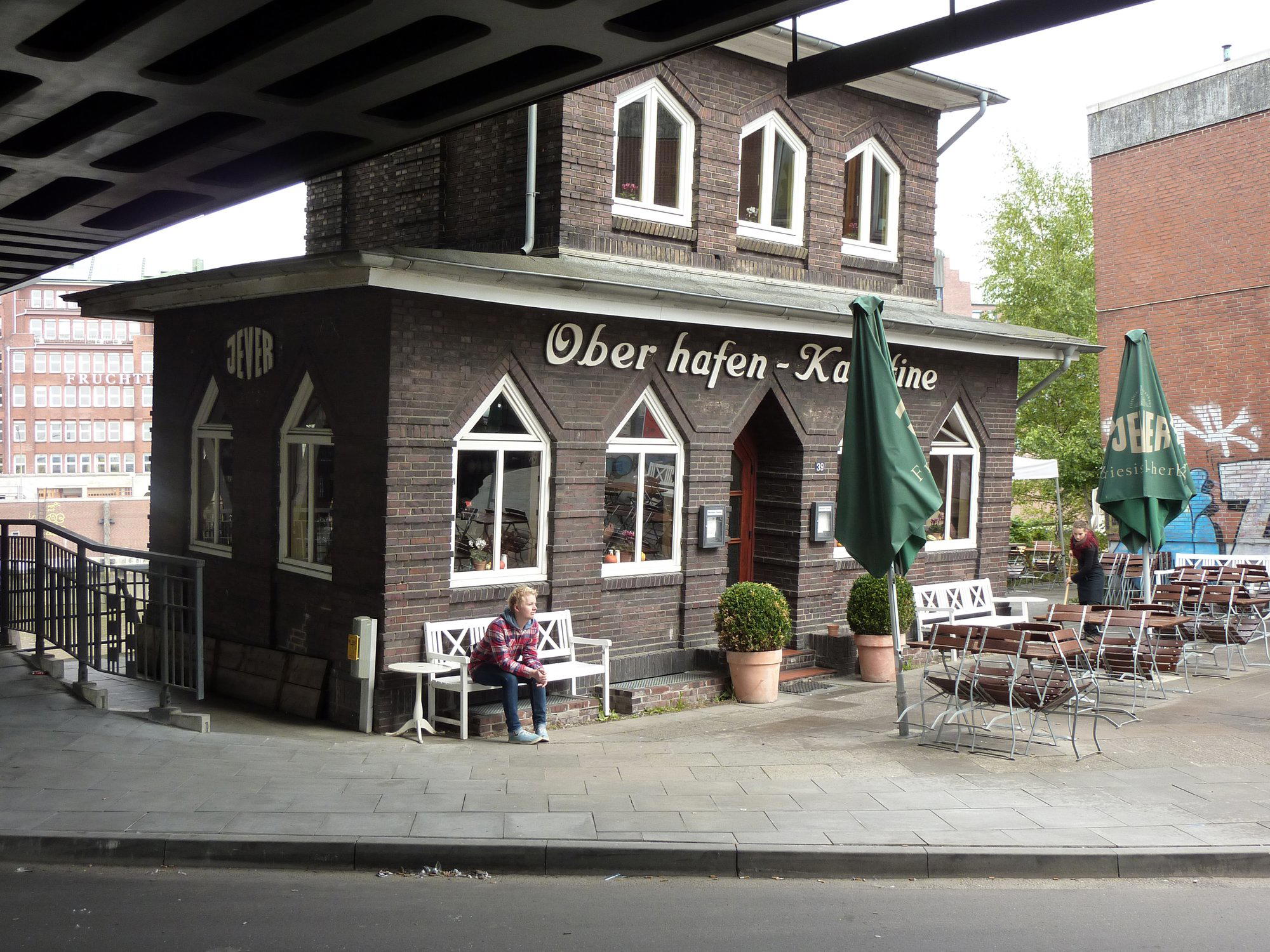
A Building That Earns Its Place on the Water
Hamburg's relationship with its harbour is long, layered, and not always comfortable. The stretch of waterfront between the old Speicherstadt and the newer HafenCity development carries both of those tendencies at once: restored red-brick warehouses converted into offices and galleries on one side, contemporary architecture pushing toward the Elbe on the other. Oberhafen-Kantine, at Stockmeyerstraße 39, sits between those two gravitational pulls and belongs to neither. The building itself is visibly off-axis, tilted by the kind of ground movement that affects old harbour structures over time, and that physical quirk reads as an honest record of age rather than a design affectation. Approaching along the canal-side path, the structure looks like it has simply refused to be replaced.
The Oberhafen district, in which the kantine sits, is one of Hamburg's less-discussed quarters despite its proximity to the heavily visited Speicherstadt. It has historically functioned as a freight and operational zone rather than a visitor destination, which means its character developed around utility rather than presentation. That distinction still shows. The creative studios and small workshops that have moved into the area in recent years have not homogenised it; the industrial skeleton remains visible, and Oberhafen-Kantine reads as part of that skeleton rather than as a tenant decorating it.
Where the Harbour Quarter Meets the Table
Hamburg's dining scene occupies a broad range of registers. At the leading end, places like Restaurant Haerlin and The Table Kevin Fehling operate within the formal fine-dining tier, while 100/200 Kitchen and bianc represent the creative and Mediterranean-leaning middle of the premium market. Lakeside occupies a different mood again, oriented around the waterside setting as much as the plate. Oberhafen-Kantine does not position against any of these directly. Its competitive set is defined less by cuisine category or price bracket than by atmosphere and address: the kind of Hamburg establishment where the room's history is inseparable from the reason you came.
That category of venue, the historically grounded, atmosphere-first address in a port city with strong civic identity, holds particular value in Hamburg because the city is not short of technically accomplished restaurants. What it has fewer of are places where the setting generates meaning on its own terms, independent of what is on the plate. Germany's decorated dining circuit, from Schwarzwaldstube in Baiersbronn to Aqua in Wolfsburg and Vendôme in Bergisch Gladbach, is built largely around technical excellence and controlled environments. Oberhafen-Kantine operates in a different register: the setting does the heavier contextual work, and the experience is shaped by where you are as much as what you order.
The Neighbourhood as Context
Understanding what Oberhafen-Kantine offers requires understanding what the Oberhafen district is and, equally, what it is not. It is not the Speicherstadt, which despite its brick-and-canal atmosphere has become a managed heritage zone, largely populated by design agencies and museums since UNESCO designation. And it is not HafenCity, the planned urban quarter that has grown up around the Elbphilharmonie and represents Hamburg's most deliberate pitch to international attention. Oberhafen sits between these two more publicised zones and has resisted the programming that has shaped both of them.
That resistance is partly structural. The area's buildings were built for operational port work, not for occupation by visitors, and adapting them has required a different approach than the warehouse conversions to the west. The result is a district that feels contingent in the leading sense: things are here because they fit, not because they were placed here by a development plan. That quality, rare in any major European waterfront, is precisely what gives Oberhafen-Kantine its context. The tilted building on the canal is not a curated quirk; it is a genuine artefact, and the difference registers when you are sitting in it.
Visitors arriving from the central Speicherstadt can reach the kantine on foot along the canal path, a walk that takes them through the transition zone where the heritage district gives way to something less resolved and more interesting. The address is not immediately obvious from the main pedestrian routes, which contributes to the sense that finding it involves at least some degree of intention.
Placing Oberhafen-Kantine in a Wider German and International Frame
Across Germany, a recurring tension in the dining and hospitality scene sits between the technically precise, award-oriented end of the market and establishments that trade on atmosphere, history, and a sense of place. The decorated tier, represented in cities like Munich by JAN or in Berlin by CODA Dessert Dining, operates according to a different logic than a harbour kantine with a century of material history behind it. Neither is superior; they answer different questions about what eating out is for.
Internationally, the comparison is equally instructive. The waterfront dining tradition in port cities, whether in San Francisco, where Lazy Bear has defined a particular kind of communal, atmosphere-conscious dining, or in New York, where Le Bernardin represents the opposite pole of technical formality, reflects how much a city's identity shapes what its restaurants are asked to do. Hamburg's identity as a working port city, rather than a gastronomic capital in the French or Spanish sense, means that places like Oberhafen-Kantine carry a different kind of symbolic weight. They are evidence of what the city values beyond the plate.
Within Germany's wider restaurant geography, the Moselle and Rhine corridor, home to establishments like Schanz in Piesport, Waldhotel Sonnora in Dreis, and Bagatelle in Trier, has historically dominated the decorated dining conversation. Hamburg's contribution has been more about the character of individual venues, particularly those that reflect the city's maritime economy and civic self-image, than about accumulating stars. ES:SENZ in Grassau and Victor's Fine Dining by Christian Bau in Perl are part of a different Germany entirely: refined, wine-region-adjacent, destination-focused. Oberhafen-Kantine is Hamburg in a more fundamental sense.
Planning Your Visit
The kantine's location on Stockmeyerstraße places it within walking distance of both the Baumwall U-Bahn station and the Speicherstadt's western edge, making it accessible without being obviously signposted on the main tourist routes. Visitors consulting the full Hamburg restaurants guide will find it sits in a distinct geographical and atmospheric category from the city's central dining district around the Altstadt and the Alster. The canal-side approach on foot is the most direct way to arrive, and the building's distinctive tilt makes it identifiable before you reach the entrance. Given the limited publicly available information on booking procedures, hours, and current pricing, contacting the venue directly or checking current listings before visiting is advisable.
The Essentials
A compact comparison to help you place this venue among nearby peers.
| Venue | Cuisine | Price | Notes |
|---|---|---|---|
| Oberhafen-KantineThis venue — the venue you are viewing | Not listed | Not listed | Not listed |
| The Table Kevin Fehling | Creative | €€€€ | Not listed |
| bianc | Not listed | €€€€ | Modern Mediterranean, Mediterranean Cuisine |
| Lakeside | German Lakeside | €€€€ | Not listed |
| Heimatjuwel | German, Creative | €€€ | Not listed |
| Landhaus Scherrer | Modern European, Classic Cuisine | €€€€ | Not listed |
Continue exploring
More in Hamburg
Restaurants in Hamburg
Browse all →
Bars in Hamburg
Browse all →
Hotels in Hamburg
Browse all →
Wineries in Hamburg
Browse all →
At a Glance
- Rustic
- Well Known
- Cozy
- Classic
- Casual Hangout
- Group Dining
- After Work
- Historic Building
- Waterfront
- Standalone
- Beer Program
- Local Sourcing
- Waterfront
Current opening hours
- Monday
- Closed
- Tuesday
- 5–10 PM
- Wednesday
- 12–10 PM
- Thursday
- 12–10 PM
- Friday
- 12–10 PM
- Saturday
- 12–10 PM
- Sunday
- 12–5:30 PM
Hours can change for holidays and private events. Last verified .
Intimate and nostalgic with dim lighting in a historic dark red brick building that leans noticeably forward, creating a charming and quirky atmosphere that transports diners to Hamburg's working-class harbor heritage.
Know Before You Go
- Getting there
- Stockmeyerstraße 39, 20457 Hamburg, Germany