
Miidera Chikara Mochi Honke places Otsu’s wagashi culture in a practical, low-priced format: Japanese traditional sweets, cafe seating, take-out, and a free Otsu-e gallery upstairs. Its Tabelog 100 selection for Japanese traditional sweets and sweets cafes in WEST 2023 makes it a useful stop for reading the city through local confectionery rather than a full restaurant meal.
Pearl is the En Primeur Club membership app — saves, bookings, and concierge access live there. Same editors, same standards.
- Address
- 2 Chome-1-30 Hamaotsu, Otsu, Shiga 520-0047, Japan
- Phone
- +81 77-524-2689
- Website
- tikaramoti.jp
 Saves & bookings on Pearl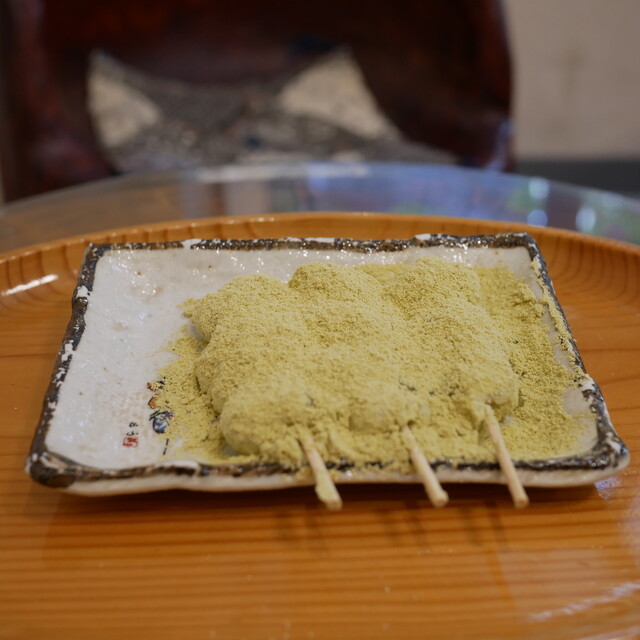
Hamaotsu’s old lakeside quarter asks for a different dining rhythm than Kyoto’s temple-side kaiseki rooms or Osaka’s counter culture. The approach here is modest in scale: a house restaurant, 31 seats across 13 tables, non-smoking service, take-out, and an upstairs Otsu-e gallery that keeps the city’s folk-art tradition in the same building as its sweets. Miidera Chikara Mochi Honke belongs to that category of Japanese travel eating where the point is not a long meal, but a precise stop: a regional wagashi address that tells the visitor how Otsu eats between stations, temple visits, and lakefront walks.
Otsu’s food identity is often read through larger meals: Omi beef, soba, lake fish, kaiseki, and ryokan cooking in the mountains above Lake Biwa. Wagashi gives the city another register. Traditional sweets in Japan are built around agricultural fundamentals, rice, beans, sugar, starch, tea, and seasonal cues, but the format is just as important as the ingredients. A sweets cafe has to function for locals dropping in, families moving through town, and visitors who want a regional product without committing to a formal restaurant. That is why a low-budget sweets house can matter as much to the city’s dining map as a higher-priced beef specialist.
Rice, bean, and tea culture in Otsu's smaller dining register
Japanese confectionery is not dessert in the Western restaurant sense. It sits closer to tea culture, gift culture, and local pilgrimage eating, where texture and portion carry as much meaning as sweetness. Otsu, sitting beside Lake Biwa and close to Kyoto without being absorbed by it, has long worked in that middle zone: accessible to day-trippers, old enough to keep its own customs, and compact enough for specialist shops to remain part of ordinary city movement.
That context is useful because the category can be easy to underrate. A Tabelog 100 selection for Japanese traditional sweets and sweets cafes in WEST 2023 places Miidera Chikara Mochi Honke inside a curated regional field, not merely among general cafes. The distinction matters. Wagashi evaluation rewards consistency, ingredient handling, and a format that respects the product’s role, rather than the theatrics of a long tasting menu. In Otsu, that puts this address in conversation with a different kind of excellence than Omi Gyu Senmon Ten Omi Kadoman, where the price band and beef focus speak to a more formal, protein-led meal.
For a wider read on the city, Chikasada, Hirasansou (Kaiseki), Jidoriya Onza, and Korakuan show how Otsu spreads its dining identity across eel, mountain kaiseki, chicken, and local Japanese cooking. The sweets cafe belongs in that same conversation because it preserves a shorter, lower-cost ritual: something bought to carry away, eaten with tea, or used as a pause between more structured meals.
A house restaurant format, with Otsu-e upstairs
The room matters because wagashi does not need restaurant drama to make its case. A house-restaurant setting keeps the experience domestic rather than ceremonial, while the free Otsu-e gallery upstairs adds a cultural layer specific to the city. Otsu-e, the folk pictures historically associated with the old Tokaido road, suits the format: both the sweets and the pictures belong to travel, gifting, and local memory rather than luxury performance.
That makes Miidera Chikara Mochi Honke a useful corrective to itineraries that treat Otsu only as a side trip from Kyoto. The city has enough dining range to support several kinds of day: sweets near the station, beef at a higher spend, soba at a mid-range pause, and formal Japanese cooking when the schedule allows. For planning that wider circuit, Our full Otsu restaurants guide gives the restaurant frame, while Our full Otsu hotels guide, Our full Otsu bars guide, Our full Otsu wineries guide, and Our full Otsu experiences guide help separate a quick lakeside stop from a slower Shiga stay.
The comparison with other Japanese casual formats is instructive. A sweets cafe is closer in purpose to the tightly focused everyday addresses that define a city from the side:.cafe in Osaka for cafe culture,.know in Kumamoto for local-format dining, (Shoku) Vietnam in Kawasaki for neighborhood specialization, and [Curry Senmon Ten] Maruyama Kyoju. in Sapporo for single-category focus. None of these needs to behave like a destination tasting room to be worth mapping; their value is in how clearly they express a narrow food culture.
How to use it in an Otsu day
The smart way to read this address is as a punctuation mark, not the main meal. Its low spend, take-out service, and child-friendly setup make it more flexible than Otsu’s reservation-led restaurants. The opening pattern also suits early movement through town, which is useful in a city where temple visits, lakefront walks, and rail connections shape the day more than late-night dining.
For travelers building a Japan itinerary around compact, category-specific food stops, this sits comfortably beside casual specialists elsewhere: -Grilled beef Sukiyaki- KAMAKURA TANUKIAN 鎌倉 たぬき庵 in Kamakura for beef sukiyaki,. 鮪と炭火焼き うお炭 秋葉原店 in Tokyo for tuna and charcoal-grill dining, Jōdo Saké Bar in Los Angeles for sake-led Japanese drinking culture abroad, and Onigiri Time in Pasadena for rice-ball specialization. The common thread is not luxury; it is clarity of category.
Miidera Chikara Mochi Honke earns attention because Otsu’s food culture is broader than its formal restaurant addresses. The Tabelog 100 recognition supplies the external signal, the sweets-cafe format supplies the everyday usefulness, and the Otsu-e gallery ties the visit to a local visual tradition. For travelers who usually skip sweets shops in favor of lunch reservations, this is the kind of small stop that changes the reading of a city.
Comparable Spots, Quickly
Comparable venues by cuisine and price in the same metro.
| Venue | Cuisine | Price | Awards | Notes |
|---|---|---|---|---|
| Miidera Chikara Mochi HonkeThis venue — the venue you are viewing | Traditional Japanese wagashi & cafe | $ | , | |
| Ramen Yoshichi Katata ten | Tonkotsu ramen shop | $ | , | Katata |
| Omi Gyu Senmon Ten Restaurant Matsukiya Honten | Omi Beef Steak and Sukiyaki | $$$ | , | Karahashicho |
| 炭火割烹 蔓ききょう | Charcoal-Grilled Kappo with Wild Game | $$$ | , | Seta |
| Jidoriya Onza | Omi Jidori Yakitori | $$$ | , | Mano |
| Sara Soba Nagisa An | Izushi-style sara-soba and Shiga regional cuisine | $$ | , | Nionohama |
Continue exploring
More in Otsu
Restaurants in Otsu
Browse all →
Bars in Otsu
Browse all →
Hotels in Otsu
Browse all →
Wineries in Otsu
Browse all →
At a Glance
- Classic
- Cozy
- Iconic
- Solo
- Family
- Casual Hangout
- After Work
- Historic Building
- Standalone
- Local Sourcing
- Street Scene
A traditional, homey sweets shop and cafe with simple table seating, bright daytime light, and a relaxed, nostalgic atmosphere where guests can pause for mochi and tea while trams pass in front of the storefront.