
In Imaike, Nagoya’s ramen culture has room for small counters that work outside the city’s heavier noodle stereotypes. Menya Tamagusuku sits in that lane with ramen, Okinawa cuisine and Okinawa noodle soup, a 12-seat counter format, and selection for Tabelog Ramen AICHI “Tabelog 100” 2025.
Pearl is the En Primeur Club membership app — saves, bookings, and concierge access live there. Same editors, same standards.
- Address
- 愛知県名古屋市千種区今池1-6-8 ブルースタービル 1F
- Website
- tabelog.com
 Saves & bookings on Pearl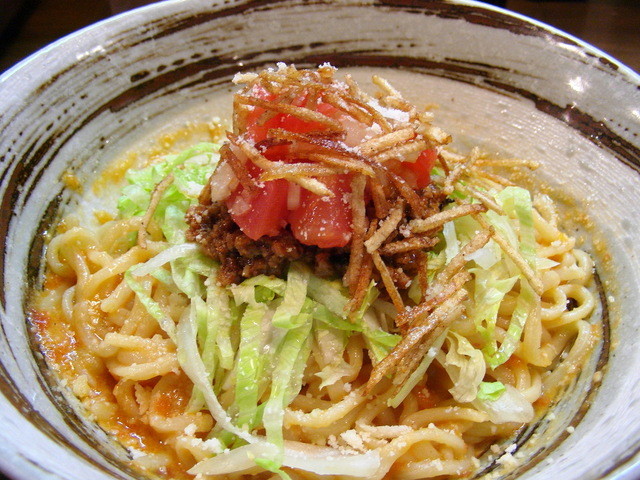
Imaike is not the polished, department-store version of Nagoya dining. It is denser, later, more local in rhythm: station exits, compact buildings, quick meals, and counters where the room tells diners to focus. In that setting, ramen works less as spectacle than as urban infrastructure, a small bowl-driven format built for repeat use, solo eating, and tight turnover. Menya Tamagusuku belongs to that practical Nagoya tradition, but its Okinawa thread gives the address a different register from the city’s miso-heavy shorthand.
Nagoya’s noodle identity is often reduced to its local comfort canon, yet the stronger story is variety inside narrow formats. Ramen shops here can be intensely specific without becoming expensive or ceremonial. Menya Tamagusuku’s categories, ramen, Okinawa cuisine and Okinawa noodle soup, place it in a smaller subcurrent: regional Japanese cooking filtered through the speed and discipline of a counter shop. That matters for sustainability in the plainest sense. Compact menus, counter seating, and bowl-based service tend to reduce the theatrical excess that surrounds higher-spend dining. The interest is in concentration rather than abundance.
Okinawa noodle language inside Nagoya's counter culture
Okinawa noodle soup carries a different set of references from mainstream ramen. It often points toward stock clarity, pork, wheat noodles, and island-seasoned restraint rather than the fat-forward arms race that defines many urban ramen styles. The point at Menya Tamagusuku is not novelty for its own sake; it is the way a regional vocabulary can sit naturally inside a Nagoya working-neighbourhood format. In a city where ramen can lean heavy, this category signal gives diners a reason to think beyond broth intensity alone.
The shop’s recognition helps locate it in the local hierarchy without overstating the case. Selection for Tabelog Ramen AICHI “Tabelog 100” 2025 places it among Aichi’s named ramen addresses for that year, and its Tabelog score is listed at 3.66. Those are useful signals in Japan, where ramen prestige is often built through repeat local consensus rather than international awards. They also suggest a diner base that values consistency and specificity over luxury markers.
The surrounding comparison set makes the point clearer. Imaike Hanten and Hyakurotei Imaike ten occupy low-to-mid everyday dining territory, while WARUNG PHUAN sits at a higher spend bracket, and Sushi Tesaku moves into a different occasion category. Nakaya Pan, by contrast, shows how inexpensive specialist formats can carry serious local gravity. The restaurant reads closer to that specialist logic than to occasion dining: the appeal is precision within a small frame.
A small-room model with a lighter footprint
Environmental claims in restaurants deserve restraint unless a venue publishes hard sourcing or waste data. What can be assessed here is format. A 12-seat counter, non-smoking room, and no private-room structure make this a lean operation by design. The ramen counter is one of Japan’s more efficient dining forms: limited space, quick service rhythm, and cooking organized around repeatable components. It does not need imported luxury cues to justify attention.
That restraint is also cultural. In premium travel, sustainability is often discussed through certifications and architecture, but in Japanese casual dining it frequently appears as compactness, narrow specialization, and low-waste menu discipline. A shop built around bowls and counter seating asks less of real estate and service theatre than a multi-course restaurant. For a visitor, that can be a sharper way to read Nagoya: not through grand statements, but through small businesses that compress regional identity into a meal measured in minutes rather than hours.
The Okinawa angle adds another layer. Regional Japanese cuisines have often travelled through diaspora, labour migration, student neighbourhoods, and late-night districts before becoming fashionable. In Nagoya, an Okinawa-leaning noodle shop in Imaike speaks to that cross-regional everydayness. It is not trying to turn island cooking into fine dining. It keeps the language within the ramen shop’s democratic grammar.
How to place it in a Nagoya food day
For travellers building a serious Nagoya itinerary, this is the kind of stop that works as counterweight to the city’s more formal meals. Use Our full Nagoya restaurants guide to frame the broader dining map, then treat Imaike as a neighbourhood with its own cadence rather than a quick detour from Sakae or Nagoya Station. Nearby planning can sit alongside Our full Nagoya hotels guide, Our full Nagoya bars guide, Our full Nagoya wineries guide, and Our full Nagoya experiences guide for a fuller read on the city.
Within Nagoya’s restaurant pages, the spread of addresses also shows how broad the city’s dining grammar has become: 1022, 451, Aaron, Alan., and All Day Dining Montmartre belong to a different reading of the city than a compact ramen counter in Imaike. That contrast is the value. Nagoya rewards diners who move between formats rather than chasing only high-spend rooms.
For wider Japan context, compare how specialist casual formats travel across cities: -Grilled beef Sukiyaki- KAMAKURA TANUKIAN 鎌倉 たぬき庵 in Kamakura. 鮪と炭火焼き うお炭 秋葉原店 in Tokyo.cafe in Osaka.know in Kumamoto, (Shoku) Vietnam in Kawasaki, and [Curry Senmon Ten] Maruyama Kyoju. in Sapporo all underline the same national pattern: tight concepts can carry as much identity as formal restaurants. Even abroad, Jōdo Saké Bar in Los Angeles and Onigiri Time in Pasadena show how Japanese formats gain force when they stay disciplined.
The editorial case for the restaurant is therefore specific rather than grand. It gives Nagoya ramen a regional Japanese accent, keeps the experience compact, and has enough local recognition to justify attention from diners who care about the mechanics of a city’s everyday food culture. In a travel schedule crowded with famous dishes and hotel dining rooms, this is the smaller counter that explains how Nagoya actually eats.
Local
Comparable venues to anchor price and recognition.
| Venue | Cuisine | Price | Notes |
|---|---|---|---|
| Menya TamagusukuThis venue — the venue you are viewing | Okinawan-style Ramen & Soki Soba | $ | Not listed |
| Baika Do | Japanese traditional sweets (wagashi) shop | $ | Chikusa |
| Kawaguchi Ya | Japanese confectionery shop | $ | Naka |
| Minochu Honten | Traditional Nagoya Wagashi (Japanese Confectionery) | $ | Naka |
| Tonkatsu Shokubo Atsumaru | Tonkatsu | $ | Moriyama |
| Kourai Dojo | Nagoya Kourai-kei ramen | $ | Chikusa |
Recognition history
Dated appearances from independent guides and award organizations, with the underlying list record or original source where available.
Tabelog 100 #17 · No. 17
Tabelog · Tabelog 100 - Ramen - AICHI - 2025
Continue exploring
More in Nagoya
Restaurants in Nagoya
Browse all →
At a Glance
- Cozy
- Lively
- Solo
- Casual Hangout
- After Work
- Group Dining
- Standalone
A small, non-smoking counter-only ramen bar on the first floor of an urban building, with a casual, cozy feel and hints of Okinawan izakaya character, suited to solo diners and friends dropping in for a focused bowl of noodles.