
Tabelog 100 #82
Our verdict
Menya Agosuke is a Joetsu ramen and tsukemen address with Tabelog Ramen EAST 100 selections in 2017, 2018, 2019, and 2025. Its appeal sits in the regional ramen lane: casual, low-cost, counter-and-table dining where sourcing and broth discipline matter more than ceremony.

Pearl is the En Primeur Club membership app — saves, bookings, and concierge access live there. Same editors, same standards.
- Address
- 1650 Shimomonzen, Joetsu, Niigata 942-0063, Japan
- Phone
- +81 25-545-3335
- Hours
- Mon ClosedTue–Fri 11:30 AM–2:30 PM, 5:30–9 PMSat–Sun 11:30 AM–3 PM, 5:30–9 PM
- Website
- menya-agosuke.com
- Directions
- Get directions
The menu
What to order
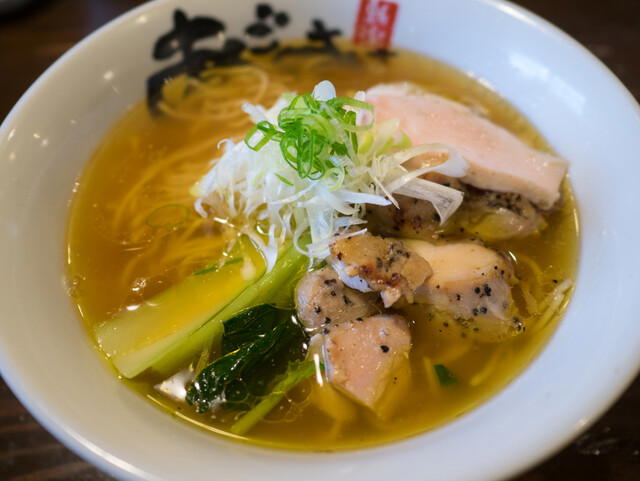
- Ago-dashi ramen
- Shrimp soup tsukemen
- Uma shio torimen
Approach ramen in Joetsu and the mood changes from metropolitan queue culture to something more local and practical: everyday diners moving through the same room, the counter doing its quiet work, and the bowl carrying most of the argument. Menya Agosuke belongs to that Joetsu rhythm, where ramen is not a luxury performance but a serious regional meal built on stock, noodles, and choices that have to justify repeat visits.
That context matters. Japan’s ramen conversation often defaults to major-city density or famous regional styles, but Joetsu has its own claim on the category, shaped by local appetites and a long habit of treating noodle shops as everyday infrastructure. In Joetsu, the ramen house is less about theatrical minimalism than reliability, speed, and depth in the bowl. Menya Agosuke sits inside that tradition while carrying a national trust signal: Tabelog Hyakumeiten recognition in 2025.
Joetsu ramen, read through stock and restraint
The useful way to read this kitchen is through ingredient logic rather than ornament. Ramen and tsukemen are the core categories, which places the shop in a format where broth concentration, noodle texture, balance, and finishing choices do the heavy lifting. Tsukemen, in particular, exposes a kitchen quickly: dipping broth has to carry intensity without turning blunt, while noodles need enough structure to remain convincing outside soup. In regional Japan, this is where good ramen separates itself from merely popular ramen.
Menya Agosuke’s Tabelog score of 3.69 and 2025 Hyakumeiten recognition place it in a narrower band than the average neighbourhood noodle stop, but the experience remains grounded in the price logic of everyday ramen rather than tasting-menu dining. The listed budget for both lunch and dinner sits at JPY 1,000–1,999, which is important: the point is not expense, but precision inside an accessible format.
The sourcing angle is not about naming rare ingredients for prestige. It is about the way a regional ramen shop uses everyday materials with discipline. Joetsu food culture rewards directness, warmth, and savoury depth; ramen in this part of Japan often reads through that appetite for concentration. A shop serving both ramen and tsukemen has to manage extraction and seasoning across two formats, not simply ladle one base into every bowl.
A casual room with award-level signals
The room tells a useful story about the target audience without needing to be treated as a luxury stage. Menya Agosuke reads as a practical Joetsu ramen stop rather than a destination built only for travelling obsessives. That matters in a city where a serious noodle address still needs to function as part of daily life. Its value is clearest when the recognition is placed beside the modest budget range.
Compared with Joetsu peers, the framing is particularly telling. Gangitei and Shokudo New Misa help show how varied a Joetsu food plan can be, while Menya Agosuke’s distinction is recognition within a low-cost ramen category where small differences in broth construction, noodle handling, and consistency are what earn notice. That is the right lens: not a splurge, but a calibrated ramen stop with enough external validation to justify planning around it.
For travellers building a Joetsu food day, this is the kind of place that works better as a meal anchor than a decorative detour. The city’s dining scene rewards attention to local formats: noodle shops, set-meal houses, casual counters, and family-friendly rooms that keep prices in check. The broader context is useful through our full Joetsu restaurants guide, while the city’s other travel layers sit in our full Joetsu hotels guide, our full Joetsu bars guide, our full Joetsu wineries guide, and our full Joetsu experiences guide.
How to place it within a Japan itinerary
Menya Agosuke makes sense for travellers who care about regional ramen as a living category rather than a checklist item. The appeal is not ceremony, chef mythology, or luxury signalling. It is the sharper pleasure of seeing how a non-metropolitan Japanese city sustains a serious noodle culture at an accessible price, with enough structure to serve regular local demand and enough focus to satisfy ramen hunters.
That distinction also helps avoid a common mistake in Japan dining plans: treating every recognised restaurant as if it demands the same level of occasion. Some meals should be about precision without formality. Here, the editorial case rests on three facts in combination: Tabelog Hyakumeiten recognition in 2025, a ramen and tsukemen format, and an accessible JPY 1,000–1,999 budget band. Together, those signals put it in a practical regional category worth seeking out when Joetsu is already on the route.
For broader comparison across Japan, the useful contrasts are not all ramen shops and do not need to be reduced to named destinations. Formal dining rooms, izakaya-grill formats, casual cafés, curry counters, burger shops, and overseas Japanese casual concepts all signal value differently. That is exactly why a Joetsu ramen room reads with such clarity: local demand comes first, the budget stays modest, and the bowl has to carry the reputation.
Frequently asked questions
Would Menya Agosuke be comfortable with kids?
Menya Agosuke is a casual ramen and tsukemen restaurant in Joetsu. For family-specific details, confirm directly with the restaurant before visiting.
What kind of setting is Menya Agosuke?
It is a ramen and tsukemen restaurant in Joetsu, positioned as an accessible everyday noodle stop rather than a formal dining room.
What price level is Menya Agosuke?
Pricing at Menya Agosuke is listed as JPY 1,000 - JPY 1,999 JPY 1,000 - JPY 1,999 View spending breakdown.
When can I go to Menya Agosuke?
Current opening hours are not provided here. Check directly with Menya Agosuke before making the trip to Joetsu.
Where exactly is Menya Agosuke?
Joetsu.
What makes Menya Agosuke worth seeking out?
Its clearest draw is recognition: Tabelog Hyakumeiten recognition in 2025. The pricing also stays in the JPY 1,000–1,999 range, which keeps it accessible for a listed ramen address in Joetsu.
Snapshot
Comparable venues by cuisine and price in the same metro.
| Venue | Cuisine | Price | Awards | Notes |
|---|---|---|---|---|
| Menya AgosukeThis venue — the venue you are viewing | Japanese Ramen | $10–20 | Tabelog 100 #82 | Not listed |
| 麺屋 あごすけ | Japanese Ramen | $10–20 | Tabelog 100 #82 | 上越市 |
| Shokudo New Misa | Ramen & Japanese cafeteria | $10–20 | Tabelog 100 #26 | Nakago-ku |
| Gangitei | Traditional Joetsu izakaya with local cuisine and sake | $30–50 | Tabelog 100 #82 | Nakacho |
| RED HOUSE (レッドハウス) | Japanese Slope-Side Casual | Not listed | Not listed | 安比高原 |
| Koshu Houtou Kosaku (甲州ほうとう 小作) | Koshu Houtou (Yamanashi Regional Noodles) | Not listed | Not listed | Fujikawaguchiko |
Recognition history
Dated appearances from independent guides and award organizations, with the underlying list record or original source where available.
Tabelog 100 #82 · No. 82
Tabelog · Tabelog 100 - Ramen - EAST - 2025
Continue exploring
More in Joetsu
Restaurants in Joetsu
Browse all →

Details
- Classic
- Cozy
- Solo
- Family
- Casual Hangout
- Standalone
- Beer Program
- Local Sourcing
- Street Scene
- A La Carte
- Counter Dining
- Beer
Current opening hours
- Monday
- Closed
- Tuesday
- 11:30 AM–2:30 PM, 5:30–9 PM
- Wednesday
- 11:30 AM–2:30 PM, 5:30–9 PM
- Thursday
- 11:30 AM–2:30 PM, 5:30–9 PM
- Friday
- 11:30 AM–2:30 PM, 5:30–9 PM
- Saturday
- 11:30 AM–3 PM, 5:30–9 PM
- Sunday
- 11:30 AM–3 PM, 5:30–9 PM
Hours can change for holidays and private events. Last verified .
A modest, house-style local ramen shop with a direct, everyday atmosphere focused on craft rather than spectacle.