
MEGURI gives Isehara’s gelato scene a farm-first anchor rather than a city-dessert gloss. Its Tabelog 100 Ice cream / Gelato 2023 selection, take-out format, six-seat scale, and Ishida Farm milk connection place it in the small Japanese category where sourcing matters as much as technique.
Pearl is the En Primeur Club membership app — saves, bookings, and concierge access live there. Same editors, same standards.
- Address
- 777 Kamiya, Isehara, Kanagawa 259-1127, Japan
- Phone
- +81 463-93-4870
- Website
- meguri-gelato.com
- Directions
- Get directions
 Saves & bookings on Pearl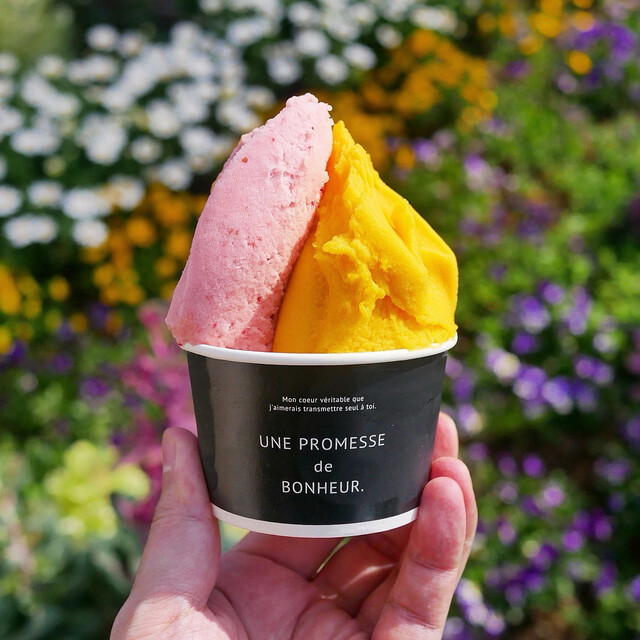
The approach to rural Isehara changes the expectation before the first spoonful: this is not the polished dessert-counter grammar of a department-store basement, but the quieter Kanagawa version, where dairy, roadside access, and local family traffic shape the experience. Japan’s gelato culture has split into two visible lanes. One borrows from Italian technique and urban design; the other leans into milk provenance, fruit seasons, and regional farm identity. MEGURI belongs to the second lane, and that matters more than any decorative language around the shop.
The signal is unusually clear for a gelato address outside a large city centre. Tabelog selected it for the Tabelog 100 Ice cream / Gelato list in 2023, a category that rewards specialist shops rather than broad restaurant polish. That recognition puts a small Isehara dairy-led shop into a national conversation about frozen desserts, where the competitive question is not just texture or sweetness, but whether the base ingredient has enough character to carry a simple format.
Farm milk gives Isehara gelato a different centre of gravity
Japanese gelato often succeeds when it avoids copying Italy too literally. The stronger domestic examples use local milk, tea, fruit, nuts, or regional produce as the argument, then let the churned format do the translation. Here, the defining fact is direct management from Ishida Farm, with fresh milk from a farm identified with Isehara over four decades. That does not automatically guarantee quality, but it does explain the shop’s editorial relevance: the product is tied to a nearby agricultural source rather than to imported dessert theatre.
That sourcing angle also explains why this address reads differently from many casual sweets stops in Kanagawa. A low-priced gelato shop can be forgettable when the experience is built only around novelty flavours; it becomes more persuasive when milk supply, small scale, and local demand align. The format is take-out led, with only six seats, so the logic is closer to a rural producer’s counter than a lingering café. The rhythm is simple: choose, eat, move on, or take frozen cup gelato for local shipping.
Isehara sits in a useful middle ground for travellers who pay attention to food beyond the major stations. The city is not trying to compete with Tokyo’s density, and that is precisely the point. In a place where a meal might otherwise mean soba, yakiniku, coffee, or a local lunch stop, a farm-linked gelato shop adds a different kind of edible geography. Readers mapping the area can place it alongside Moulus a la Meule and our full Isehara restaurants guide, then widen the trip through our full Isehara hotels guide, our full Isehara bars guide, our full Isehara wineries guide, and our full Isehara experiences guide.
The category rewards restraint more than spectacle
Gelato and ice cream shops are easy to overread. Awards, queues, and online scores can make a scoop sound grander than the actual decision facing a traveller. The better question is practical and sensory without inventing detail: is the shop built around a credible base ingredient, a disciplined format, and enough local relevance to justify a detour? MEGURI answers that with its farm connection, Tabelog category selection, take-out service, and accessible everyday pricing tier. It is not a tasting-menu proposition; it is a short, ingredient-led stop with more credibility than its casual format suggests.
The comparison within Isehara is revealing. Moulus a la Meule occupies a higher everyday dining bracket, while this gelato shop sits in a lighter, snack-scale register. That makes the two useful in different ways: one for a fuller restaurant stop, the other for a dairy-led pause built around regional production. Nearby out-of-metro comparisons such as Cafe Suzuki, Atsugi Honmaru Tei, and Yakiniku Waganse show how broad the surrounding food field becomes once travellers leave central Tokyo pricing and format assumptions behind. Dessert, in that context, can carry place as directly as a bowl of noodles or a grilled meat lunch.
There is also a family logic to the format. Children are explicitly welcomed, the spend sits in a modest range, and the take-out structure lowers the pressure that comes with formal dining rooms. That combination is common in Japan, but it is not trivial: a serious sweets stop that works for families often becomes part of a day’s route rather than a destination meal. For visitors pairing Isehara with other Kanagawa or wider Japan dining research, the same broader map might include -Grilled beef Sukiyaki- KAMAKURA TANUKIAN 鎌倉 たぬき庵 in Kamakura, 1000 in Yokohama, or (Shoku) Vietnam in Kawasaki.
How to read it within a Japan food itinerary
The case for stopping here is strongest for travellers who build itineraries around ingredient chains rather than restaurant prestige alone. Japan’s food culture is unusually good at making small specialists legible: a soba miller, a tofu maker, a wagashi counter, a coffee roaster, a dairy-linked gelato shop. The pleasure is not in scale. It is in seeing how a single ingredient moves from production into a public-facing format with minimal friction.
That is why MEGURI is better understood as part of a specialist network than as a standalone trophy. In Tokyo, Osaka, Kyoto, Kumamoto, Sapporo, Kashihara, Kanazawa, Los Angeles, and Pasadena, the same editorial thread appears in different forms: narrow formats, disciplined menus, and a clear reason for existing beyond broad hospitality. For wider context, compare the specialist logic behind. 鮪と炭火焼き うお炭 秋葉原店 in Tokyo.cafe in Osaka.know in Kumamoto, [Curry Senmon Ten] Maruyama Kyoju. in Sapporo, [ki:] in Kyoto, #肉といえば松田 奈良本店 in Kashihara, 1/3 HAMBURGER FACTORY in Kanazawa, Jōdo Saké Bar in Los Angeles, and Onigiri Time in Pasadena.
The editorial verdict is measured: this is a compact, sourcing-led gelato stop that rewards travellers already moving through Isehara or western Kanagawa, especially those interested in how Japanese regional dairy enters casual food culture. The award recognition gives it external credibility; the farm link gives it a reason to matter; the small take-out format keeps expectations correctly calibrated.
Comparison Snapshot
Comparable venues by cuisine and price in the same metro.
| Venue | Cuisine | Price | Notes |
|---|---|---|---|
| MEGURI | Farm-direct gelato & ice cream shop | $ | Isehara |
| Moulus a la Meule | Artisanal bakery with house-milled flour | $ | Isehara |
| Silk Road Ryori Budouen | Silk Road / Xinjiang homestyle cuisine | $ | Seya |
| Yamadori and Furano Cheese Factory | Furano Cheese Factory Experiences | $ | Furano |
| AKHA AMA COFFEE Kagurazaka | Thai specialty coffee café | $ | Shinjuku |
| Newcastle | Traditional Japanese curry house | $ | Chūō |
Recognition history
Dated appearances from independent guides and award organizations, with the underlying list record or original source where available.
Tabelog 100 #18 · No. 18
Tabelog · Tabelog 100 - Ice cream / Gelato - 2023








At a Glance
- Cozy
- Rustic
- Scenic
- Family
- Casual Hangout
- Solo
- Celebration
- After Work
- Standalone
- Farm To Table
- Local Sourcing
Current opening hours
- Monday
- Closed
- Tuesday
- Closed
- Wednesday
- 10:30 AM–5 PM
- Thursday
- 10:30 AM–5 PM
- Friday
- 10:30 AM–5 PM
- Saturday
- 10:30 AM–5 PM
- Sunday
- 10:30 AM–5 PM
Hours can change for holidays and private events. Last verified .
Casual, family-friendly countryside gelato shop attached to a working farm, with a relaxed, drive-stop feel rather than a formal restaurant setting.