
Man-u brings Michelin Plate-recognised oden to Osaka's Dojima district, drawing on techniques from across Japanese regional cuisine to reshape a dish that most places treat as simple comfort food. Items from the communal pot are paired with layered condiments and broths that shift the flavour profile with each combination. At the ¥¥¥ price point, it occupies a rare position: a specialty format with serious culinary ambition.
Pearl is the En Primeur Club membership app — saves, bookings, and concierge access live there. Same editors, same standards.
- Address
- Japan, 〒530-0003 Osaka, Kita Ward, Dojima, 1 Chome−2−33 5F
- Phone
- +81 6-6341-5555
- Website
- kagaman.co.jp
- Directions
- Get directions
 Saves & bookings on Pearl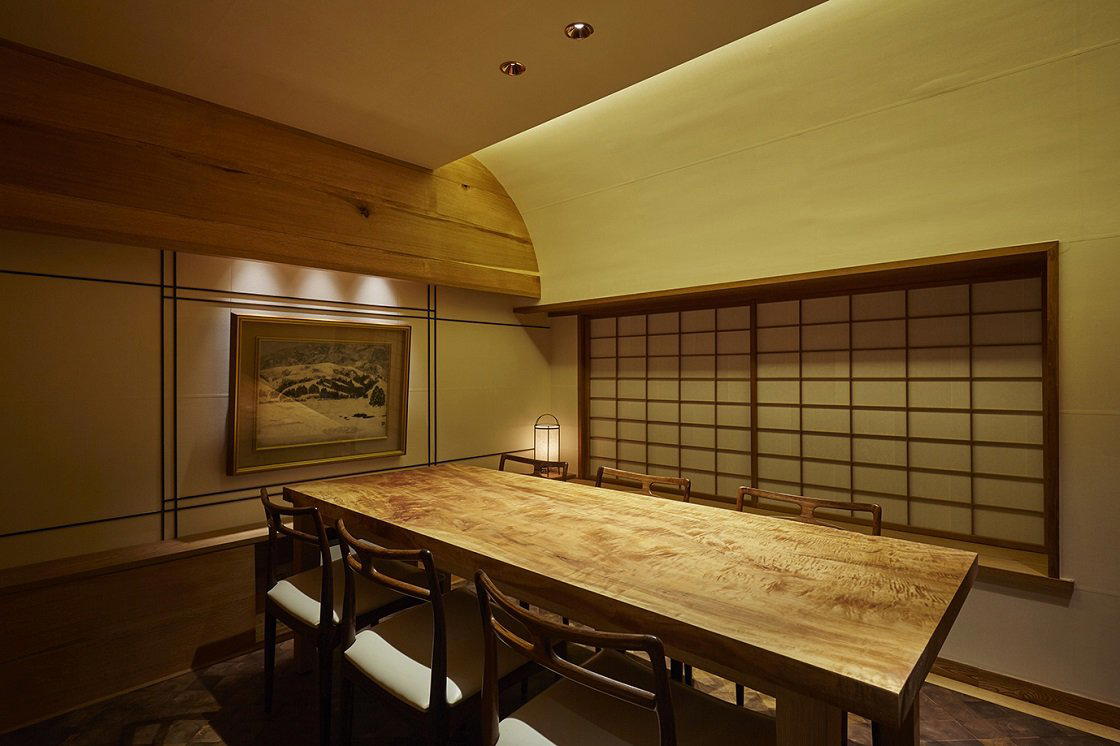
Oden as Architecture: How Man-u Builds a Menu Around a Single Pot
Most oden counters in Osaka operate on a logic of abundance. Ingredients simmer in a shared dashi broth, guests point at what they want, and the dish lands at the table more or less as it left the pot. The format is democratic and ancient, and few places in Japan ask whether it can be something more deliberate than that. Man-u, on the fifth floor of a building in Dojima, Kita Ward, is one of those places. The Michelin Guide has awarded it a Plate in both 2024 and 2025.
Dojima is a business and entertainment corridor running between Umeda and Nakanoshima, and it carries a different dining tempo than the tourist-dense lanes of Shinsaibashi or Namba. Restaurants here tend to serve a professional crowd in the evening, and the building-floor address, common to many serious small restaurants across Osaka, filters for intent.
The Menu as Sequence, Not Selection
What distinguishes Man-u's approach is the degree to which the menu functions as a composed sequence rather than an open pick-and-choose format. Items are selected from a large pot, but the kitchen pairs each element with specific condiments and broths to direct the flavour in a particular direction. That pairing logic is the architectural move: the pot is the raw material, and the condiment-and-broth system is the structure laid over it.
The combinations documented from the kitchen are specific and deliberate. Beef sinew arrives cooked with green onions, a pairing that pulls the gelatinous richness of the sinew toward something sharper and fresher. Octopus is matched with unripe pepper, an ingredient that introduces a clean, vegetal heat quite different from the dried spice it will eventually become. These are not obvious pairings, and they reflect a kitchen that has thought carefully about what each ingredient needs to express itself rather than simply simmering everything toward a common denominator.
Some items are served as soup dishes rather than pot-pulled pieces. Clams, wakame seaweed with bamboo shoots, and pike conger with matsutake mushrooms each arrive in this format. The pike conger and matsutake combination is a seasonally loaded pairing with deep roots in Kansai cuisine, where both ingredients arrive together at the turn of summer into autumn. Using it inside an oden format is a statement about the range of reference the kitchen is drawing from.
The menu extends further into territory that most oden counters would never consider. Lettuce, tomato, and figs dressed with a starchy dashi soup stock sauce appear as alternatives that break the expected ingredient register of the dish entirely. Oden's traditional vocabulary runs to daikon, konnyaku, fish cake, and tofu. Introducing fig and tomato, dressed with thickened dashi, signals that the kitchen is treating the format as a structure to work within rather than a canon to reproduce. The sequence moves through distinct moments engineered through preparation and pairing.
Where This Sits in Osaka's Dining Order
Osaka's upper tier of restaurants is dominated by kaiseki formats and European fine dining, most of them operating at ¥¥¥¥ price points. HAJIME (French, Innovative) and La Cime (French) both sit in that higher bracket, as does the innovative Fujiya 1935. At ¥¥¥, Man-u shares its price tier with Japanese-format restaurants including Kashiwaya Osaka Senriyama (Japanese) and Taian (Kaiseki, Japanese), though its format is radically different from either. Kaiseki at this price point operates through a fixed sequence of small courses across multiple preparations. Oden is a single-vessel format where the sequence is created through selection and pairing rather than through physical course changes. Man-u's achievement is making that single-vessel format feel as considered as a multi-course meal.
The comparison with Yoshitaka, another Osaka restaurant operating in the considered Japanese tradition, points to a broader pattern in the city: specialty formats at serious preparation levels tend to earn recognition precisely because they resist generalization. The kitchen at Man-u has a specific discipline and a specific body of knowledge, and the Michelin Plate reflects that concentration rather than range.
For those exploring how oden functions elsewhere in the Kansai region, Fuyacho 103 and Oito, both in Kyoto, offer points of comparison. Kyoto's oden tradition leans on lighter dashi and restrained seasoning; Man-u's cross-regional borrowings place it in a different register, more interventionist in its pairing logic, less committed to any single regional orthodoxy.
Planning a Visit
Man-u is located on the fifth floor at 1-2-33 Dojima, Kita Ward, Osaka, 530-0003. The ¥¥¥ price range places it in the mid-to-upper tier for Osaka dining, broadly comparable to serious kaiseki counters in the same bracket. Booking in advance is advisable given the Michelin recognition and the format, which does not suit walk-ins as naturally as a casual oden bar would.
| Venue | Cuisine | Price | Michelin Recognition |
|---|---|---|---|
| Man-u | Oden | ¥¥¥ | Plate 2024, 2025 |
| Kashiwaya Osaka Senriyama | Japanese | ¥¥¥ | Michelin-recognised |
| Taian | Kaiseki, Japanese | ¥¥¥ | Michelin-recognised |
| HAJIME | French, Innovative | ¥¥¥¥ | Michelin-recognised |
| La Cime | French | ¥¥¥¥ | Michelin-recognised |
Further Reading
Restaurants worth noting elsewhere in Japan include Harutaka in Tokyo, Gion Sasaki in Kyoto, akordu in Nara, Goh in Fukuoka, 1000 in Yokohama, and 6 in Okinawa.
Quick Comparison
Comparable venues nearby, for context on price, style, and recognition.
| Venue | Cuisine | Price | Awards | Notes |
|---|---|---|---|---|
| Man-uThis venue — the venue you are viewing | Modern Japanese Oden | $$$ | Michelin Plate | Not listed |
| Momen | Kappo | $$$ | Not listed | Chūō |
| Hachi | Binchōtan-Grilled Wagyu Omakase | $$$ | Michelin Plate | Kita |
| Kurubushi | Modern Kappo Omakase | $$$ | Michelin Plate | Kita |
| Naniwaryori Satou | Naniwa Ryori (Osaka-style Japanese Cuisine) | $$$ | Michelin Plate | Kita |
| Konishi | Kappo | $$$ | Michelin Plate | Kita |
Recognition history
Dated appearances from independent guides and award organizations, with the underlying list record or original source where available.
Michelin Plate
Michelin
Michelin Plate
Michelin
Michelin Plate
Michelin
Continue exploring
More in Osaka
Restaurants in Osaka
Browse all →




Bars in Osaka
Browse all →




Hotels in Osaka
Browse all →




Wineries in Osaka
Browse all →
At a Glance
- Intimate
- Elegant
- Cozy
- Sophisticated
- Special Occasion
- Date Night
- Chefs Counter
- Open Kitchen
- Sake Program
Current opening hours
- Monday
- 5–10 PM
- Tuesday
- 5–10 PM
- Wednesday
- 11:30 AM–1:15 PM, 5–10 PM
- Thursday
- 11:30 AM–1:15 PM, 5–10 PM
- Friday
- 11:30 AM–1:15 PM, 5–10 PM
- Saturday
- 5–10 PM
- Sunday
- Closed
Hours can change for holidays and private events. Last verified .
Tranquil wood-clad interior with restrained lighting focused on chef interaction at the counter.