

Michelin Plate · Tabelog 100 #20
Our verdict
A Western-style brick house in Shibuya's Daikanyama district, Madame Toki occupies a quieter register of Tokyo's French dining scene. Marble floors, antique furnishings, and a proprietress-led service team evoke a European country house. The cooking is precise and restrained, with a dessert trolley that marks the meal's close as a considered ritual rather than an afterthought.

Pearl is the En Primeur Club membership app — saves, bookings, and concierge access live there. Same editors, same standards.
- Address
- 14-7 Hachiyamacho, Shibuya, Tokyo 150-0035, Japan
- Phone
- +81 3-3461-2263
- Hours
- Mon ClosedTue–Sun 12–3 PM, 6–11 PM
- Website
- madame-toki.com
- Directions
- Get directions
A Dining Tradition That Travels Badly — and Lands Well in Daikanyama
French restaurant culture arrived in Japan in earnest during the 1970s and 1980s, carried by chefs who trained in Lyon and Paris and returned to build something that was neither imitation nor fusion. What emerged over the following decades was a category of Tokyo French dining that operates on its own terms: more disciplined than its European source material in some respects, more theatrical in others, and almost always more attentive to the choreography of service. Madame Toki sits within that tradition. The address — 14-7 Hachiyamacho, Shibuya, places it in Daikanyama, a neighbourhood that has long sustained a particular kind of refined, low-decibel hospitality. Daikanyama is not where Tokyo goes for spectacle. It is where Tokyo goes to eat well without announcing itself.
The Room as Opening Argument
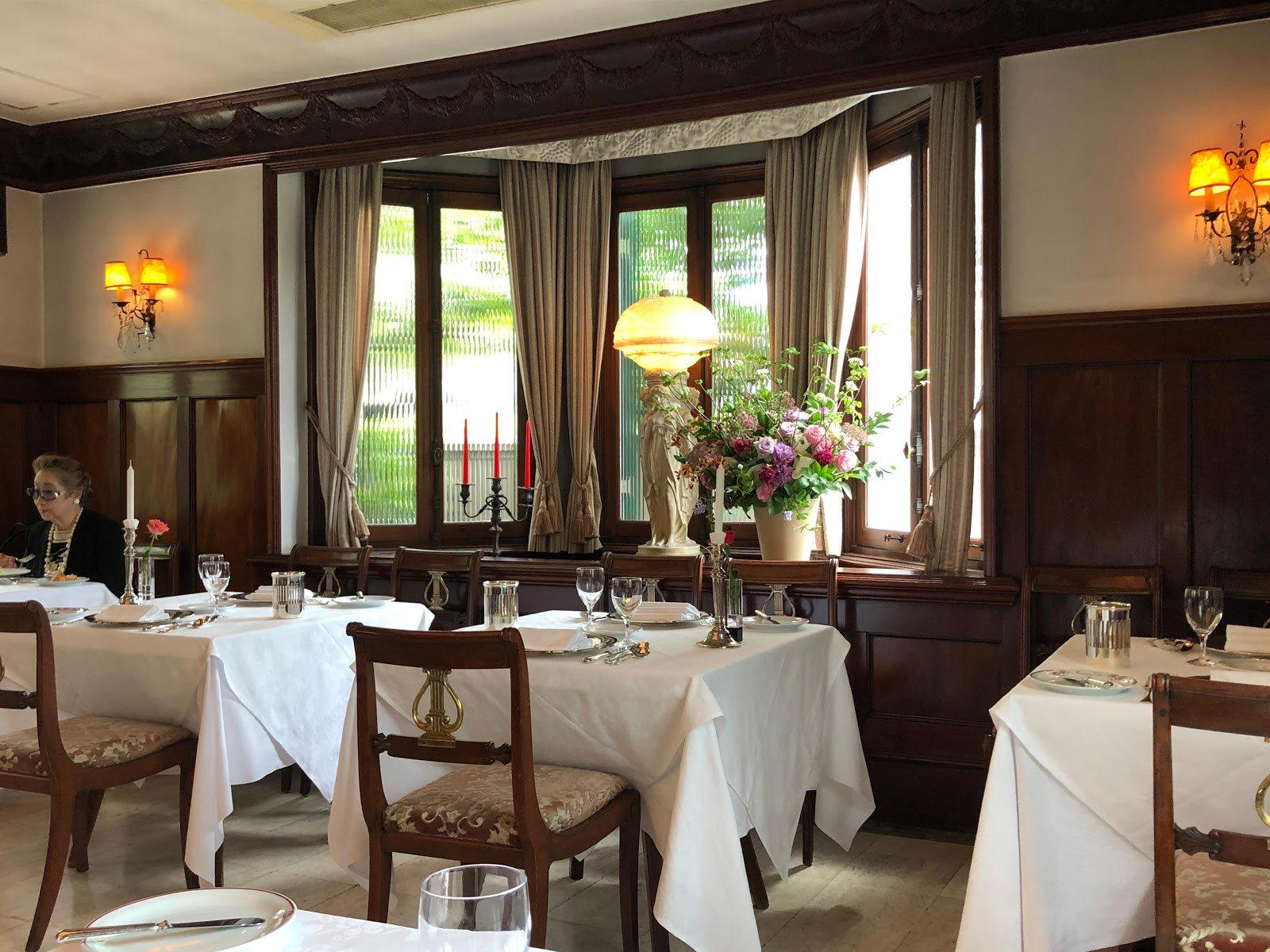
The physical argument Madame Toki makes begins outside. A Western-style brick house with red roof tiles occupies the site, a structure that reads as deliberately European against its surroundings. Inside, marble floors, antique furniture, and chandeliers compose a room that functions less like a contemporary restaurant and more like the dining room of a private European villa. That framing is not accidental. In the tier of French restaurants below the hyper-minimalist counter formats that now dominate Tokyo's upper price brackets, a significant cohort chooses classical décor as a form of credentialing, a signal that the kitchen's ambitions are rooted in tradition rather than innovation for its own sake. Madame Toki reads clearly in that register. The ¥¥¥ price point confirms the positioning: this is not the ¥¥¥¥ tier occupied by L'Effervescence (French) or the various kaiseki rooms that benchmark Tokyo's most expensive dining. It is a step below in price, and in a different conversation altogether in terms of style.
The Rhythm of the Meal
What distinguishes the French dining ritual from most other fine-dining formats is its attachment to sequence and pace. A meal structured around multiple courses, with each transition marked by a change in temperature, weight, or register, demands a service team that understands timing as much as technique. The description of Madame Toki's team as led by a proprietress who directs an attentive service staff speaks to a classical front-of-house model that has largely disappeared from younger European restaurants but persists in Tokyo's French dining rooms, where formality is treated as a form of respect rather than a relic.
The dessert trolley is the clearest expression of this philosophy. In most contemporary French restaurants in Europe and in Asia's high-modernist tier, dessert arrives plated, constructed, and non-negotiable. The trolley format inverts that relationship: the diner chooses, the meal slows, and the close of service becomes a moment of deliberate selection rather than passive reception. It is a ritual that belongs to a pre-nouvelle cuisine era of French restaurant culture, one that Tokyo's most classically minded French rooms have preserved with more fidelity than Paris itself.
The cooking that precedes that trolley is described as simple, modern, and scrupulously prepared, a phrase that, in context, signals careful sourcing and execution over conceptual ambition. Tokyo's ¥¥¥¥ French tier, from the innovation-led rooms to counters with Michelin credentials, competes on transformation and concept. Madame Toki's stated register is precision and pleasure, which is a different value proposition and one that suits the Daikanyama address. Nearby, properties like au deco, La Paix, and Patous serve as reference points for the neighbourhood's particular appetite for European cooking with genuine technical grounding.
Where It Sits in Tokyo's French Scene
Tokyo's French restaurant spectrum now runs from entry-level bistros in Shinjuku through mid-tier rooms in Minami-Aoyama and Ebisu to the three-Michelin-star tier in Nishi-Azabu and beyond. Madame Toki occupies a middle register in price but a particular position in style. The classical European villa aesthetic, the trolley service, and the proprietress-led team align it with a cohort of Tokyo French restaurants that treat continuity as a virtue. These rooms are not trying to be the next great entry on the World's 50 Best list. They are trying to deliver a recognisable French meal at a high standard of execution, night after night, for guests who know what they are asking for.
That cohort is smaller than it was two decades ago. Tokyo's fine-dining investment has migrated heavily toward Japanese-French fusion formats, kaiseki rooms adapting Western techniques, and counter-based omakase that borrows from both traditions. The French restaurant in the classical European mold, dining room, trolley, proprietress, marble, is now a minority position in the city. Harutaka (Sushi) in Ginza represents the counter-led discipline that defines Tokyo's upper tier in a very different idiom; the gap between that format and Madame Toki is as much philosophical as it is economic.
For context beyond Tokyo, the classical French-in-Asia model has equivalents across Japan. HAJIME in Osaka and Gion Sasaki in Kyoto each represent a different answer to the question of how French and Japanese sensibilities can coexist in a single room, and each draws a different kind of traveller. Internationally, Le Bernardin in New York City and Atomix in New York City occupy the upper tier of classical and progressive fine dining respectively, offering a useful frame of reference for where Tokyo's French rooms position themselves against a global benchmark.
Planning Your Visit
Madame Toki is located at 14-7 Hachiyamacho in Shibuya, a short walk from Daikanyama Station on the Tokyu Toyoko Line. The neighbourhood rewards arriving with time to spare: Daikanyama's bookshops, galleries, and low-key cafés make it one of the few parts of Shibuya that asks to be walked slowly. The ¥¥¥ pricing suggests a mid-to-upper-range meal by Tokyo standards, comfortably below the ¥¥¥¥ tier of the city's Michelin-led French rooms but priced to reflect the room and the service model. Advance reservations are advisable, particularly for evenings; the classical dining room format and proprietress-led service model do not lend themselves to walk-in availability. Phone and online booking details are best confirmed directly through the venue.
For broader planning across the city, our full Tokyo restaurants guide maps the full range of dining options across neighbourhoods and price tiers. Our full Tokyo hotels guide, our full Tokyo bars guide, and our full Tokyo experiences guide cover the wider visit. Those extending their itinerary beyond the capital will find useful reference points in akordu in Nara, Goh in Fukuoka, 1000 in Yokohama, and 6 in Okinawa. Our full Tokyo wineries guide covers wine options for those extending the evening.
Frequently asked questions
What do regulars order at Madame Toki?
What is the ideal way to book Madame Toki?
What makes Madame Toki worth seeking out?
How does Madame Toki fit into Daikanyama's dining character?
Cuisine and Awards Snapshot
Comparable venues nearby, for context on price, style, and recognition.
| Venue | Cuisine | Price | Awards | Notes |
|---|---|---|---|---|
| Madame TokiThis venue — the venue you are viewing | Classic French Fine Dining | $150–200 | Michelin Plate · Tabelog 100 #20 | Not listed |
| L'EAU | Innovative French with Japanese Seasonal Ingredients | $200–300 | Michelin Plate · Tabelog 100 #29 | Minato |
| Nœud. TOKYO | Sustainable Vegetable-Centric French | $150–200 | Michelin Plate · We're Smart World 5 Radishes | Chiyoda |
| COMME À LA MAISON | Southwestern French Bistro | $50–100 | Michelin Plate | Minato |
| Gendaisaryo Ginza Fugetsudo | Classic French with Seasonal Japanese Ingredients | $200–300 | Michelin Plate | Chūō |
| Le Jardin de Kamo | Modern Southern French | $150–200 | Michelin Plate | Chūō |
Recognition history
Dated appearances from independent guides and award organizations, with the underlying list record or original source where available.
Michelin Plate
Michelin
Tabelog 100 #20 · No. 20
Tabelog · Tabelog 100 - French - TOKYO - 2025










Madame Toki
The wine
- Wine program
- Exceptional wine program
- Extensive wine list
- Sommelier-led
Details
- Elegant
- Sophisticated
- Cozy
- Classic
- Date Night
- Special Occasion
- Celebration
- Business Dinner
- Extensive Wine List
- Sommelier Led
- Street Scene
- Prix Fixe
- Wine
- Allergy Accommodating
Current opening hours
- Monday
- Closed
- Tuesday
- 12–3 PM, 6–11 PM
- Wednesday
- 12–3 PM, 6–11 PM
- Thursday
- 12–3 PM, 6–11 PM
- Friday
- 12–3 PM, 6–11 PM
- Saturday
- 12–3 PM, 6–11 PM
- Sunday
- 12–3 PM, 6–11 PM
Hours can change for holidays and private events. Last verified .
Warm and inviting interior reminiscent of European mansions with marble floors, antique furniture, chandeliers, and a tranquil, relaxing atmosphere.