L'Atelier de la Cheffe
L'Atelier de la Cheffe serves modern French fusion bistronomique from 3 Pl. de la Révolution, with local sourcing, an open kitchen, and a street-scene view.
Pearl is the En Primeur Club membership app — saves, bookings, and concierge access live there. Same editors, same standards.
- Address
- 3 Pl. de la Révolution, 13300 Salon-de-Provence, France
- Phone
- +33677309529
- Website
- latelierdelacheffe.com
- Directions
- Get directions
 Saves & bookings on Pearl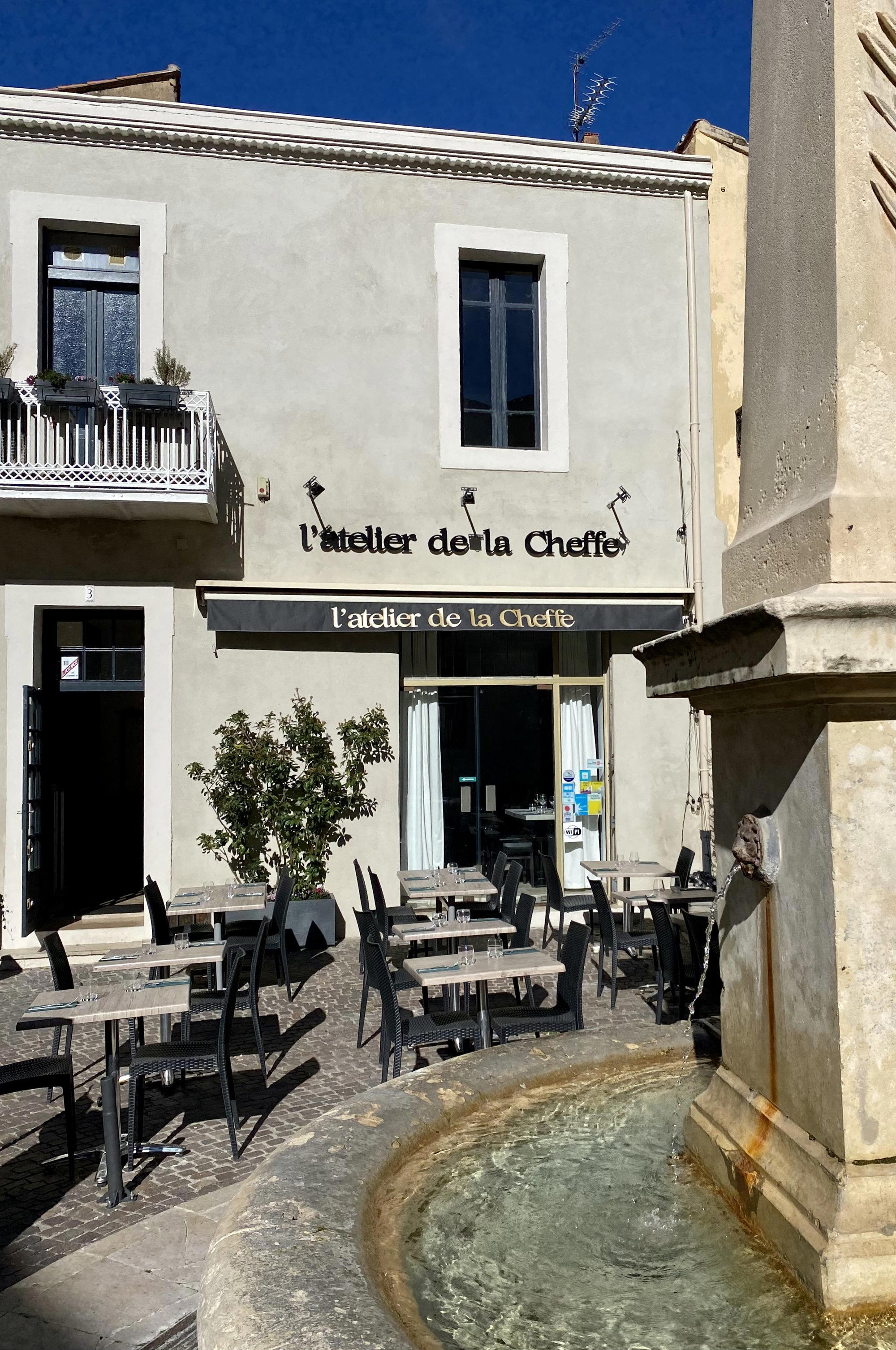
Provençal Cooking at Place de la Révolution
L'Atelier de la Cheffe is a restaurant in Salon-de-Provence, France, serving Modern French Fusion Bistronomique at a price of about $45 per person. The square at the heart of Salon-de-Provence carries the kind of accumulated quiet that comes from centuries of market days, heated conversations, and slow lunches. Place de la Révolution is not a tourist node so much as a neighbourhood anchor, and the restaurants that open onto it tend to reflect that character: direct, grounded, oriented toward the table rather than the spectacle. L'Atelier de la Cheffe sits at number 3, drawing from a culinary tradition that runs deep through this part of the Bouches-du-Rhône, one built on olive oil rather than butter, on herbs cut fresh rather than dried, and on a kitchen discipline shaped by the seasons of the Alpilles and the Crau plain nearby.
Salon-de-Provence occupies an interesting position in the French dining conversation. It is close enough to Marseille, Arles, and the Luberon to benefit from serious food culture on all sides, but remains a working Provençal town rather than a gastronomy destination. That means the restaurants here largely cook for regulars and for travellers who have looked beyond the circuit, which creates a different kind of pressure on quality than a venue in Aix-en-Aix or along the coast. For a fuller picture of where L'Atelier de la Cheffe sits in the local scene, our full Salon-de-Provence restaurants guide maps the town's dining by neighbourhood and format.
The Cultural Weight Behind "L'Atelier"
The word atelier carries specific implications in a French culinary context. It is a workshop, not a stage, a place where things are made carefully and iteratively, where the craft is ongoing rather than finished. That framing matters in the South of France, where the cooking tradition is less codified than in Paris or Lyon but no less serious. Provençal cuisine does not rely on complex sauce architecture or multi-step reduction. Its discipline is different: selecting ingredients at the right moment, understanding that a daube or a tian or a ratatouille made in September bears almost no resemblance to one made from February produce. The title cheffe, rather than chef, signals a female-led kitchen, still less common in France's dining rooms than the slow progress of recent years might suggest.
That regional context becomes useful when comparing Salon-de-Provence to the high-end Provençal and southern French venues that draw international attention. Mirazur in Menton operates at a level of international recognition that places it in a different competitive set entirely, garden-to-plate philosophy, the full ceremony of a destination restaurant. Closer in geography and character is L'Oustau de Baumanière in Les Baux, which anchors its identity in the range of the Alpilles, not far from Salon-de-Provence itself. And in Marseille, AM par Alexandre Mazzia represents what happens when a southern chef takes the regional product vocabulary and pushes it into genuinely experimental territory. The restaurant occupies a different register from all three, more intimate in scale, more embedded in daily town life, and less oriented toward the destination-dining ritual.
The French Atelier Format Across Regions
The atelier-style restaurant, small, practitioner-led, often without the full brigade structure of a classic French kitchen, has become a coherent format across provincial France. It tends to produce shorter menus with less redundancy, more dependence on what the market offered that morning, and a directness in service that reflects the absence of multiple floor layers. Auberge du Vieux Puits in Fontjoncouse in the Aude operates at a higher formal register but shares that sense of deep local rootedness, a kitchen shaped by its immediate geography. Bras in Laguiole built its reputation over decades on the herbs and grasses of the Aubrac plateau, demonstrating what sustained attention to a single terroir can produce. These are different scales and price brackets, but the same underlying logic: that a kitchen which knows its local landscape well enough can cook with less intervention, not more.
The broader French fine dining scene, represented on the international stage by places like Alléno Paris au Pavillon Ledoyen, Flocons de Sel in Megève, Troisgros in Ouches, and Paul Bocuse in Collonges-au-Mont-d'Or, operates at a different altitude. So does the French tradition as it has travelled: Le Bernardin in New York City carries the rigour of classical French technique into a different urban context. Auberge de l'Ill in Illhaeusern and Au Crocodile in Strasbourg anchor Alsatian cooking in its own regional identity. Even Atomix in New York City, with its tasting-menu precision, reflects how the atelier mindset has crossed culinary traditions. None of these are direct comparators to Salon-de-Provence, but they frame the range within which French culinary culture operates, from the institutionalised to the deeply local.
Within Salon-de-Provence's Dining Scene
Town has a second table worth knowing: Le Moulin d'Isnard provides a different point of comparison within the same city, useful for understanding how Salon-de-Provence's dining splits in terms of format and register. The two venues represent different ways of approaching Provençal cooking in a mid-sized town with a serious food-buying culture but limited tourist infrastructure. Other regional benchmarks, such as Christopher Coutanceau in La Rochelle, Assiette Champenoise in Reims, and Georges Blanc in Vonnas, show how strong regional cooking traditions develop independently across France, each shaped by different product sets and histories.
Planning Your Visit
The restaurant is located at 3 Place de la Révolution in Salon-de-Provence, a central square that is walkable from the old town and the Château de l'Empéri. Salon-de-Provence is accessible by train from Marseille Saint-Charles in under an hour, and by road from Aix-en-Provence in roughly 30 minutes. For tables that fill around lunch service or on market days, planning at least several days ahead is sensible.
Booking and Cost Snapshot
Comparable venues nearby, for context on price, style, and recognition.
| Venue | Cuisine | Price | Awards | Notes |
|---|---|---|---|---|
| L'Atelier de la CheffeThis venue — the venue you are viewing | Not listed | $$$ | Not listed | Not listed |
| Le moulin d'Isnard | centre historique, French Bistronomique | $$$ | Not listed | Not listed |
| Atelier Salone | centre ville, Modern French Bistronomy | $$ | Bib Gourmand | Not listed |
| Villa Salone | Not listed | $$$ | Michelin 1 Star | centre of town, Modern French Provençal Fine Dining |
| La récréation | Lourmarin, Provençal French Bistro | $$$ | Not listed | Not listed |
| MITCH | Centre Ville, Contemporary French | $$$ | Not listed | Not listed |
Continue exploring
More in Salon-de-Provence
Restaurants in Salon-de-Provence
Browse all →
Bars in Salon-de-Provence
Browse all →
Hotels in Salon-de-Provence
Browse all →
At a Glance
- Elegant
- Cozy
- Modern
- Intimate
- Date Night
- Special Occasion
- Brunch
- Open Kitchen
- Local Sourcing
- Street Scene
Current opening hours
- Monday
- Closed
- Tuesday
- 7–9:30 PM
- Wednesday
- 7–9:30 PM
- Thursday
- 12–1:30 PM, 7–9:30 PM
- Friday
- 12–1:30 PM, 7–9:30 PM
- Saturday
- 12–2 PM, 7–9:30 PM
- Sunday
- Closed
Hours can change for holidays and private events. Last verified .
Chic and warm interior blending modern and traditional elements with an open kitchen fostering convivial contact.