Krameramtsstuben occupies one of Hamburg's most historically layered addresses, Krayenkamp 10 in the Altstadt, where the physical fabric of the building does as much editorial work as anything on the plate. The address places it inside a tradition of Hamburg dining rooms that predate the city's postwar reinvention, making it a reference point for understanding how the city's older dining culture has persisted alongside its newer fine-dining generation.
Pearl is the En Primeur Club membership app — saves, bookings, and concierge access live there. Same editors, same standards.
- Address
- Krayenkamp 10, 20459 Hamburg, Germany
- Phone
- +494940365800
- Website
- krameramtsstuben.de
- Directions
- Get directions
 Saves & bookings on Pearl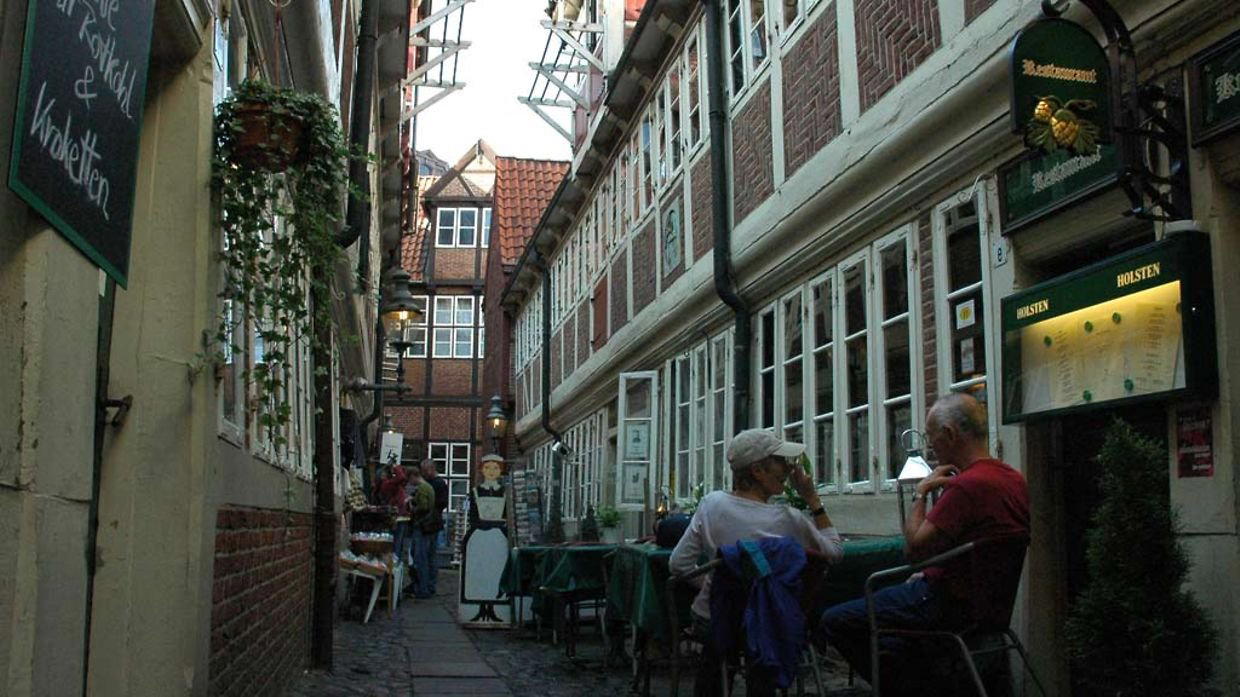
A Room That Does the Talking
Hamburg's dining scene divides clearly along architectural lines. On one side sit the purpose-built contemporary spaces: the open kitchens, the poured concrete, the Nordic minimalism that now characterises the upper tier from venues like The Table Kevin Fehling and bianc. On the other side sit rooms that predate all of that, rooms where the architecture carries memory the renovation crews never quite reached. Krameramtsstuben belongs firmly to the second category. Its address at Krayenkamp 10, in the Altstadt district near the Michaeliskirche, places it within a cluster of seventeenth-century almshouse buildings that the city of Hamburg has preserved as a protected ensemble. The dining room does not exist in spite of that history; it exists because of it.
The Krameramtshöfe — the complex of which Krayenkamp 10 is part — was originally built between 1676 and 1757 to house the widows of members of the Krämeramt, Hamburg's guild of small traders. The half-timbered structures, arranged around a narrow courtyard, represent one of the few surviving examples of that guild-era urban form in northern Germany. Approaching from the street, the transition from Hamburg's contemporary city fabric to this compressed, low-ceilinged world of dark timber and small-paned windows is abrupt enough to function as its own kind of threshold. The physical container announces, before any food arrives, that this is not a room designed to showcase a chef's contemporary vision. It is a room that shapes the experience on its own terms.
Interior Architecture as Editorial Frame
In cities with a long civic history, the most interesting dining rooms are often not the ones that deploy the most architectural language but the ones that have the least need to. Krameramtsstuben operates in that mode. The interior retains the structural logic of its seventeenth-century origins: low beamed ceilings, panelled walls, proportions dictated by the original residential function of these narrow guild houses. For anyone tracking the current wave of design-led hospitality, the kind of deliberate material curation seen at 100/200 Kitchen or, further afield, at ES:SENZ in Grassau, Krameramtsstuben offers a useful counterpoint. Here the design brief was not written by a studio. It was written by four centuries of use.
That physical specificity has consequences for how the room seats and contains its guests. The spatial logic is intimate rather than expansive, with the low ceiling compressing sound in ways that push conversation inward, toward the table rather than across the room. It is the architectural opposite of the high-ceilinged brasserie format that Hamburg also does well, and it creates a dining tempo to match. Rooms like this tend to attract guests who are not in a hurry, and the rhythm of service in older Hamburg establishments generally reflects that expectation. Visitors arriving from the city's newer fine-dining tier, where tasting-menu pacing is tightly choreographed, may find the experience calibrated differently.
Hamburg's Older Dining Tradition
Germany's fine-dining conversation is dominated by its Michelin-starred tier, with reference points ranging from Aqua in Wolfsburg and Vendôme in Bergisch Gladbach to Schwarzwaldstube in Baiersbronn and Victor's Fine Dining by Christian Bau in Perl. Hamburg participates in that conversation through venues like Restaurant Haerlin, which holds its position at the upper end of the city's formal dining hierarchy. But Hamburg also maintains a parallel tradition of civic dining rooms that are not primarily about the chef or the tasting menu, rooms where the address, the building, and the cultural associations of the space carry the primary weight.
Krameramtsstuben operates in that parallel tradition. It is not a venue positioning itself against the Michelin tier; it is operating in a different register entirely, one that Germany's older free cities, Hamburg, Bremen, Lübeck, have historically supported. The Hanseatic merchant class built civic institutions, guild houses, and public buildings that required associated dining, and some of that institutional dining culture has persisted in adapted form. Understanding Krameramtsstuben means understanding that context, rather than benchmarking it against the contemporary fine-dining generation at Lakeside or the dessert-forward innovation at CODA Dessert Dining in Berlin.
For a broader orientation to Hamburg's current dining map, the EP Club Hamburg restaurants guide places venues across price tiers and neighbourhood contexts, including how the Altstadt's older establishments relate to the Hafencity and Eppendorf dining corridors that have attracted more of the city's newer openings. Internationally, the civic-dining-room format that Krameramtsstuben represents has analogues at places like Le Bernardin in New York City, not in cuisine style, but in the idea that a room's institutional weight contributes to the experience independently of what is served. The comparison also holds in the other direction: venues like Atomix in New York City represent the opposite pole, where the entire physical and conceptual framework is designed from scratch around a specific culinary programme.
Planning a Visit
Krayenkamp 10 is a short walk from the U3 station at Rödingsmarkt, and the surrounding Altstadt streets are walkable from the central Rathaus area in under ten minutes. The Krameramtshöfe courtyard itself is a publicly accessible heritage site, which means the approach to the restaurant passes through a space that rewards unhurried arrival rather than a quick transit from the nearest transport connection. Visitors coming directly from Hamburg's contemporary dining corridor around the Hafencity or from venues in the west of the city near Schanz-level ambition will be moving into a markedly different architectural and social register. For booking, dietary enquiries, and current hours, contacting the venue directly via its official channels is the appropriate route; the specific operational details are subject to change and are best confirmed before arrival. Those planning a wider German itinerary might also consider JAN in Munich, Waldhotel Sonnora in Dreis, or Bagatelle in Trier as part of a broader circuit of Germany's dining rooms with distinct spatial identities.
Continue exploring
More in Hamburg
Restaurants in Hamburg
Browse all →
Bars in Hamburg
Browse all →
Hotels in Hamburg
Browse all →
Wineries in Hamburg
Browse all →
At a Glance
- Rustic
- Cozy
- Classic
- Historic
- Intimate
- Date Night
- Special Occasion
- Historic Building
- Extensive Wine List
Current opening hours
- Monday
- Closed
- Tuesday
- 12–10 PM
- Wednesday
- 12–10 PM
- Thursday
- 12–10 PM
- Friday
- 12–10 PM
- Saturday
- 12–10 PM
- Sunday
- 12–10 PM
Hours can change for holidays and private events. Last verified .
Cozy, rustic atmosphere with antique charm, creaking floors, low ceilings, and candlelit tables in a historic Hamburg alley.
Know Before You Go
- Getting there
- Krayenkamp 10, 20459 Hamburg, Germany