
A 12-seat counter near Aratama Bashi, Komugi to Yakiago Sugure sits in Nagoya’s serious everyday ramen tier rather than its splurge-dining circuit. Recognition in Tabelog 100 - Ramen - AICHI - 2025 and a compact ramen-tsukemen format explain the loyal repeat trade: this is a shop built around regulars, counter rhythm, and low-friction solo dining.
Pearl is the En Primeur Club membership app — saves, bookings, and concierge access live there. Same editors, same standards.
- Address
- 2 Chome-30-2 Suyamacho, Mizuho Ward, Nagoya, Aichi 467-0066, Japan
- Phone
- +81 52-852-0152
- Website
- menjasugure.com
 Saves & bookings on Pearl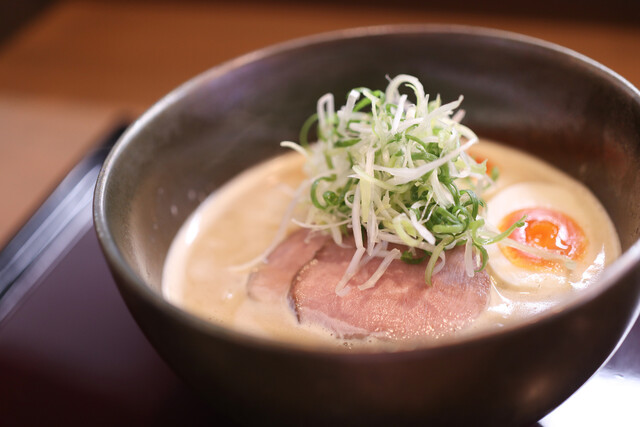
The room is counter-first: close seating, quick turnover, and the kind of quiet concentration that defines Japan’s stronger ramen shops outside the tourist corridors. In Nagoya, ramen often competes with the city’s heavier local food signatures, from miso-katsu to hitsumabushi, so a serious noodle counter has to win loyalty on repeatability rather than spectacle. Komugi to Yakiago Sugure belongs to that local equation: small format, focused categories, and a regulars’ cadence that rewards people who know how to read a ramen shop without needing ceremony.
Its recognition in Tabelog 100 - Ramen - AICHI - 2025 places it within Aichi’s competitive ramen bracket, not merely as a convenient neighbourhood stop. That matters because ramen in Japan is judged with unusual precision by returning diners: broth direction, noodle texture, ticket-flow discipline, counter speed, and whether the bowl holds attention after multiple visits. The shop’s Tabelog score of 3.63 is another useful signal in a category where local reviewers tend to be granular and unforgiving.
Aichi ramen culture rewards focus over performance
Nagoya’s dining identity is often discussed through regional set pieces, but its ramen scene is more about micro-specialisation. The stronger shops rarely try to cover every style. They narrow the field, sharpen a broth or dipping-noodle grammar, and let the counter do the rest. Here the categories are ramen and tsukemen, a pairing that speaks to two kinds of regular: the diner who wants a complete bowl in one tempo, and the diner who prefers the denser, separated rhythm of dipping noodles.
The name signals wheat and grilled flying fish, but the more useful editorial point is format. This is not the luxury ramen-as-theatre model seen in some major-city counters. It sits closer to the everyday specialist tier, where price discipline and repetition carry weight. Compared with Nagoya peers in the supplied set, Una Toyo occupies a higher everyday spend band, while peu frequente sits in the same sub-JPY 999 bracket. Ebi Soba Hiiro and out-of-metro references such as Raa Menya Shio Soba Shizuku move into the JPY 1,000 to JPY 1,999 range. Komugi to Yakiago Sugure’s listed budget keeps it in the leaner, more habitual category.
That price tier changes the reader’s expectations. The appeal is not a long tasting sequence or a chef-led narrative. It is the promise of a tightly run bowl-and-counter experience that can become part of a local routine. Regulars return to places like this because the variables are controlled: seating is limited, the menu lane is clear, and the meal fits into the daily city rather than demanding a special occasion.
The regulars' code: counter seats, solo dining, no wasted motion
The 12 counter seats are more than a capacity note; they define the social contract. A small ramen counter in Japan asks diners to order decisively, eat at the pace of the room, and leave the seat cleanly for the next person. That unwritten choreography is why solo dining works so well here. Family-friendly information and children welcome status widen the audience, but the core experience remains counter dining, not lingering table service.
Reservations are unavailable, which puts the shop in the classic ramen queue economy. That is not a flaw in this category; it is how demand is rationed. The split service pattern across lunch and dinner also suits regulars who treat ramen as a timed meal rather than an evening plan. For travellers, the more intelligent move is to think like a local: avoid building a whole day around a single bowl, but place it near transit and let the counter format do what it is designed to do.
Take-out is listed, though the room’s logic still points toward eating at the counter when possible. Ramen and tsukemen are temperature- and texture-sensitive forms, and the Japanese counter tradition exists because the bowl is meant to move from kitchen to diner with minimal delay. No smoking, no private rooms, and no private use keep the identity narrow. This is a specialist shop, not a multi-purpose restaurant.
Where it fits in a Nagoya dining itinerary
Komugi to Yakiago Sugure is a useful corrective to the way visitors often over-plan Nagoya meals around headline regional dishes. The city’s better eating is more varied than that, and a ramen counter in Mizuho Ward adds a different register: low-cost, high-specificity, and more connected to routine than occasion. It pairs naturally with a day that moves by subway rather than taxi, especially for travellers who want one meal outside the central hotel-and-station orbit.
For broader planning, Our full Nagoya restaurants guide maps the city’s dining range beyond ramen, while Our full Nagoya hotels guide, Our full Nagoya bars guide, Our full Nagoya wineries guide, and Our full Nagoya experiences guide help place a noodle stop inside a fuller itinerary. Nearby city listings such as 1022, 451, Aaron, Alan., and All Day Dining Montmartre show how varied the local field becomes once the search moves beyond a single cuisine label.
It also helps to read Japanese casual dining comparatively. -Grilled beef Sukiyaki- KAMAKURA TANUKIAN 鎌倉 たぬき庵 in Kamakura represents a different comfort-food tradition. 鮪と炭火焼き うお炭 秋葉原店 in Tokyo sits closer to seafood-and-grill urban dining, and.cafe in Osaka.know in Kumamoto, (Shoku) Vietnam in Kawasaki, [Curry Senmon Ten] Maruyama Kyoju. in Sapporo, Jōdo Saké Bar in Los Angeles, and Onigiri Time in Pasadena underline the same point from different angles: casual Japanese eating is strongest when format and expectation are aligned.
The editorial verdict is clear without needing inflated language. This is a Nagoya ramen counter for diners who value structure: limited seats, specialist categories, award-list recognition, and a price point that makes return visits plausible. Travellers chasing grand theatre may miss the point. Regulars rarely do.
Credentials Lens
Comparable venues by price and recognition.
| Venue | Cuisine | Price | Notes |
|---|---|---|---|
| Komugi to Yakiago SugureThis venue — the venue you are viewing | Ramen and Tsukemen | $ | Not listed |
| Menya Ierou | Japanese Ramen | $ | Nakagawa |
| Niboshi Ramen 88 Honten | Niboshi (dried sardine) ramen shop | $ | Nakamura |
| Ramen Burai | Nagoya neighborhood ramen shop | $ | Midori |
| Takumi Mitsukoshi ten | Japanese Curry Counter by Nagoya Takumi | $ | Naka |
| Ramen mellow | Ramen shop | $ | Midori |
Recognition history
Dated appearances from independent guides and award organizations, with the underlying list record or original source where available.
Tabelog 100 #40 · No. 40
Tabelog · Tabelog 100 - Ramen - AICHI - 2025
Continue exploring
More in Nagoya
Restaurants in Nagoya
Browse all →
At a Glance
- Cozy
- Casual
- Solo
- Casual Hangout
- Standalone
- Beer Program
- Local Sourcing
Current opening hours
- Monday
- 11 AM–2 PM, 6–9:30 PM
- Tuesday
- 11 AM–2 PM, 6–9:30 PM
- Wednesday
- 11 AM–2 PM, 6–9:30 PM
- Thursday
- 11 AM–2 PM, 6–9:30 PM
- Friday
- 11 AM–2 PM, 6–9:30 PM
- Saturday
- 11 AM–2:30 PM, 6–9:30 PM
- Sunday
- 11 AM–2:30 PM, 6–9:30 PM
Hours can change for holidays and private events. Last verified .
Compact, counter-seat ramen shop atmosphere focused on quick, casual dining rather than a long stay.